Pack · 11 talks · 5h 26m to watch, 67 min to read

Post-training and RL

In one financial tool-use task, a trained 4 billion parameter model outperforms a 235 billion parameter baseline, but only because the team knows which behavior to reward. Human preference, imitation and verifiable correctness produce different systems, and the base model must already contain skills that reinforcement learning can combine. Product work makes those distinctions concrete. An inbox or coding task needs a realistic environment, and engineers still have to read the rollouts because reward hacks can look like progress. When a task has no exact answer, judges, grounding and known end states have to provide a usable signal. Asynchronous rollouts keep GPUs busy but introduce stale-policy variance, so environments, inference and training must run separately without losing the tests that defined success.

3
Lakshya Agrawal, GEPA · 21:28
Beating RL With Reflection: GEPA and Optimize Anything

Why here: Bigio chooses among ways to change the weights. Agrawal argues that RL methods such as GRPO reduce a rollout full of reasoning, tool calls and error messages to one score. GEPA reads the whole trace and rewrites the prompt instead, and in his comparison one reflection round on three examples reached twice the gains of 25,000 GRPO rollouts. Singh then turns to the case where the weights must change.

4
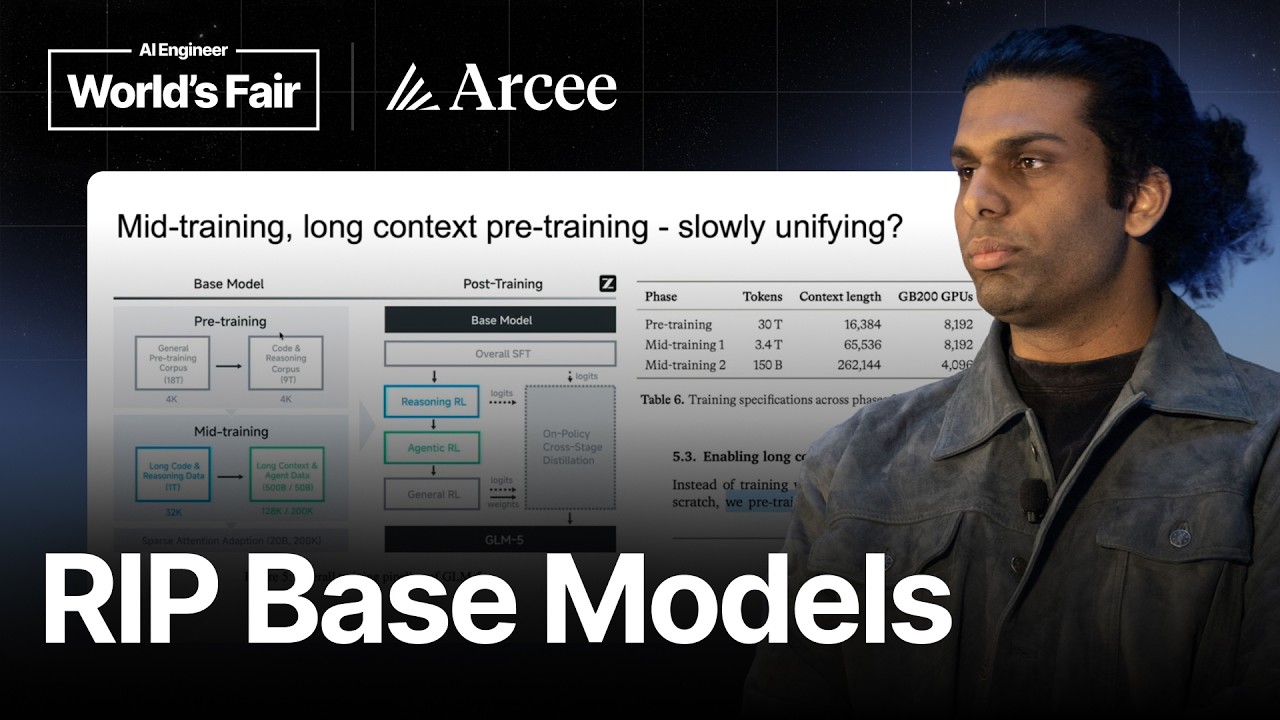
Varun Singh, Arcee AI · 17:45 · AI Engineer World's Fair 2026
The Base Model Is Dead

Why here: Agrawal improves a system without touching its weights. Singh asks what the weights must already contain when RL does run: mid-training supplies agentic data, and supervised learning supplies skills for RL to compose. Crawford then shows one of those compositions in action through disciplined tool use.

9
Will Brown, Prime Intellect · 19:27 · AI Engineer World's Fair 2026
Reinforcement Learning without Verifiable Rewards

Why here: Hang and Zhou assume success can be graded cleanly. Brown deals with reports, browsing and other work where it cannot. Grounding, judges and known end states manufacture a usable signal. Garg and Li come next because generating enough exploratory rollouts turns reward design into a systems problem.

11
Will Brown, Prime Intellect · 46:52 · AI Engineer World's Fair 2026
Modern Post-Training: A Deep Dive

Why last: Garg and Li isolate the throughput problem. Brown reconnects it to everything before it: one environment can produce evals, SFT data, distillation data or RL rollouts, while separate inference and training services stop long agent runs from blocking the batch. This is the assembled system the first nine talks prepare.