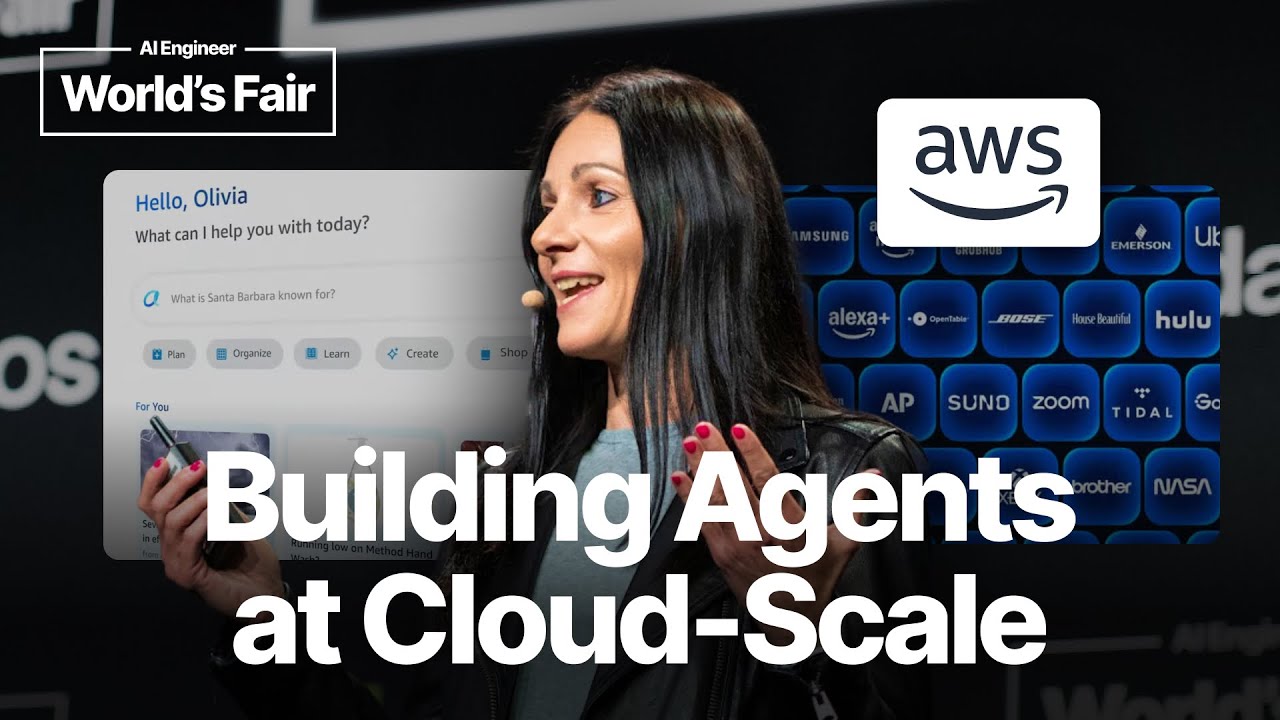
Amazon uses hundreds of specialized expert systems to coordinate Alexa capabilities with partner services and devices.
2
Strands Agents lets developers define an agent with a model, a prompt, and tools, then move from local tests to cloud deployment.
3
MCP servers can be moved from local standard I/O implementations to remotely hosted Lambda services with API Gateway, authorization, and session storage.
Summary
Antje Barth explains how AWS teams build agents that can operate across large numbers of services, devices, and users. She uses the reworked Alexa as an example: it coordinates hundreds of specialized expert systems with tens of thousands of partner services and devices. Amazon Q Developer in the CLI shows a smaller production service that AWS built and shipped in three weeks. Barth then introduces Strands Agents, an open-source Python SDK that lets developers define an agent through a model, prompt, and tools, with support for multiple model providers, retrieval, multimodal inputs, MCP, and multi-agent workflows. The practical deployment example moves an MCP server from local standard I/O to Lambda behind an MCP gateway, with API Gateway, an authorizer, and DynamoDB session storage. The talk also points toward agents calling other agents through emerging protocols such as MCP and A2A.
Alexa uses specialized experts to coordinate a large service network
Barth presents the reworked Alexa as an example of agents operating at cloud scale. Alexa Plus works through hundreds of specialized expert systems, which the Alexa team defines as groups of capabilities, APIs, and instructions for a specific task. These experts coordinate with tens of thousands of partner services and devices. The demo shows Alexa handling schedules, travel, shopping, home cameras, and conversations in one interaction. Barth says Amazon has more than 600 million Alexa devices in the world, making this a large deployment rather than a small prototype.
Production agent services can be shipped quickly when models handle planning
Barth uses Amazon Q Developer in the CLI to show an agentic service that can answer natural-language questions, debug issues, read and write files, and connect to an MCP server for AWS documentation. The CLI asks for permission before using the documentation tool, then returns an answer grounded in official AWS material. AWS built and shipped this service within three weeks. Barth attributes that speed to rethinking how agents are built and letting capable models decide, plan, reason, and take actions while developers focus on what the agent should do.
Strands Agents connects a model and tools through a small amount of Python
Strands Agents is an open-source Python SDK that Barth says can be used to build and run agents in a few lines of code. Developers define a prompt and tools, test the agent locally, and deploy it to the cloud when ready. The SDK uses Amazon Bedrock by default, with Claude 3.7 Sonnet shown in the example, but it also supports Llama, Anthropic, Meta, OpenAI, providers available through LiteLLM, and custom model providers. Barth explains the name as a reference to the two strands of DNA, with the SDK connecting the model and the tools.
Tool retrieval keeps large tool collections out of the model context
Strands Agents includes more than 20 pre-built tools for tasks such as file manipulation, API calls, AWS services, memory, and retrieval. Its retrieve tool performs semantic search over a knowledge base. Barth describes an internal AWS agent with more than 6,000 tools. Instead of placing all 6,000 descriptions in one context window, the team stores the descriptions in a knowledge base. The agent retrieves only the tools relevant to the current task and gives those tools to the model to choose from. Strands also supports images, video, audio, deeper reasoning, graph workflows, and swarms of sub-agents.
MCP starts locally and needs a remote deployment pattern for scale
Barth describes the original MCP standard I/O pattern as a way for local clients to connect to tools. Her example uses the Python SDK and FastMCP to define a dice-rolling tool with a number-of-sides input. To run this remotely, the server can be deployed as a Lambda function using streamable HTTP and placed behind an MCP gateway. The example adds an authorizer, with Cognito available as another option, and stores session data in DynamoDB. AWS provides an MCP Lambda handler to connect the Lambda function to the MCP server.
A remote MCP tool can be consumed by a Strands agent
In the deployment demo, AWS SAM deploys the MCP Lambda function and produces an API Gateway URL. The client uses Strands Agents' MCP integration to connect to that URL, pass an authorization token, list the available tools, and provide them to the agent. The agent is then asked to roll a D20. The remote tool runs and returns seven. Barth's point is that once the MCP server is running in Lambda, it can use the other capabilities and applications already available in AWS. The example is deliberately small, but the same deployment pattern can support larger integrations.
Barth describes agent-to-agent communication as the next step after connecting agents to tools. AWS has joined the MCP steering committee and contributes to the community around the protocol. She also says support for A2A is coming to Strands Agents. Quoting her colleague Danielle, Barth says, "The atomic unit of all digital interactions will be an agent call." She imagines personal agents connecting to an agent store and combining with other agents to complete tasks.
"You can simply start with defining a prompt and your tools in code and then test it out locally and then once you're ready, deploy it for example in the cloud."09:00
Who should watch
You are building an agent locally with MCP and need a path to a remotely hosted service.
Your team wants an SDK that supports tools, retrieval, multiple model providers, and multi-agent workflows without writing every planning step by hand.
You run AWS services already and want to understand how Lambda, API Gateway, authorization, and DynamoDB fit into an agent deployment.