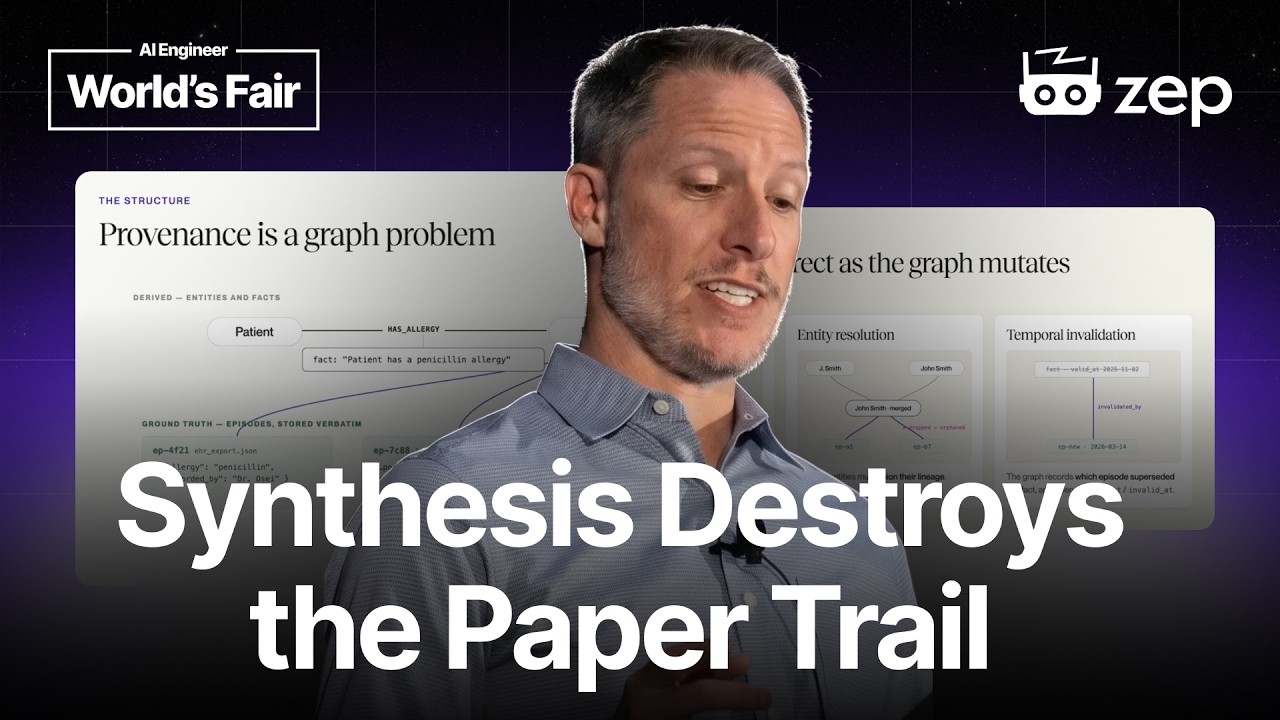
LLM synthesis can produce facts that do not appear verbatim in any source, so a source ID attached afterward cannot preserve their full lineage.
2
Graph-based provenance links source episodes to entities and facts, allowing engineers to trace, filter, mutate, and delete derived data through those relationships.
3
A fact should survive source deletion only when at least one remaining source still supports it, while business rules decide how mixed-trust sources affect retrieval.
Summary
Daniel Chalef argues that provenance must be part of the data model for knowledge graphs built by LLM pipelines. An LLM may merge identities, combine several sources into one fact, or invalidate an earlier fact when new data arrives. A source ID on the final value cannot reliably preserve that history. In Graphiti, source data becomes episode nodes, and entities, relationships, and derived facts link back to the episodes. Provenance is then a graph walk. When entities merge, their source links are retained. When a fact changes, the sources behind the mutation are recorded. Metadata can flow from an episode to everything derived from it, allowing agents to filter facts from verified clinical sources. The same links support deletion: a fact remains if another episode still supports it. Chalef is also direct about the cost. Graph construction is expensive, so Graphiti uses traditional retrieval and NLP methods where possible to reduce LLM use.
LLMs combine information from many sources and produce summaries, extracted facts, or structured records that may not appear verbatim in any input. Chalef says this synthesis is non-deterministic and often destroys the trail showing how an output was built. Provenance means tracing an artifact to its origin and understanding why it exists. He connects that work to legal compliance, debugging, source trust, and decisions about which artifacts to delete. The difficulty grows when these operations happen at scale across chat, voice transcripts, email, and business data.
Chalef describes an agent retrieving context about a patient and returning the confident statement, "Patient has a penicillin allergy." That statement was synthesized from an electronic health record, a PDF lab report, and text entered by the patient into an AI intake chat. If the agent presents the fact to a doctor without showing that one source was the patient, the doctor may misunderstand its reliability. For complex agent applications, Chalef says it is often impossible to point to the exact source of a retrieved fact or assess its veracity.
A source ID breaks when facts are merged and changed
A source ID works in a structured warehouse when a pipeline copies or deterministically mutates one value and the sources remain easy to mark. LLM context pipelines behave differently. A fact may come from several sources, and entities such as J. Smith and John Smith may be merged into one identity. New data can invalidate older facts, so the store changes beneath a pointer. Chalef says an append-only log becomes difficult to manage as these changes accumulate. Lineage therefore needs to remain an evolving set of links through mutation.
Provenance becomes a graph walk when sources are graph nodes
In Graphiti, source data becomes episodes. In Chalef's example, three source episodes produce two entities, a patient and penicillin, plus the relationship between them. Those nodes and the edge can be hydrated into the fact that the patient has a penicillin allergy. Tracing that fact back to its origins is a graph walk. The model keeps the relationship between source data and derived artifacts inside the knowledge graph, rather than trying to reconstruct it from a separate log after synthesis has happened.
Merges and contradictions require lineage to change with the graph
When two entities merge, the combined entity must retain the source links from both original entities. Otherwise, a source is silently dropped. When new data contradicts an existing fact, Graphiti records the invalid date on the mutated edge and notes the source episodes that caused the mutation. This lets the graph retain both the history of the earlier fact and the information that changed its status. Provenance is therefore maintained as the graph evolves, rather than treated as a fixed property of the first extracted value.
Metadata can flow from one source tag to every derived fact
Chalef describes metadata projection as a way to classify facts across many episodes. If an episode comes from an electronic health record, it can receive an EHR tag during ingestion. Entities and facts derived from that episode inherit the tag. An agent that needs facts from verified clinical sources can filter for that tag while walking the graph. One tagging action at ingestion then supports later evaluation of a fact's source quality. The graph exposes which episodes carry the tag, while the agent applies the business policy.
Mixed-trust facts need policies that depend on the fact
A fact with several parent episodes can have a mixture of verified and unverified sources. Chalef gives two contrasting healthcare cases. For an allergy flag, failing to retrieve the fact because one parent is unverified could lead to a dangerous prescription, so any source of the three should block the prescription. For consent on file, every parent episode needs to be verified, because acting on unverified consent is also unsafe. The graph exposes the metadata on each parent, but the agent must apply the appropriate rule for the situation.
Lineage also supports retention policies and right-to-be-forgotten requests. In Chalef's example, the patient's intake chat data must be deleted while the EHR and lab report remain. The allergy fact survives because two parent episodes still support it. A contact preference fact is deleted because it came only from the removed intake data. The rule is that a fact is deleted only when no remaining episodes support it. The same links used to trace provenance make this decision possible.
Graph provenance improves auditing while adding cost
Chalef summarizes the approach as engineering lineage into the graph and keeping sources verbatim. This gives users a way to check a fact against its sources, understand why it exists, debug how it was generated, and determine what to delete. He also says lineage and graph construction are expensive. In the question period, he explains that Graphiti uses LLMs for extraction but relies on traditional information retrieval, NLP, entropy-based methods, simhash, deduplication, and conflict resolution where possible. Those methods are cheaper, faster, and more deterministic.
"Lineage needs to be built in to the data structure, engineered into the data structure, which is a graph, not logged afterwards."10:26
Who should watch
You are building agent memory or a knowledge graph from multiple user, clinical, business, or conversational sources and need to explain where retrieved facts came from.
Your system must handle source deletion, retention rules, or right-to-be-forgotten requests without deleting facts that other sources still support.
You are weighing graph-based memory against markdown or file-based memory and want to understand the provenance and cost tradeoffs.