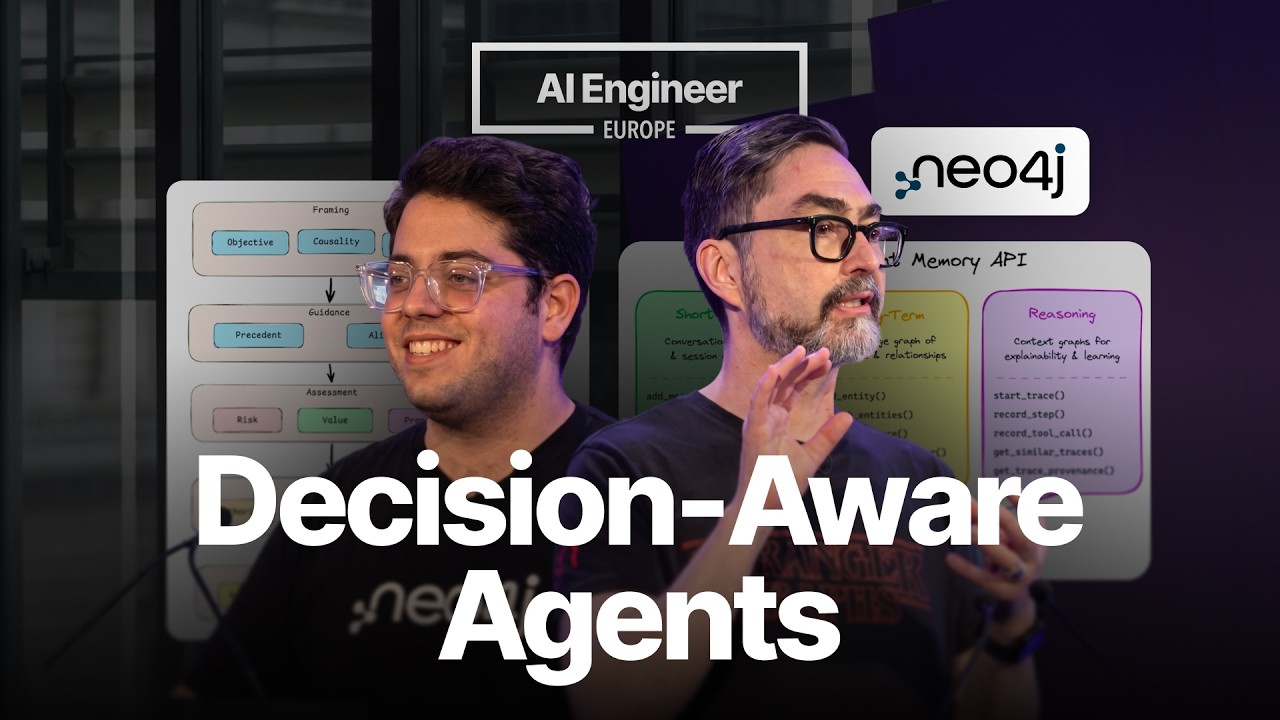
Context graphs add policies, rules, and prior decisions to an agent's knowledge and tools, so it can explain why an action fits the situation.
2
A decision workflow should frame the local context, check global rules and precedent, assess risk and value, then act only when the agent has enough authority and certainty.
3
Recording the reasoning behind each decision gives future agents precedent, while domain-specific details still have to be designed for each use case.
Summary
The talk presents context graphs as a way to give AI agents the reasons behind actions. A normal knowledge graph can supply facts, content, and tools. A context graph also stores policies, rules, organizational guidance, prior decisions, and reasoning. The proposed decision workflow starts by framing the problem, including its objective, causal history, and environment. The agent then checks global rules and precedent before assessing risk, reversibility, the cost of being wrong, and the value it is trying to maximize. One agent can propose alternatives while another checks authority and decides whether to act or escalate to a human or a higher-privilege agent. The full reasoning chain, decision, and resulting actions are written back to the graph. This creates precedent for later agents. Andreas is clear that the framework is general, while the details of every stage depend on the domain.
Context graphs give agents the reasons behind actions
The talk places context graphs within context engineering. Agents already have strong language, reasoning, and creative abilities, and graphs can provide missing knowledge, tools, content, and memory. Context graphs add policies and rules so agents can make decisions with more than factual information. The important addition is the "why": the data should explain why an agent needs to do something in a particular situation. This moves the design question from what an agent can do to why a given action is appropriate.
Agent memory combines conversation state, general context, and reasoning
The memory graph described in the talk has short-term memory for conversations and state history, plus long-term memory for generalized information about organizations, people, and other entities. Reasoning is also stored. This lets an agent connect a task to the policies and rules that support a particular action. In the wider agentic graph application, an agent first looks for knowledge in its sources, then queries the graph when needed. A text-to-Cypher tool can translate natural language into a graph query and retrieve the relevant content.
Decision-making starts by framing the local situation
The proposed workflow begins when an agent reaches a point of uncertainty and enters a decision-making subprocess. It records the objective, the causal chain that led to the current state, and the environment in which the decision operates. Ordering a product, handling a financial request, and giving medical guidance have different consequences, so the environment changes how the agent should reason. The talk argues that agents need these details stated explicitly because people usually carry them as implicit knowledge.
Global rules and prior decisions must be checked together
After framing the local situation, the agent gathers wider context. It checks what happened before and looks for global business rules. Those rules may be hard rules described in a formal process or softer guidance found in Slack channels and Google Docs. Prior decisions can support consistency, but current rules may have changed or may justify overriding precedent. The workflow therefore keeps precedent and applicable rules in the same decision process instead of treating past action as an automatic answer.
Reference class validation determines whether statistics apply
Risk analysis begins by asking which group or reference class the situation belongs to. The medical example is prescribing drug X for symptom Y: the treatment may be right for 99% of people, while it could be fatal for the remaining 1%. An agent must establish whether the person is in the larger or smaller group before acting. The talk also asks whether the decision is reversible and what the cost of being wrong would be. A missed purchase and a decision where a life is at stake require different levels of care.
A risk and value analysis has to state what matters
The agent must make its value target explicit. It may be trying to maximize savings or minimize a cost, and those goals affect the action it chooses. Without those particulars, the agent may rely on a general pattern such as what usually works. The workflow separates analysis from authority. One focused agent can propose alternatives and list their pros and cons, while another checks whether it has the authority and certainty to act. If it does not, the case goes to another agent or a human.
Writing reasoning back to the graph creates precedent
After a decision, the system records what was considered, what was left out, the reasoning process, the decision itself, and the actions taken. It can also record that no action was taken because there was not enough information or certainty. This provides tracing and accountability. Later agents can use the stored decision as precedent and may do better because they can see how an earlier case was handled. The speaker also gives a caveat: the framework is general, but the details of each step are highly specific to the domain.
"Context graph is really the shift of having AI agents that already are very good in providing knowledge to their users having the right tools and content and context, but with context graphs we would really like to provide additionally to the knowledge the right rules and policies to the agents to help them become more capable to drive decisions."03:08
Who should watch
You are building agents that can take actions in financial, purchasing, medical, or other settings where the cost of a wrong decision varies widely.
Your agent has access to tools and accounts but lacks a clear process for handling uncertainty, authority, escalation, or changing business rules.
You want prior decisions and their reasoning to become usable precedent for later agents.