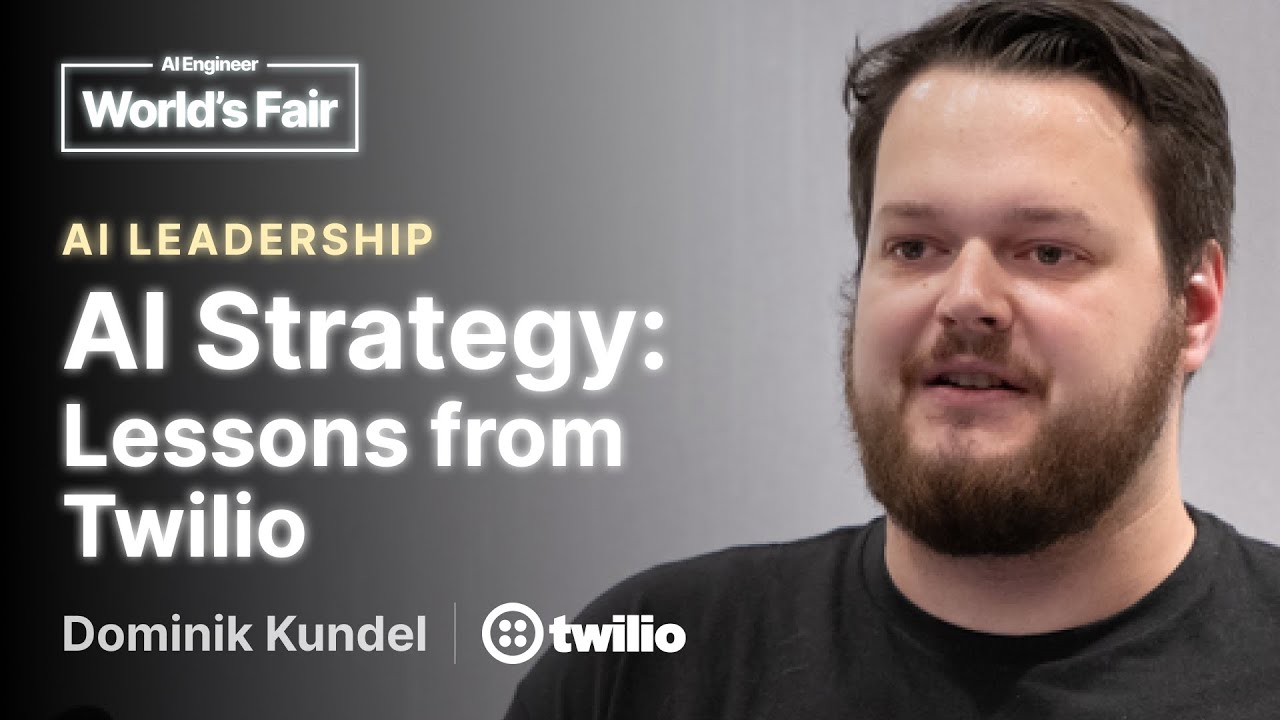
Twilio treats AI as a feature that can spread across existing products, while its Emerging Tech and Innovation team explores disruptive changes to customer engagement.
2
The team learned to put rough prototypes in customers' hands, use internal dogfooding, and ship through a separate Alpha brand with clear expectations.
3
Curiosity, flexible systems and roadmaps, and sharing work early with colleagues and customers help the team experiment without isolating itself from the business.
Summary
Dominik Kundel describes how Twilio's 16-person Emerging Tech and Innovation team explores AI without putting the company's existing customer base at risk. The team is separate from Twilio's traditional Communications and Customer Data Platform businesses, but AI is treated across the company as a feature rather than the responsibility of one AI team. Kundel explains the difference between sustaining innovation and disruptive innovation, then describes how the team moved from customer-memory prototypes to an agent builder. Early work generated good customer feedback but lacked a large enough market to gain priority with R&D. The team changed its process by exposing customers to rough prototypes, dogfooding an IT help desk use case, and creating Twilio Alpha for developer previews and waitlists. Kundel is direct about the unresolved tension between shipping quickly and meeting Twilio's normal quality standards. He ends with three operating lessons: stay close to customers and developers, ship early, and share work inside and outside the company.
Twilio gives AI work a separate innovation team, while AI remains a company-wide product concern
Dominik Kundel leads Twilio's 16-person Emerging Tech and Innovation team, which includes engineering, product, design, and go-to-market members. The group works as self-contained as possible while the company continues to run its Communications and Customer Data Platform businesses. Its focus is the future of customer engagement, including emerging technologies such as AI. Kundel stresses that it is not Twilio's AI team. Twilio sees AI as a feature that can spread across products and help customers engage their own customers more effectively. Innovation remains everyone's job, while this team concentrates on questions about what could disrupt Twilio and how the company might respond.
AI is advancing on both the sustaining and disruptive sides of innovation
Kundel separates sustaining innovation from disruptive innovation. Sustaining work improves an established product for an existing customer base, such as making a Sony mirrorless camera better. Disruptive products can begin with poor quality but satisfy a niche, as early phone cameras did. AI is moving on both sides at once. Photoshop's generative fill and AI features added to existing Apple products fit the sustaining pattern. Agents and GPTs fit the disruptive pattern because their quality, regulation, and cost are still unsettled. Enterprise adoption is often being dictated by legal teams, while startups and small businesses may see agents as a way to add value where support and sales already fall short.
Twilio's first customer-memory prototypes had good feedback but lacked a market that R&D could prioritize
The team began as a three-person Skunk Works group building a bridge between Twilio's customer data and communications platforms. Large language models seemed well suited to translate between unstructured communications and structured customer data. The team designed an AI personalization engine, a retrieval-augmented generation system over Segment customer profiles, and an AI perception engine that turned communications into customer profiles. Together, these formed a customer-memory concept. Customers liked the direction, but the team was solving a niche problem for the emerging agent market. The quality and cost were not ready, and the opportunity did not have enough immediate market demand to compete with sustaining work and profitability priorities.
Rough customer access changed the team's prototyping process
The next project, AI Assistants, was an agent builder for omnichannel customer engagement built on the customer-memory idea. This time the team stopped making work mainly for polished demonstrations. It ran internal hackathons and gave visiting customers access to very rough prototypes for a day, asking them to report what was wrong and what the product should do. The approach was frightening because customers saw all the unfinished edges, but it produced useful information. The team also looked for internal dogfooding opportunities. An IT help desk use case was deliberately low risk and did not perfectly match the expected buyer, yet it provided data about quality problems and product structure.
Twilio Alpha lets the team ship unfinished AI products with explicit expectations
Generative AI changed Twilio's usual development sequence. Instead of collecting training data, training a model to a target quality, and then releasing it, a team can build a prototype or MVP quickly and use customer feedback to improve it. That creates a problem for a company with an established quality bar: the system needs real use before its quality is good enough. Kundel says Twilio looked at GitHub Next and Cloudflare's Emerging Technologies and Incubation group, including projects such as Workers, D1, and Workers AI. Twilio responded by creating the Twilio Alpha sub-brand. It supports early shipping, developer previews, waitlists, and quick onboarding while making reliability and availability expectations clearer.
Curiosity and flexible architecture matter more than prior AI experience
Kundel says the team has not solved the question of what qualifies as fast enough, so it relies on operating principles. When hiring, it prioritizes curiosity and creativity over existing AI experience. Engineers receive problems to solve rather than waiting for product managers to define every feature. The team also assumes that any model may become redundant tomorrow. It does not chase every new model or paper, but it tracks known limitations and tests whether a new model matters. When Claude 3.5 Sonnet arrived, the team could decide within a day whether to investigate it immediately or put it in the backlog. A dedicated innovation team also protects roadmap flexibility because it has fewer prior customer commitments.
The team learned that isolation made its work less useful
In its first year, the self-contained team took its independence too far. It worked quietly in its own corner and shared information only when necessary. Some Twilio teams did not know the group existed or understand what it was building, leaving the innovation team responsible for finding conflicts and collaboration opportunities. Customers were also asking what Twilio was doing about AI. Kundel argues that a B2B company can help customers become thought leaders in their fields, so the team should share its work externally as well. Sharing internally spreads what the team has learned and reveals opportunities. Sharing externally helps customers think about their own products and future plans.
The team's final principles connect early feedback with internal alignment
Kundel condenses the lessons into four principles. The team stays customer- and developer-obsessed by speaking with customers early and often, learning about their businesses and future vision rather than only their current Twilio problems. It ships early and often, with expectations set clearly enough for customers to try unfinished work. It hires for curiosity and gives people ownership of problems so they can build quickly. Finally, it shares as it goes, both inside Twilio and with customers. These principles are meant to keep experimentation close to real needs while allowing the team to explore changes that the existing product roadmap may not yet accommodate.
"Our third learning was to share things as we go both internally and externally."18:25
Who should watch
You are deciding whether AI experiments belong inside existing product teams or in a separate group, and need a concrete account of the tradeoffs.
Your company needs to release AI features before they meet its normal quality bar, while keeping customer expectations clear.
You lead an innovation or R&D team that has become isolated from the rest of the company and wants to improve feedback, collaboration, and roadmap flexibility.