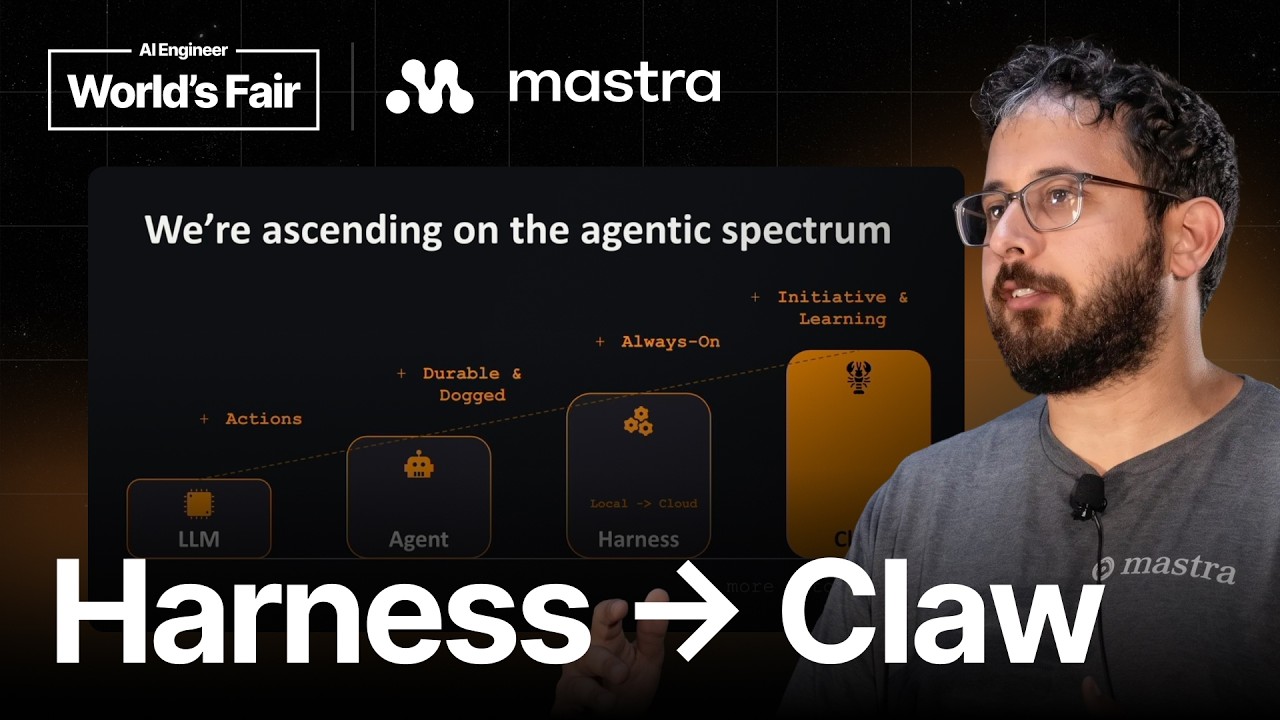
A harness adds durability, planning, parallel work, background tasks, and persistent sessions to an agent loop.
2
Cloud harnesses stay available through Slack, mobile apps, and cloud sandboxes, while producing pull requests instead of only local files.
3
Harnesses will expand toward claws that can listen to events, contact users, wake on a heartbeat, store accessible memory, and improve themselves.
Summary
Sam Bhagwat describes a progression from LLMs to agents, harnesses, and claws. An agent has an action loop, tool calls, memory, retries, and context engineering. A harness adds the ability to work for hours or days, recover interrupted sessions, plan, run parallel subagents, use skills, start background tasks, compact context, and let users steer or interrupt work. Cloud harnesses extend this model through Slack, mobile apps, cloud sandboxes, and pull requests. Bhagwat calls the next step a claw. It has initiative, listens to external feeds, wakes on a heartbeat, uses communication channels, stores accessible memory, and may improve its own skills or code. He expects harnesses to keep expanding because users want more access and automation. He also predicts a shakeout similar to mobile apps, where people keep only a small number of highly useful or frequently used claws.
Agents become harnesses when they can persist and keep working
Bhagwat places LLMs, agents, harnesses, and claws on an agentic spectrum. An agent differs from a one-shot LLM call through its loop, tool calls, memory, retries, context engineering, and state. A harness adds durability and what he calls doggedness. It can run for hours or days, recover after a lost connection, and resume from the point where it stopped. This makes the system useful for work that cannot fit inside one request and response.
Harnesses add many ways to manage long-running work
The harness features Bhagwat lists include planning mode, parallel subagents, a terminal user interface, slash commands, and skills. A harness can create agents dynamically, start background Bash tasks, and automatically compact its context when the window fills. It persists threads so users can resume them later. Users can queue work, steer it, or interrupt it instead of waiting passively for a single model turn. Session-long tool approval also lets an approval apply across repeated calls.
Cloud harnesses are always available and run work in distributed sandboxes
Bhagwat describes a shift from local harnesses to cloud harnesses that are always on. A team might talk to one in Slack, with the system parsing instructions from several colleagues and using user metadata. A mobile app might tunnel to a local machine, or the harness might run in cloud sandboxes. The cloud gives more resources and allows more parallel subagents than a single computer, although it requires a different architecture. Coding work increasingly ends in a GitHub pull request rather than only a local work tree.
Claws add initiative and learning to an always-on harness
The harness-to-claw transition adds initiative and learning. Bhagwat gives the example of an assistant that notices an urgent email and asks whether it is really urgent. The system listens to external feeds, wakes on a defined heartbeat, and reaches users through text, WhatsApp, Telegram, or another channel. It may expose a daemon or gateway for incoming and outgoing requests. It can also use traces to improve itself, generate skills automatically, or modify the code that drives it, although Bhagwat says the industry has not settled on the right approach.
Steinberger's law says every harness will expand into a claw
Bhagwat proposes Steinberger's law: "every harness will expand until it becomes a claw." He gives technological, economic, and psychological reasons. Users want to message their harness in Slack, start overnight tasks before bed, and get code or other actions from the tokens they provide. As harnesses gain more capabilities, users will want access from more places and at more times. The claw is the result of adding initiative, external connections, and ongoing availability.
Only a small number of claws will stay in people's lives
Bhagwat compares the expected claw market with mobile platforms in the 2010s. Phones enabled many activities, including directions, ride hailing, payments, music, video, food delivery, and accommodation booking. Yet people usually settle on one or two familiar apps in each category. He says a product must be highly economically valuable or used frequently to stay in someone's mind. He expects a similar shakeout for claws, with people keeping only a small number of very powerful or frequently useful systems.
Agent builders need to keep adding capabilities before the shakeout
Bhagwat advises builders to keep up with the rapid rate of change and give users the capabilities they need. A product can lose users to a newer, more powerful system if it falls behind. He also warns that reaching the top of the current market is temporary. He expects another wave of competition and consolidation later in the 2020s, so builders need to account for future changes rather than treating the current harness design as finished.