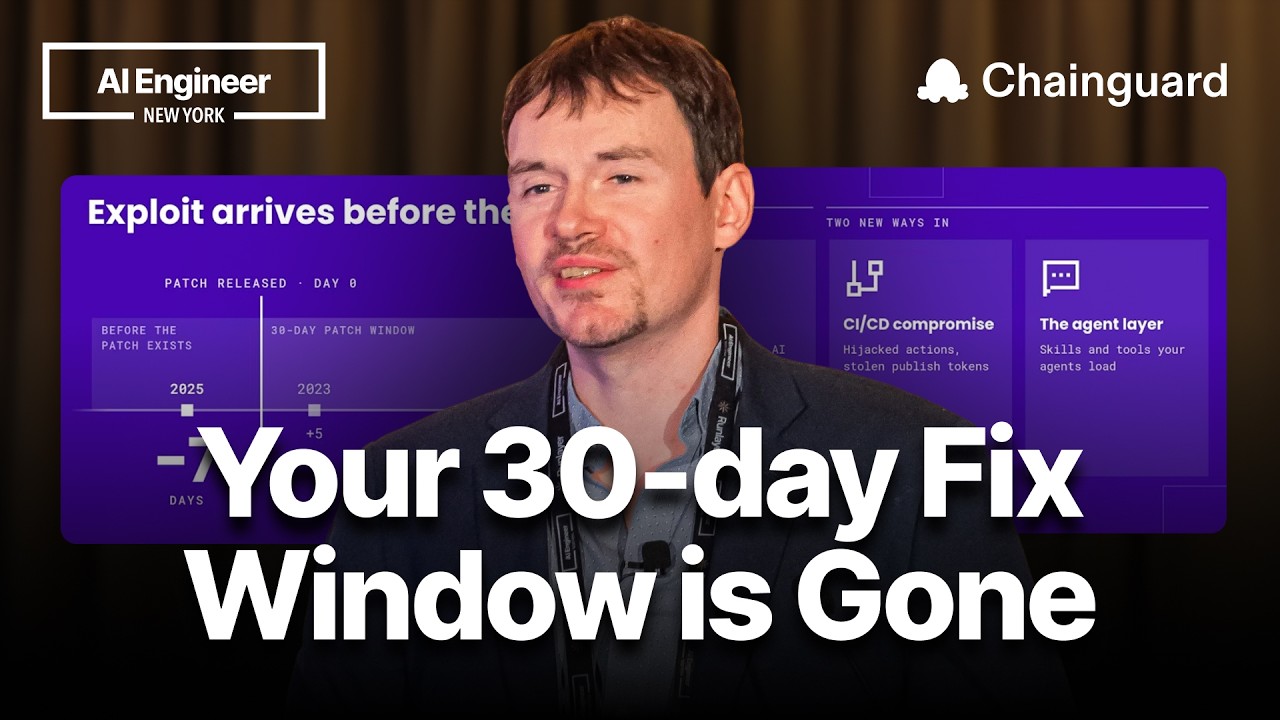
Frontier AI has shortened the gap between vulnerability discovery and exploitation until exploits arrive before patches on average.
2
A 30-day remediation cycle is too slow for current attacks, so teams need cooldown periods, faster CVE fixes, and signed artifacts.
3
Security teams need to cover malware, known CVEs, zero days, and side doors such as CI/CD systems, developer laptops, and agent skills.
Summary
Patrick Smyth argues that frontier AI has changed the timing and scale of open source attacks. He cites Mandiant data showing that exploits now arrive before patches on average, compared with a 63-day gap in 2018 and 2019. A 30-day remediation process therefore leaves too much time for attackers to act. Smyth describes a recent wave of supply chain malware, including attacks that spread through shared dependencies. He frames the problem around four attack surfaces: malware, known vulnerabilities, zero days, and side doors such as CI/CD, developer workstations, and agent skills. His recommendations include cooldown periods for packages, faster CVE remediation, operational security for developer devices, and signing artifacts with Sigstore and SLSA. He also describes Chainguard products and projects such as Wolfi, Chainguard Libraries, Chainguard Actions, and hardened agent skills.
Frontier AI gives attackers the capabilities of a larger team
Smyth describes several attacks that used AI to increase an individual attacker's reach. A 17-year-old in Japan reportedly used ChatGPT to exfiltrate about 4.4 million records from an internet cafe and used a stolen card to buy Pokémon cards. Another attacker used Claude Code against 17 organizations, including healthcare, government, and major corporations. The attacker used it to choose targets, write ransom letters, organize files, and carry out attacks. Smyth's framing is that AI moves each attacker up a level: an engineer can operate like a team, while a team can approach advanced persistent threat capability.
Smyth contrasts the old timing between exploitation and remediation with the current one. In 2018 and 2019, the average gap was 63 days. He says the latest Mandiant M-Trends data shows a negative 70 days, meaning exploitation arrives before the patch on average. He connects this shift to the wider use of software and to frontier models that can find and chain vulnerabilities. The exact average is noisy, but his point is operational: defenders can no longer assume that a patch will exist before attackers begin using a flaw.
A 30-day vulnerability process leaves too much exposure
The familiar process is to scan software with tools such as Grype and Trivy, collect CVEs, rank them by severity, and send remediation work to a team. Smyth says the problem is that 30 days may as well be a million years for some current attacks. Attackers can move quickly on known vulnerabilities, while new techniques can find vulnerabilities outside existing databases. Teams still need a remediation cadence, but the old 30-day window no longer matches the speed of exploitation.
Supply chain malware spreads through shared dependencies
Smyth describes a wave of supply chain malware that has become frequent enough to make a monthly incident calendar unrealistic. He mentions Shai Hulud, a worm from the JavaScript ecosystem, along with copycats and other attacks involving tools and packages. An Axios attack was live for only two hours but reached 600,000 downloads. The attacks can chain together because organizations share dependencies. Compromising one maintainer or package can therefore expose the users and downstream projects that depend on it.
The software supply chain puts every organization between users and upstream code
Smyth explains the supply chain problem as a position between two groups. Users rely on an organization's infrastructure and software, which creates a responsibility to protect them. The organization also pulls code from upstream projects and package repositories that it is difficult to fully vet or control. Any imported component can compromise the organization and its users. This structure creates the basic supply chain problem: teams must protect software that includes code and systems outside their direct control.
Teams need four separate attack surfaces in their security plan
Smyth groups the current problem into malware, known vulnerabilities, zero days, and side doors. Cooldown periods can reduce the risk from newly published malicious packages. Known CVEs still need fast remediation, even though many findings are noise. Frontier models make zero days more important because they can chain smaller vulnerabilities into an exploit. Side doors include CI/CD systems, developer laptops, and the agentic layer, where attackers can target weak configurations, poisoned models, or insecure skills.
Signing every artifact creates checks between supply chain stages
Smyth recommends signing artifacts whenever they are created, then checking the signature at the next stage. He describes Sigstore as useful for signing and SLSA as a way to attach cryptographically signed provenance to an artifact. Internal pipelines can verify that provenance before accepting an artifact. This addresses attacks that alter tags, download pages, dependencies, or other steps between source code and the software users receive. The goal is a zero-trust approach to software pipelines.
Smyth says agent skills are an emerging side door because teams may not know what those skills do or how they were built. Chainguard takes third-party skills from upstream repositories, hardens them through deterministic and agentic pipeline steps, and distributes the result. He also says organizations can submit their own skills for hardening and internal discovery. In his recent analysis, he estimates that about 5% of upstream agent skills are actively malicious, while another 30% to 40% have serious security problems even without malicious intent.