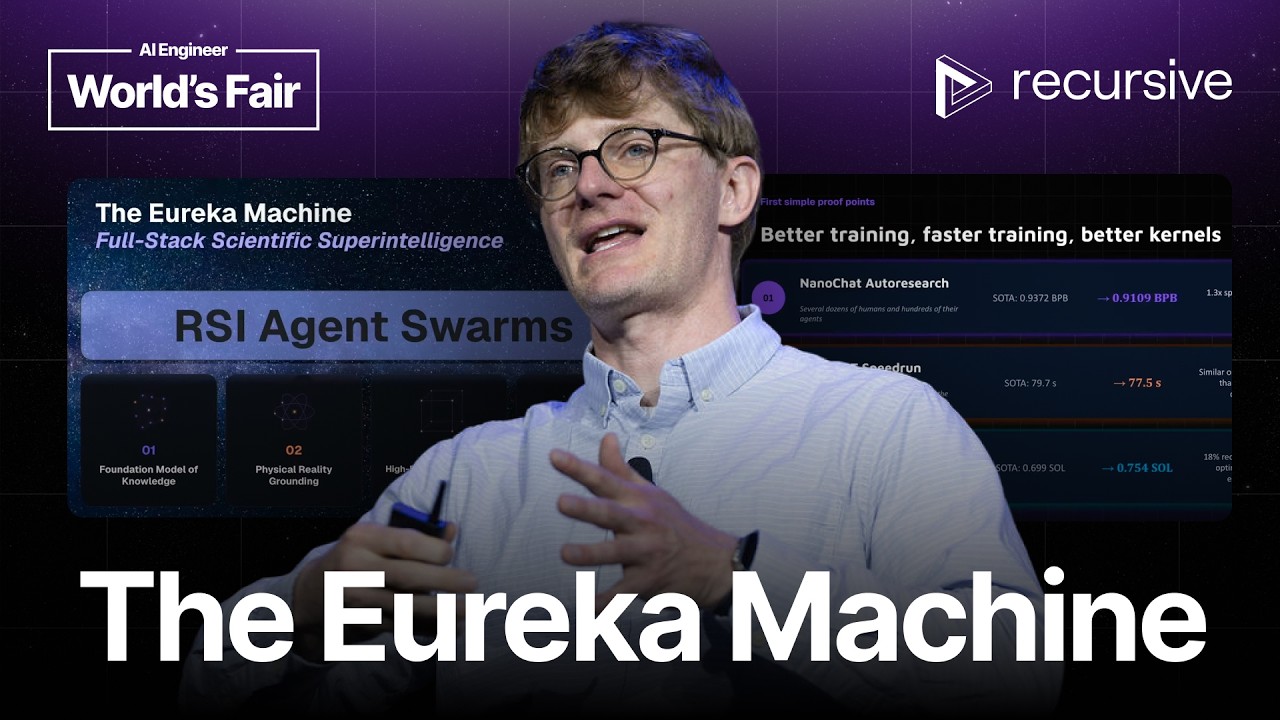
Richard Socher argues that scientific research can be automated by combining existing knowledge, measurement data, simulations, physical experiments, and agent swarms.
2
He proposes recursive self-improvement, where an AI system examines its own code, training process, harness, and results, then builds a better version of itself.
3
Early examples improved NanoChat, accelerated NanoGPT training, and found better CUDA kernels, although Socher says these results are still small steps toward a general research system.
Summary
Richard Socher presents automated scientific research as his version of going to Mars. He draws on biological evolution and Karl Popper's account of science as a process of proposing ideas, testing them, and discarding weak ones. His proposed Eureka machine would gather existing knowledge and measurements, create simulations where possible, run physical experiments when needed, and coordinate agents across fields such as medicine, economics, and astrophysics. Socher argues that research increasingly suffers from a shortage of people for narrow specialties. The system should first improve AI research itself through recursive self-improvement. He shows early results on NanoChat accuracy, NanoGPT training speed, and CUDA kernels. These systems found useful changes beyond simple hyperparameter tuning, but he is careful about their limits. They are small demonstrations rather than a finished machine that can conduct general science. He closes by inviting people to help build it.
Evolution offers a model for building systems that keep discovering new solutions
Socher begins with evolution as an open-ended process that produced biological complexity over roughly 3.5 billion years. He then connects biological evolution to technological change, from hunting and farming through science and the Industrial Revolution. Humanity has repeatedly created technologies that support more people and expand the frontier of what is possible. His claim is that AI development can borrow from this pattern. Processes that search, test, and retain useful changes can produce results that are difficult to design by hand. He also jokes that AI engineers may eventually manage an AI engineer that handles the detailed work.
Technology has compressed major advances into a single human lifetime
Socher uses flight to show how quickly progress can accelerate. Someone born in 1900 would have been alive when the Wright brothers achieved sustained powered flight, then would have seen humans reach the Moon in 1969. He says people today may be too late to explore Earth and too early to explore the stars, while being on time to build AI that moves from being worse than humans at every task to being better at specific tasks. He estimates that this shift could take around 60 years, or perhaps 30 because progress is moving faster. He presents automated research as a way to compress the timeline again.
Scientific progress follows a process of proposing ideas and testing them
Drawing on Karl Popper, Socher describes science as an evolutionary competition among theories. Researchers propose explanations and subject them to rigorous empirical testing. The theories that withstand testing survive, while shortcomings push researchers toward new ideas. This process connects scientific discovery to natural selection. Socher says AI systems would need access to tools such as web search to find existing theories and evidence. More science can produce more technology, which can support further growth and human flourishing. He uses this argument to ask whether humanity should devote more resources to scaling scientific discovery.
A shortage of researchers limits progress across increasingly narrow fields
Socher cites Stanisław Lem's observation that science can expand so widely that too few people remain available for each specialized area. There may be many niche subfields, but it is difficult to get a large number of people focused on one narrow question. As scientific knowledge widens, the number of researchers working on any single section can fall. Socher treats this bottleneck as a reason to automate parts of discovery. An automated system could work across physics, chemistry, biology, neuroscience, medicine, economics, and astrophysics without requiring a large human team for every subfield.
The Eureka machine would combine knowledge, data, simulations, experiments, and agents
Socher's Eureka machine would first collect what humanity already knows and bring scientific measurement data into the system. For questions that cannot yet be measured, it would build simulations. He says anything that can be simulated can be verified and solved with AI. When simulation is insufficient, a physical industrial lab would run experiments in the real world. An agent swarm would work across these sources of knowledge, data, experiments, and rewards. He presents this as a general design for automating scientific discovery rather than as a system limited to one discipline.
AI infrastructure needs to be redesigned around machine researchers
Socher argues that the tools built for people should be rethought as infrastructure for AI. At You.com, he says web search for language models and agents can return thousands of long, readable snippets instead of ten blue links with short summaries. He extends the same idea to browsers, GPUs, and other layers of computing. These tools become inputs for systems that can read, reason, run experiments, and build new capabilities. The point is to create infrastructure that lets an AI researcher use far more context and computation than a person can manage directly.
Recursive self-improvement lets an AI inspect and change its own research system
Socher says the most direct route to a supermachine is to have it build itself. AI is code, and AI can now write code over longer time horizons. A recursive self-improvement system would examine its own shortcomings, then update its code, training process, harness, and results in a later version. He distinguishes this from asking an AI to improve a separate small model. The latter is useful and may be an important milestone, but it does not meet his definition of true recursive self-improvement. He reduces the research loop to generating ideas, implementing them, and validating them.
Early automated research systems have produced concrete improvements
Socher gives three early proof points. NanoChat trained a small chat model in less than five minutes, and an automated run lowered the community's bits-per-byte result from 0.93 to 0.91 after more than a day or two. The system found changes such as hash bigram and trigram embeddings, tables, and learned gates rather than only tuning hyperparameters. A NanoGPT speed run reached 70 seconds, more than two seconds faster on its benchmark than the previous result. For CUDA kernels, the system found results that beat the best entries on Nvidia's benchmark leaderboards across categories after a couple of days. Socher says the results were checked for reward hacking and other problems.
"True recursive self-improvement is when you have an AI that has a sense of self-awareness of its own shortcomings, full access over everything in its arsenal from pre-training to RL training and harnesses and everything, and then actually updates that entire system in the next version of itself."14:47
Who should watch
You are building AI agents and want a concrete design for systems that search, implement, and test research ideas over longer runs.
You work on scientific computing, model training, GPU performance, or research infrastructure and want examples of where automated experimentation can help.
You are interested in recursive self-improvement and want to hear a proposal that separates early demonstrations from a general scientific system.