Frontier AI has been restricted by a narrow career path and by access to large, colocated pretraining systems.
2
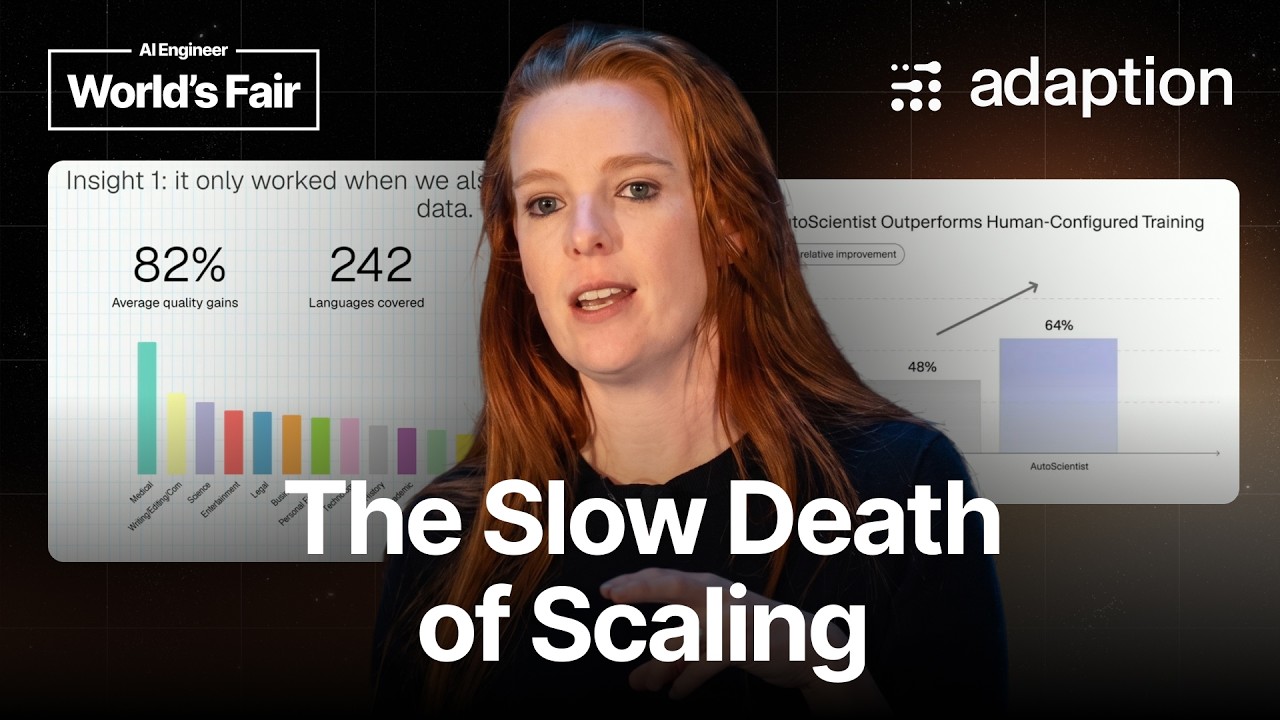
AutoScientist automates model training across data, models, alignment, and domain adaptation, and its results improved after data quality became part of the search.
3
Hooker argues that pretraining has reached a size ceiling for current architectures, making post-training, distributed compute, recipes, and algorithms more important.
Summary
Sara Hooker argues that frontier AI has been shaped by an unusually narrow path: the right PhD, the right lab, the right project, and access to enough GPUs. She sees two changes widening participation. AutoScientist automates the training loop, searching across data, model architectures, sizes, and alignment choices. It only produced stronger returns after the system co-optimized data quality with the model. Hooker also argues that pretraining scale is losing its economic advantage for current architectures. Smaller models are beginning to outperform larger ones, while post-training and other distributed forms of compute can produce more useful returns. This shifts the advantage toward research ideas and domain-specific recipes. She is careful about the safety risks of wider access and says customization is a different question from open sourcing a frontier model. Her broader claim is that lowering the cost of asking questions will change which questions researchers and organizations can pursue.
Frontier AI followed an unusually narrow path into professional labs
Hooker describes the path to frontier AI research as heavily filtered. A researcher had to enter the right PhD program, join the right industry lab, choose an interesting problem at the right time, and produce work that earned access to the frontier. She says this was also her path through a PhD, DeepMind, and other frontier labs. The system became even narrower because computer science research required substantial compute. A handful of labs could build the models that everyone else used, while entire regions were absent from maps of statistically significant breakthroughs. Hooker asks who gets to shape the frontier and who gets to answer the questions that computer science tools make possible.
AutoScientist searches across the full model-building loop
AutoScientist automates the training of models and co-optimizes the loop from data through alignment. It chooses and evolves its approach for a domain and its data. Hooker says it outperformed research staff because people often have experience with particular model types, while the system searched across different architectures, model sizes, and dense and mixture-of-experts designs. The broader search space allowed it to exploit experience and improve its own process. She presents this as a way to increase the speed of innovation and raise the chance that a given training run will succeed.
Data quality had to be optimized alongside the model
Hooker says AutoScientist did not deliver its strongest returns when the agent treated data as a secondary choice. The team had to control data quality and co-optimize it with the model. Adaptation decisions affected the data, and the data then informed later model decisions. This process combined information from the adaptive data component with domain knowledge and the system's ability to improve for a particular domain. She connects this result to a broader principle: automating model research requires control over the whole flow, rather than optimizing architecture while leaving the data process mostly fixed.
The reported 60 percent win rates were an early stopping rule
Hooker warns that the win-rate figures in the AutoScientist results need context. They cluster just above 60 percent because the team set the budget to stop once the system passed that level. After removing that stopping barrier, the results continued to rise over time. She also says the system changes many hyperparameters at once, while human researchers are more cautious about making simultaneous changes. That wider exploitation of the search space may reduce the compute needed for customization and make training more predictable. The point is about how an automated search can explore combinations that a human team may avoid.
Domain adaptation matters most where general models fall short
The strongest early interest in AutoScientist came from medicine, science, law, and code. Hooker says these fields contain tasks where current models often fall short and where the final stage of customization matters greatly. The system's purpose is to shorten the innovation cycle and make successful use of compute more likely. She also describes plans for adaptive test-time compute, where the amount of computation changes according to the task. The company chose to support 242 languages from the start and is interested in non-verifiable tasks, which Hooker describes as a large part of everyday work.
Continual learning requires models that interact with their environments
Hooker says the model is no longer an isolated object built by one team and handed to separate teams for serving and user interfaces. The important intelligence is now a model that interacts. That makes efficient interaction and continuous learning from the environment central problems. Her aim is to accelerate learning so that builders can give models more control over their own adaptation. AutoScientist is one part of that effort. She says the benefits would be limited if using the system still required a lab to bring an enormous stockpile of GPUs.
Current scaling economics favor distributed compute and better recipes
Hooker argues that pretraining size is no longer the most rewarding way to improve a model. Pretraining usually requires large, colocated systems with enough capacity for redundancy. Inference and other forms of compute can be distributed more easily and can offer higher returns for the same amount of computation. She links the weaker returns from pretraining to saturation in current architectures. On the Open LLM leaderboard, she says smaller models under 13B have increasingly outperformed larger models. This changes the research opportunity toward post-training, algorithms, and domain-specific recipes.
A current architecture may have reached its size ceiling
In the questions, Hooker clarifies that she is not claiming everyone should use a very small model. Frontier models are still large, and larger models can provide useful knowledge for distillation. Her claim is that no frontier lab is likely to quadruple the size of its model again for pretraining on the current architecture. The architecture sets a ceiling, and she believes this one is probably near its size ceiling. That leaves room to innovate within the existing size range, especially by moving more work into post-training and improving data quality. A new architecture could change the conclusion.
"I would like to say that we are ripe for a revolution in who gets to participate at the frontier of AI."04:24
Who should watch
You are building domain-specific models and want to understand why automated training must include data quality and alignment choices.
Your team has limited access to colocated pretraining compute and wants to evaluate where post-training or distributed compute may offer better returns.
You are thinking about wider access to frontier AI and want a view that addresses both the opportunity and the safety costs of giving users more control.