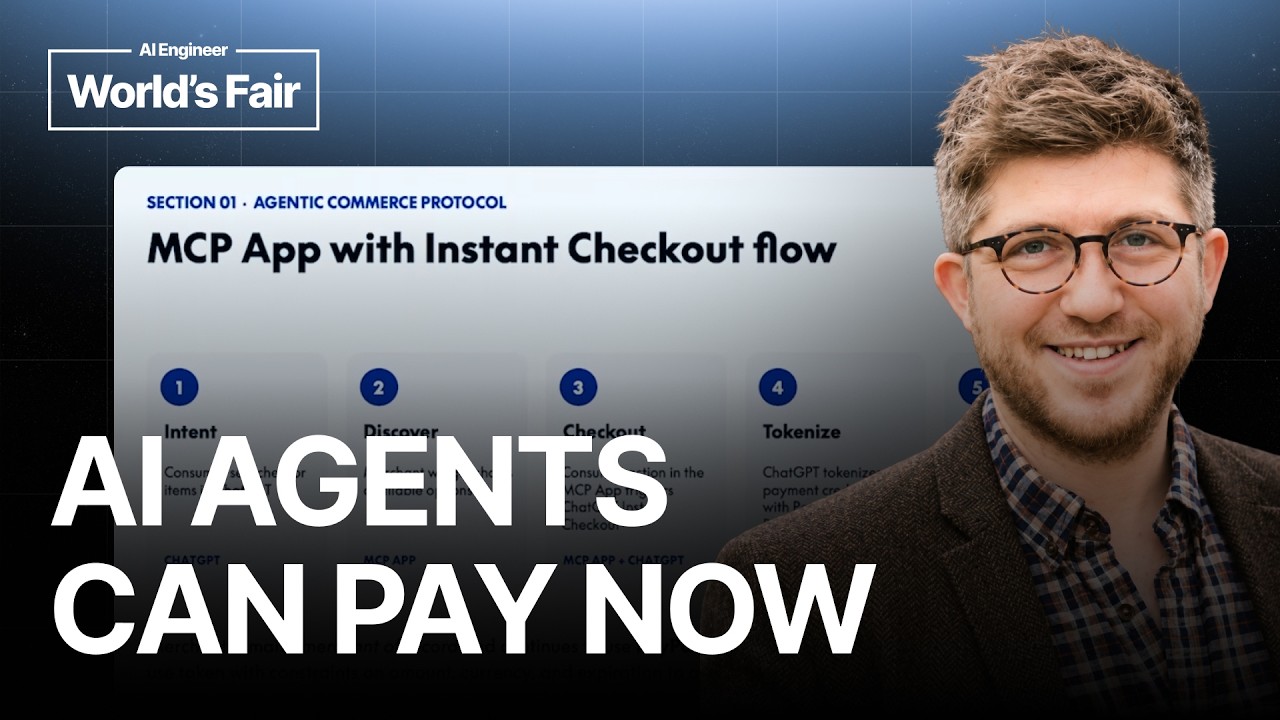
Merchants can accept agent-initiated payments through ChatGPT's Agentic Commerce Protocol, Google's Universal Commerce Protocol, or an MCP app with an external checkout page.
2
Tokenization replaces card details with constrained tokens, so agents and merchants can pass payment credentials without taking on the card data directly.
3
ChatGPT gives merchants control over an in-agent MCP app, Google AI Mode requires endpoints without a merchant-built UI, and external checkout gives the merchant the most control with more user friction.
Summary
Sam Parsons explains three ways merchants can accept payments started by AI agents. In ChatGPT, a merchant-built MCP app controls product discovery and its UI, then triggers Instant Checkout through the Agentic Commerce Protocol. In Google AI Mode, the merchant uses the Universal Commerce Protocol, publishes product and payment endpoints, and relies on Google Pay for tokenization. The merchant does not build an in-agent interface. The third option uses an MCP app that sends the user to an external checkout page, which gives the merchant control over payment methods and the full checkout experience but adds a handoff. Across the flows, PayPal Enterprise Payments tokenizes payment credentials and returns tokens constrained by merchant, amount, currency, and expiry. Merchants receive those tokens through their normal processing paths, while settlement, refunds, chargebacks, risk, and compliance continue through PayPal Enterprise Payments.
PayPal is building payment connections for several agent environments
Parsons frames PayPal Enterprise Payments as the payment layer for large merchants that want to accept transactions initiated in different agent environments. He introduces three paths: OpenAI's Agentic Commerce Protocol in ChatGPT, Google's Universal Commerce Protocol in Google AI Mode, and an MCP app connected to an external checkout. He says the first two protocols are very similar when compared at the specification level. The area is still early, so he presents the options as current integration paths rather than a settled standard.
A ChatGPT MCP app lets the merchant control product discovery inside the agent
The ChatGPT path uses an MCP app, which combines an MCP server with embedded HTML and JavaScript that agents can render. In the shopping flow, the merchant's app shows products and controls the look, feel, content, and interactions. ChatGPT hosts the experience, but the merchant controls the product interface. When the user chooses to buy, the app triggers Instant Checkout through the Agentic Commerce Protocol.
ChatGPT's checkout tokenizes payment details before the merchant processes the order
The user enters a card or uses stored credentials in ChatGPT's Instant Checkout experience. PayPal Enterprise Payments tokenizes the credential, replacing the transactable card number with a token that can be passed around without exposing the original payment data. The merchant receives the token through its MCP server and processes it like a normal PayPal Enterprise Payments token. After the transaction, the merchant's app can update to show the confirmed booking or order.
The ChatGPT integration has a client trigger and a server-side completion step
Parsons identifies two main integration points for the ChatGPT path. JavaScript in the MCP app triggers the Instant Checkout experience. The merchant's MCP server then receives a call to its complete checkout tool, including the token. The merchant can continue with its usual payment processing. The merchant still has to build and operate the MCP app, including its product experience.
Payment tokens are limited to the transaction context where they were created
The tokens used in the flows are constrained by the merchant, so a token can only be processed for the specified merchant. They also have a maximum amount, a currency, and an expiry. Parsons says transactions retain attribution to their source, so a ChatGPT transaction appears as such within PayPal Enterprise Payments. These restrictions prevent a token from being reused indefinitely or applied to an unrelated transaction.
Google AI Mode requires payment endpoints rather than a merchant-built interface
In Google's flow, the Universal Commerce Protocol creates a checkout session against the merchant while the user shops in AI Mode. Google Pay handles tokenization with PayPal Enterprise Payments, then the merchant receives the token during the completion step. The merchant provides products and endpoints for payment completion. It does not create an MCP app or an in-agent UI. Its integration includes a well-known JSON file with payment configuration and an endpoint that receives the checkout session completion request.
An external checkout MCP app gives the merchant more control and adds a handoff
The third path uses an MCP app to show product cards and a checkout button, then sends the user to an external checkout page. The merchant controls the external page and can offer any payment method there. A session connects the external page to the MCP app, which updates after checkout to show the order status. Parsons describes this as more flexible than in-agent checkout, but it introduces friction because the user leaves the agent to complete payment.
MCP elicitation may reduce the friction of external validation later
Parsons mentions elicitation as an MCP app feature that is still not supported by most major agents. It could allow an external validation step to happen more smoothly, potentially through an iframe. For now, he presents the external checkout handoff as the practical option available in the demonstrated flow. Merchants can choose among ChatGPT, Google AI Mode, and an MCP app based on how much interface control they need.
"Tokenization means where the user exchanges a real payment credential that's transactable, say your credit card number, and instead they exchange that for a token that can then be passed around without increasing PCI scope."06:05
Who should watch
You are building a commerce experience and need to decide whether checkout should happen inside ChatGPT, inside Google AI Mode, or on your own page.
Your payment system needs to accept agent-initiated transactions without passing raw card details through the agent or adding those details to the merchant's PCI scope.
You already use MCP apps and want to understand the trade-off between controlling an in-agent UI and sending users to an external checkout.