AI can produce financial content quickly, but its probability-based outputs are not enough for work that must be numerically justified.
2
Kepler keeps the model responsible for reasoning and planning while deterministic tools extract, calculate, store, and check financial data.
3
Every number needs a provenance chain that records its source, transformations, and internal inputs so the resulting work product can be replayed and verified.
Summary
Vinoo Ganesh argues that financial AI has a verification problem. Language models are useful for reading, reasoning, and planning, but they are probability machines and should not perform arithmetic or write financial figures directly. Kepler puts a deterministic substrate around the model. The model identifies what information is needed and selects the relevant operation, while databases, code, and structured data tools extract numbers, perform calculations, persist results, and run checks. Atomic provenance ties each number to its source. Scope determinism limits the model to tasks where nondeterminism is useful. Derivation chains record how ratios, multiples, and other outputs were produced according to a firm's own rules. Ganesh says citations only show where information may have come from. Verification must prove that the number is correct and that the process followed the organization's rules. The same pattern could apply to legal research and drug discovery, where missing or invented entities create serious problems.
Financial AI has turned producing work into a reading and verification problem
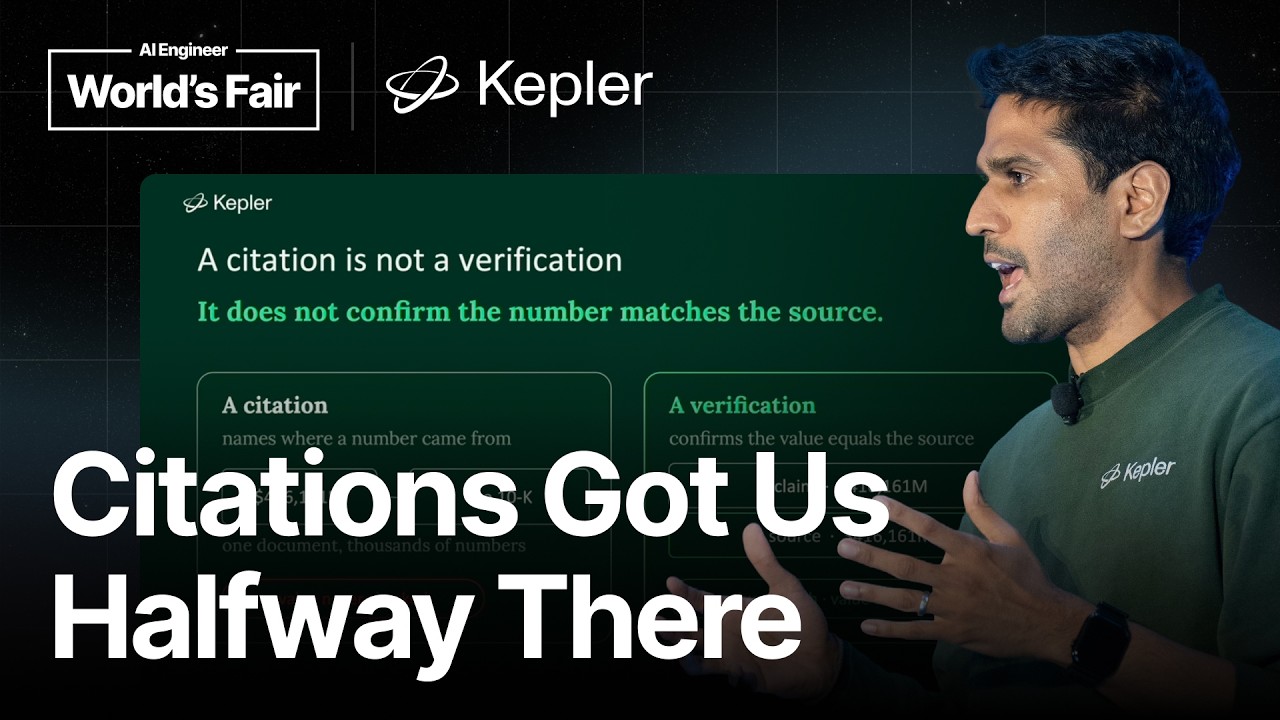
Ganesh says AI has made it cheap to produce code, marketing copy, DCFs, and other content, but people still cannot easily verify what the model produced. In finance, the earlier advantage came from analysts who could search widely and understand sources of alpha. Once everyone can access the same information through tools such as Tegus, that advantage declines. The difficult question becomes whether the output is trustworthy. A citation is only an after-the-fact audit. Verification requires a deterministic, repeatable way to prove that a number is right, such as showing that extracted revenue is the correct revenue from a specific 10-K.
A model cannot be evaluated into deterministic behavior
Ganesh describes language models as probability machines that are good at next-token prediction. He says evaluations cannot turn a nondeterministic model into a deterministic system. Models can produce a confident answer or work out how to make an EBITDA adjustment, but they should not be responsible for the mathematical adjustment itself. This matters in regulated finance, where a trading decision or fairness opinion needs to be justified from sources and underlying information. The model must be part of a larger process that can show how an output was produced.
Verifiable finance needs a deterministic substrate around the model
Ganesh says Kepler models AI after a portfolio manager who has access to deterministic tools and operates within a risk threshold. The model handles non-deterministic work such as reasoning and planning. External tools handle calculations and data operations. Kepler's approach has three stated tenets: atomic provenance, scope determinism, and derivation chains. The design starts from a division of responsibility. Humans should not copy a number from a PDF filing into an Excel model, and the model should not directly perform that same fragile operation. A system should record the steps that connect the source to the final work product.
Atomic provenance keeps the model from writing financial numbers
With atomic provenance, the model writes a reference to where a number came from instead of writing or manipulating the number. A database or another numerical system then reads and writes the figure with the required fidelity. Kepler runs a deterministic check and removes any number that cannot be independently verified. Ganesh distinguishes this from asking several probabilistic models to review one another. The canonical process extracts a number, persists it, checks that the process occurred correctly, and repeats the relevant verification cycle. A wrong number is still wrong even when an extraction model reaches 94% accuracy.
Scope determinism lets the model choose a computation without performing it
Kepler separates the model's reasoning from the deterministic pieces of the task. The model can decide that it needs net margin and identify the information required to calculate it. Code and deterministic platform components then parse the filing or XBRL, pull the relevant values, calculate the result, and persist the data outside the model's understanding. Ganesh asks why anyone would run 1 + 1 through a multi-billion-parameter model when one CPU cycle is enough. This division also reduces cost because the model does not spend tokens doing work that ordinary computation can perform.
Derivation chains encode each firm's rules for ratios and financial outputs
Many financial outputs do not appear directly in a filing. Gross margin, EBITDA adjustments, and enterprise value depend on definitions that differ between firms and analysts. Kepler therefore records the chain of events behind each output, including the inputs, transformations, and rules used. Ganesh compares this to the reasoning an analyst follows when making a risk-reward or trading decision, except the system can replay and rewind the process. The platform knows which data points it is allowed to produce from structured filings or numerical sources, and it avoids extracting unsupported figures from prose or raw tables.
Ganesh says a verified data point is not enough if the system cannot show that the number follows the company's own philosophy. Citations provide only about half of the needed path. The rest comes from tracking provenance and preserving the process that produced the result. He compares this with software, where pull requests, commits, unit tests, and code reviews remain stored. Finance needs a similar record of how its work product was built. The remaining personalization problem is encoding an organization's investment process as a verifiable ontology rather than optimizing token usage.
The same provenance pattern can apply outside financial services
Ganesh says the approach generalizes to fields where missing or invented entities are harmful. In legal work, a preprocessing step could extract entities such as the parties in a case and store them deterministically so the system does not hallucinate citations. In drug discovery, the same process could track every compound mentioned in NIH white papers. He compares the current state of AI adoption with e-commerce before internet security, when people were not comfortable putting credit card numbers online. In his view, deterministic verification is the missing layer that can make generated work usable in more disciplines.