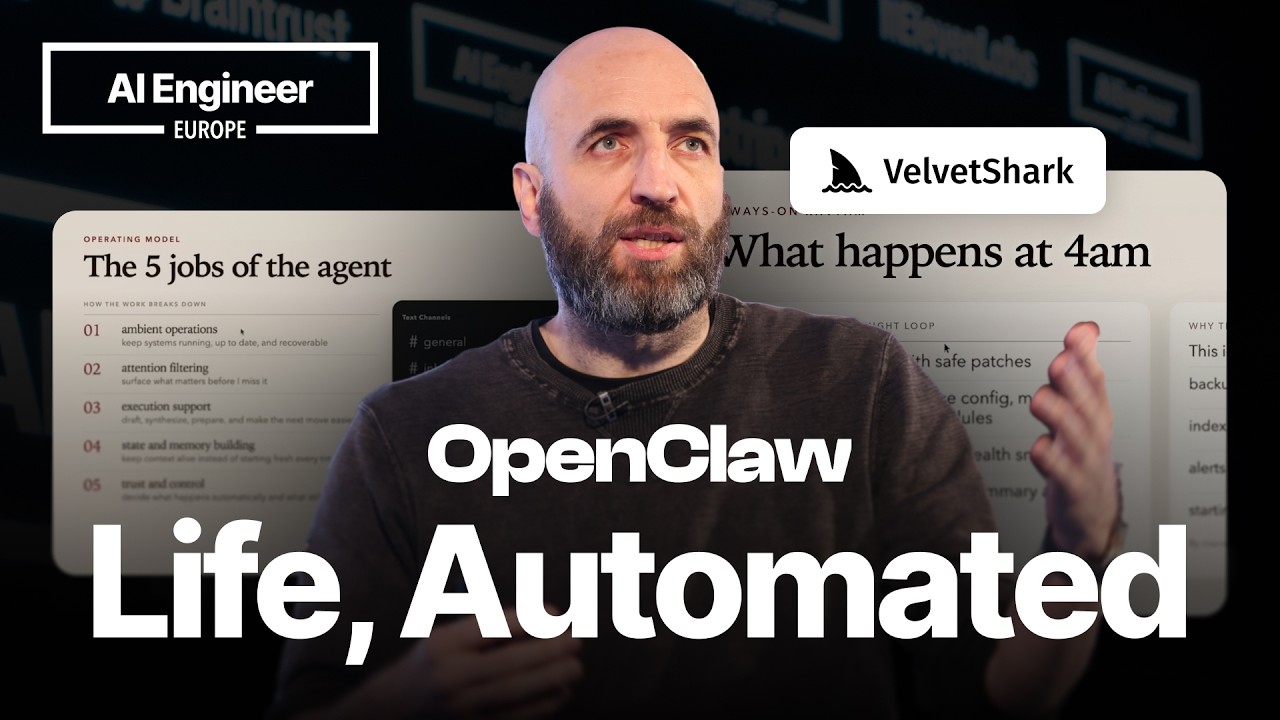
Radek Sienkiewicz expanded OpenClaw gradually, adding one permission and workflow at a time instead of handing it control all at once.
2
The agent uses his Obsidian vault, email, calendars, files, scripts, and Discord channels to maintain systems, filter attention, and prepare work while he sleeps.
3
The setup stays useful through incremental changes, inspectable files, memory maintenance, automation guardrails, and clear rules about what the agent may do.
Summary
Radek Sienkiewicz describes how OpenClaw grew from a chat interface into a personal agent with access to his email, notes, files, calendar, operating system, and business workflows. He started with one channel and one simple task, then expanded whenever he encountered a recurring need. His Obsidian vault, which contains about 3,000 notes, gives the agent context for research, projects, email, and bookmarks. Overnight jobs update software, refresh indexes, back up data, and prepare morning summaries. The agent also filters urgent messages, renews a domain, and drafts replies for approval. Radek explains that the system depends on a mix of LLM judgment, deterministic scripts, editable memory files, and critical rules. He is candid about failures from bad memory, brittle long automations, noisy nodes, and weak boundaries. His guiding idea is to build for his future self, who wakes up to work that has already been prepared or completed.
Incremental permissions made broad control manageable
Radek did not give OpenClaw complete access in one move. He began with a single chat channel, first WhatsApp, then Telegram, and now Discord, with one simple ability. Each new need led to another small workflow. This also shaped how he handled failures. When an update or change broke something, he took one small step back, fixed the problem, understood why it happened, and added a setup that would prevent it happening again. He says this process reduced the risk of breaking or bricking his computer because every change remained understandable and reversible.
The biggest increase in usefulness came when Radek connected his Obsidian knowledge base. It contains about 3,000 markdown notes covering work, personal matters, tasks, projects, research, articles, and saved links. OpenClaw can search the vault and its other memory systems. When he adds a link to an inbox, the agent analyzes it, adds tags and context, checks related material already in the vault, and creates connections. It can later remind him that an old note is relevant to a new bookmark. Radek says this turned bookmarks he would never revisit into a growing source of connected information.
Overnight jobs prepare the system for the next morning
While Radek sleeps, the agent handles maintenance that would otherwise require his attention. It indexes content, backs up data, refreshes QMD, memory, and Obsidian indexes, and prepares email and calendar summaries. In the worst case, he expects to lose only a couple of hours of work or content. OpenClaw also manages parts of its own updating process through scripts that specify what can break, how to verify a change, and how to bring the gateway back online. By morning, the latest version and updated information are waiting for him.
The agent has separate jobs for maintenance, filtering, and work support
Radek groups his agent's work into ambient operations, attention filtering, and execution support. Ambient operations cover updates, plumbing, and other background tasks. Attention filtering uses email access and Obsidian context to identify urgent or important events. The agent noticed a failed Netflix payment, identified an approaching domain renewal, and sent messages through Discord. It also renewed the domain. For project email, it can read the message, understand what has already happened, and prepare a reply in a draft folder for Radek to accept, delete, or edit.
Discord channels turn recurring conversations into workflows
Radek creates a dedicated Discord channel when a type of conversation happens often enough. His channels include an inbox for links, consulting for client projects, video research, morning briefings, Instagram, YouTube, OpenClaw maintainer work, and a playground for experiments. The consulting channel has project context such as quotes, deadlines, tasks, and next steps. The playground lets him test another model, workspace, or memory arrangement. Successful experiments can be promoted, while unsuccessful ones are discarded. The channel structure gives each recurring activity a place and a defined purpose.
LLM judgment works alongside scripts and editable memory
The system splits work between language models, scripts, files, and tools. The LLM handles judgment, such as understanding an email, interpreting context, and making connections. A script handles a fixed rule such as 'if this happens, do this', so the model can be skipped. Radek maintains memory files including SOUL.md and critical rules, and he has changed from one large memory file to a memory folder with a process for promoting useful memories. Because the files are inspectable and editable, he can read what the agent knows, correct it, and adjust the instructions.
Memory growth and long automations create maintenance work
Radek is direct about the problems that appear as the system grows. Bad memory compounds when the vault, nodes, and memory files reach thousands of items, so the memory needs active maintenance. Ten-step automations are brittle and will eventually break. He recommends splitting them into simpler automations or adding effective guardrails. Noisy nodes need regular cleaning, and weak boundaries require work on SOUL.md and the other instruction files. The agent is useful because its internals remain available for inspection, rather than hidden behind an opaque interface.
Radek frames the whole setup around his future self. He used to imagine the past self as someone who left work for the present self, while the future self could supposedly handle anything later. His goal now is to become friends with that future self and help it. The agent prepares as much as possible before the next day, so Radek wakes up to completed or organized work. He does not present this as a universal configuration. His advice is to start with one recurring pain, build trust gradually, add a knowledge base, move information into markdown when useful, inspect the system, and optimize it for the person he will be tomorrow.
"Start with one recurring pain, grow trusting incrementally, build the knowledge base."17:30
Who should watch
You are considering giving a personal agent access to files, email, calendars, or business systems and want an example of expanding permissions gradually.
You already have an agent with scattered automations and need practical ideas for memory files, overnight maintenance, Discord workflows, and recovery steps.
You want an honest account of where a personal agent fails, especially when memory grows, automations become long, and boundaries are unclear.