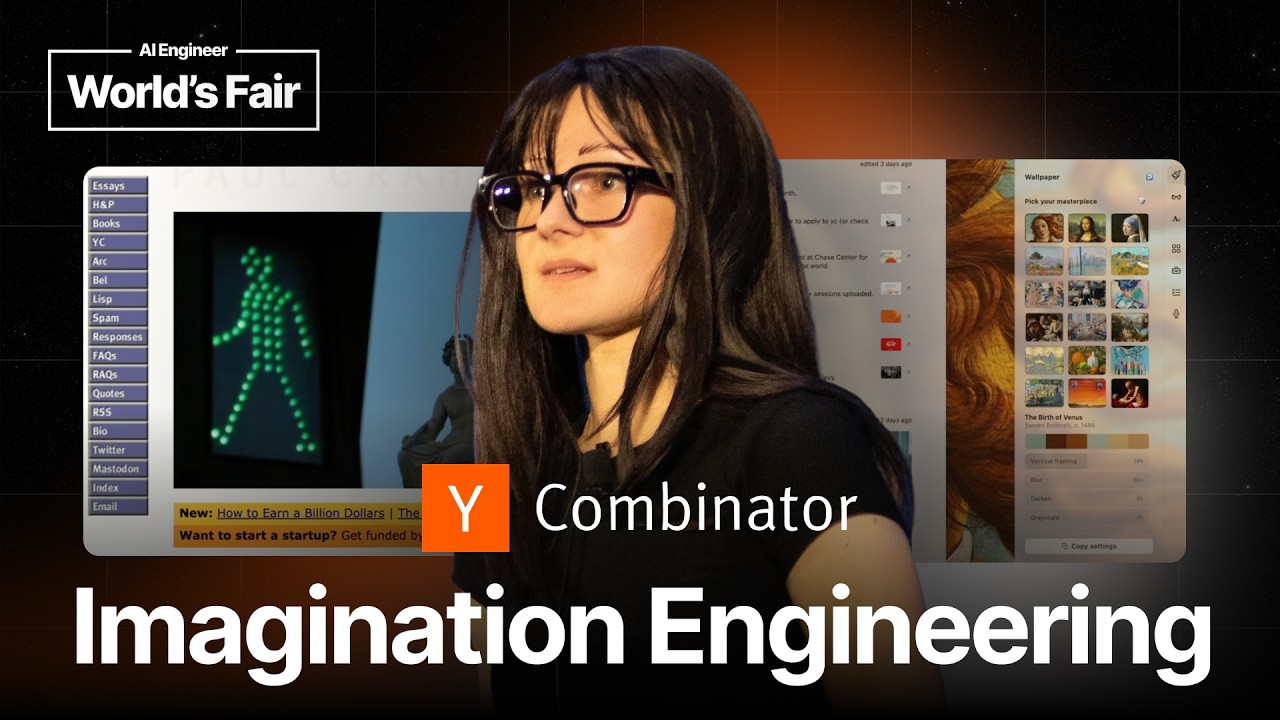
As AI models make software easier to produce, Eve Bouffard thinks the scarce human skill will be inventing unusual ideas.
2
Sharing a stream of consciousness in public lets AI turn raw thoughts into a personal website, design system, voice file, and project backlog.
3
AI tools can create small, personal software on demand, from a visual map of historical thinkers to an emoji picker and short research reports.
Summary
Eve Bouffard argues that increasingly capable AI models will make execution much easier, so people should spend more effort stretching their imagination and inventing things that do not yet seem possible. She connects this idea to the Library of Alexandria and to Paul Graham's habit of thinking in public. Her own experiment, an Eve Thoughts Slack channel, captured a week of unfiltered ideas that an AI model turned into a personal website. She then demonstrates software made for immediate needs, including Shape of Minds, a visual tool for comparing historical figures, and a custom emoji picker. She also uses models to produce short reports on subjects such as design principles and Renaissance patronage. The talk is an enthusiastic account of personal software made from loose thoughts, with examples of how AI can turn attention, curiosity, and unfinished ideas into working artifacts.
The human bottleneck is moving toward unusual ideas
Eve Bouffard says recent models are becoming capable enough that people will soon be able to one-shot almost anything. Her concern is that execution will become easy while coming up with "crazy ideas" becomes the harder part. She wants people to stretch their minds and invent things that currently seem impossible. She frames this as a period like the Library of Alexandria, when people should consolidate existing knowledge and create more knowledge for humanity. Her prompt for the audience comes from Paul Graham: "live in the future and then build what's missing." The point is to notice what a future-oriented life would require, then make the missing tools or experiences.
Thinking in public turns private thoughts into shared material
Eve describes an experiment based on a Slack channel created by Lewis at Conductor, called Lewis Thoughts. Lewis posts his stream of consciousness, including thoughts about features and ways to improve the product, so colleagues can see how he thinks. Eve created Eve Thoughts in the YC Slack and spent a week brain-dumping everything that crossed her mind. She then asked Opus 4.8 to make a website from those notes. She compares this with Paul Graham's public essays and calls it "thinking in public," giving trusted YC colleagues access to her ongoing thoughts. The experiment feels slightly science-fictional to her, but she wanted to see what would happen.
An AI-generated personal website can organize a person's mental output
The website generated from Eve's Slack posts collected many parts of her life and work. It noticed that she loves art and let her customize the background. It gathered admired quotes, YC projects, media appearances, daily tools, books that changed her life, books she wants to read, and trains of thought. The site supports dark mode, font and typeface controls, width controls, and translation into other languages. Eve also asked AI to create a voice.md file from her online writing, including tweets, and distill her tone into a reusable description. A design-language file updates when she changes the site or adds a component. She also made skills that she can invoke when needed.
Design work becomes a system of adjustable, reusable components
Eve shows how AI connected her personal interests to the site's design. She used Paper's sheeters as a design tool and applied them to the background, with controls for changing the result. She predicts that future design work will involve many sliders. For the broader project, she asked Fable 5 to extract butterflies from its campaign and turn them into individual components. She also built a dashboard describing the website's stack, an early design system to keep the interface consistent, and a checklist to track whether the project was complete. Claude generated items such as an Open Graph image. A glossary in Markdown records the displayed information in a form agents can read more efficiently than the page itself.
Shape of Minds is software made from a question about great thinkers
Eve's main demonstration is Shape of Minds, a tool she built in a morning with Opus 4.8. It explores commonalities across historical figures by comparing dimensions such as thinking, obsessions, quirks, origins, routines, output, work habits, love interests, worldview, religion, habits, and knowledge. The interface is responsive: hovering over a figure explains what makes that person distinctive in a dimension. Eve shows Bach as an example and points out patterns such as many German figures in the set. She asks Fable 5 to summarize the most interesting commonalities. The generated highlights include a tendency to argue, childlessness among many figures, and the popularity of naps. She presents the project as an exploratory tool rather than a finished theory.
Software on demand lets personal annoyances become small tools
Eve says people should ask an agent to make software whenever a stream of consciousness suggests a tool. She gives the example of an emoji picker for Slack. She likes using emojis to make people smile, but found the standard Slack and iOS pickers inefficient when she wanted a particular reaction. She built a custom picker that searches for fun Slack emojis and copies the selected emoji with one click. The tool exists because a small personal frustration was worth fixing immediately. Her broader claim is that people do not need to wait for a product team or a large project to make this kind of software. They can describe the need and ask an AI model to build it.
AI reports let people study subjects in the gaps of an ordinary day
Eve describes everyone as a student of life and says new models let people learn at a pace that was previously impossible. When she has a thought about a subject she wants to understand, she asks a model to prepare a short report. She has used this approach for the ten principles of good design and Renaissance patronage. The reports are brief enough to read while traveling to work, returning from an event, or moving between other activities. She connects this habit to Cloud Workspaces and Conductor Cloud, which she expects will let her start multiple agents while traveling. The model becomes a way to follow curiosity as soon as it appears, without waiting for a dedicated study session.
Development logs can record how an AI-built project changes
Near the end, Eve shows a backlog of changes made while she was finishing Shape of Minds and adjusting the website. The log records the evolution of the repository over time, including tweaks made shortly before the talk. This extends her thinking-in-public experiment from raw thoughts to the construction process itself. The project contains its own stack description, design-system notes, voice and design files, checklist, glossary, and change history. Eve treats all of this as an experiment and asks the audience how they are experimenting with models. Her closing position is practical: keep turning thoughts into artifacts, then preserve enough of the process to see how the work developed.
"I think that the new bottleneck will be to come up with like crazy ideas because it's going to be really easy to one-shot absolutely everything and anything very soon."00:32
Who should watch
You are already using AI coding tools but mostly for conventional product work, and want examples of smaller tools you can make for yourself.
You keep notes, ideas, or research questions that rarely become projects. Eve's Eve Thoughts experiment shows one way to turn that material into a working site.
You work on design, research, or internal tools and want to see how AI can produce reusable project documentation alongside the interface.