Infinibranch lets agents snapshot, branch, replicate, and reverse virtual-machine environments so they can explore actions without permanently committing to mistakes.
2
Morph Liquid Metal adds container runtime support, millisecond branching, autoscaling, and planned GPU support to Morph's cloud infrastructure.
3
Morph is building reasoning systems that branch environments and subagents, use verifiers, and produce outputs checked through formal methods.
Summary
Jesse Han argues that agents will need a different kind of cloud infrastructure because they will act, reason, and search at much higher speed than humans. Morph's Infinibranch virtualizes storage, networking, and compute so agents can snapshot environments, branch them, run parallel attempts, and restore useful states. Han presents this as a way to make irreversible computer actions reversible and to support test-time search against verifiers. He then describes reasoning-time branching, where an agent delegates parts of a problem to subagents running in branched copies of the same environment. A chess example shows how this can expand the search space and find a move faster. The talk then moves toward verified superintelligence, combining long-running reasoning, external software, formal verification, and a computational language for checking outputs. Han announces Christian Seed as Morph's chief scientist and Magi 1, a model planned to use Infinibranch for verified reasoning.
Thinking machines need environments that can keep up with their speed
Han frames advanced AI as a new kind of being that may develop intelligence, reasoning ability, and personhood. He uses Einstein's thought experiment about racing a beam of light to describe the isolation of a machine that thinks much faster than the world around it. If interaction with external systems is slow, the machine cannot fully act on its thoughts. Han says such systems need an embodied world that can react at comparable speed and offer many possible paths. This leads to Morph's focus on cloud infrastructure that lets agents interact with complex software environments with very low latency.
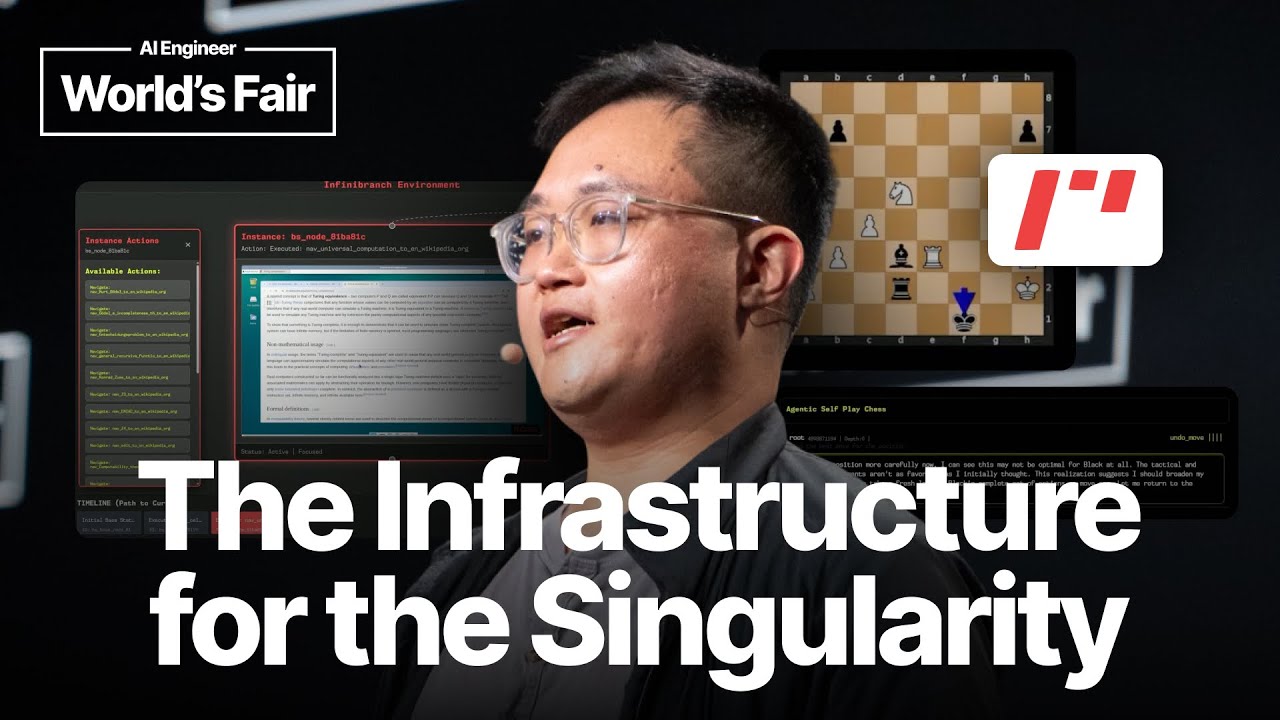
Infinibranch is presented as virtualization, storage, and networking technology designed for agent workloads. It can run whole virtual machines in the cloud, then snapshot, branch, and replicate them in a fraction of a second. An agent can navigate a browser, click links, try an action, and backtrack if the result is poor. It can also take many actions in parallel to explore possible outcomes. Han describes this as giving the machine a form of grace because mistakes no longer have to permanently determine what happens next.
Morph Liquid Metal moves branching into millisecond workflows
Han announces Morph Liquid Metal as a new version of the infrastructure. He says it improves performance, latency, and storage efficiency by another order of magnitude. It includes first-class container runtime support, branching in milliseconds rather than seconds, and autoscaling from zero to infinity. GPU support is planned for Q4 2025. The broader goal is a cloud substrate for agents, where workspaces can be declared in advance, started and stopped without friction, and passed between people, agents, and other agents.
Snapshots let agents search across durable parallel workflows
Morph's snapshot model supports test-time search against verification conditions. Han compares its layered side effects to Docker layer caching and calls the approach "git for compute." A workspace can be prepared from a snapshot, then handed to many parallel agents through a durable workflow. In his example, agents try different ways to start a server on port 8000. One fails and another succeeds, after which the successful result can move to a later stage. The same snapshot can be stored, replicated, rehydrated, and reused with little overhead.
Han shows a chess agent that uses tool calls during reasoning and a restricted chess engine as a verifier. Ordinary tool use already lets the agent reason about positions, but the agent can get stuck in a local minimum. Reasoning-time branching adds the ability to copy the environment, delegate parts of the problem to subagents, and explore multiple continuations in parallel. The subagents return results to the main agent, which recombines them to select a move. Han says the approach can launch a multi-agent swarm and find a correct solution in less wall-clock time.
Infrastructure limits the use of branching for reinforcement learning
Han says this style of reasoning has not been widely explored because the infrastructure is difficult to build. Branching environments must support large-scale reinforcement learning, high-throughput interaction, and coordination among multiple agents. Morph's claim is that infrastructure improvements make these workloads possible. The environment needs to be copied and restored quickly, while agents must communicate results and compare them against a verifier. In this design, the cloud is part of the reasoning system rather than a place where an already-finished model merely runs.
Verified superintelligence would check its own outputs
Han connects the infrastructure work to alignment and language. He argues that existing natural language is insufficient for expressing what a superintelligent system should do, and that a new computational language needs algorithmic guarantees about correctness. Morph's proposed verified superintelligence would reason for long periods, interact with external software at high throughput, and use formal verification software to examine and improve its reasoning. Its outputs would be algorithmically checkable and expressible in a shared computational language.
Magi 1 is planned as a model built around branching and verification
Han announces Christian Seed as Morph's chief scientist and says Seed previously co-founded xAI and worked on code reasoning, BatchTorm, and adversarial examples. He describes Seed's work as combining verification methods, symbolic reasoning, and large language models. Han says Morph has begun developing Magi 1 from the ground up to use Infinibranch for reasoning-time branching and verified reasoning. The model is planned for Q1 2026 and is intended to operate inside a cloud environment designed for high-speed interaction.