Go-to-market requires both a good product and a way to get it into customers' hands, and engineers can now treat much of that work as an AI engineering problem.
2
Exa built a live data system around its market, customers, internal tools, and external web data so agents can research accounts and act on signals.
3
An agent-first company needs programmatic access to its data, while consistent interfaces and customizable purchased software still have an important place.
Summary
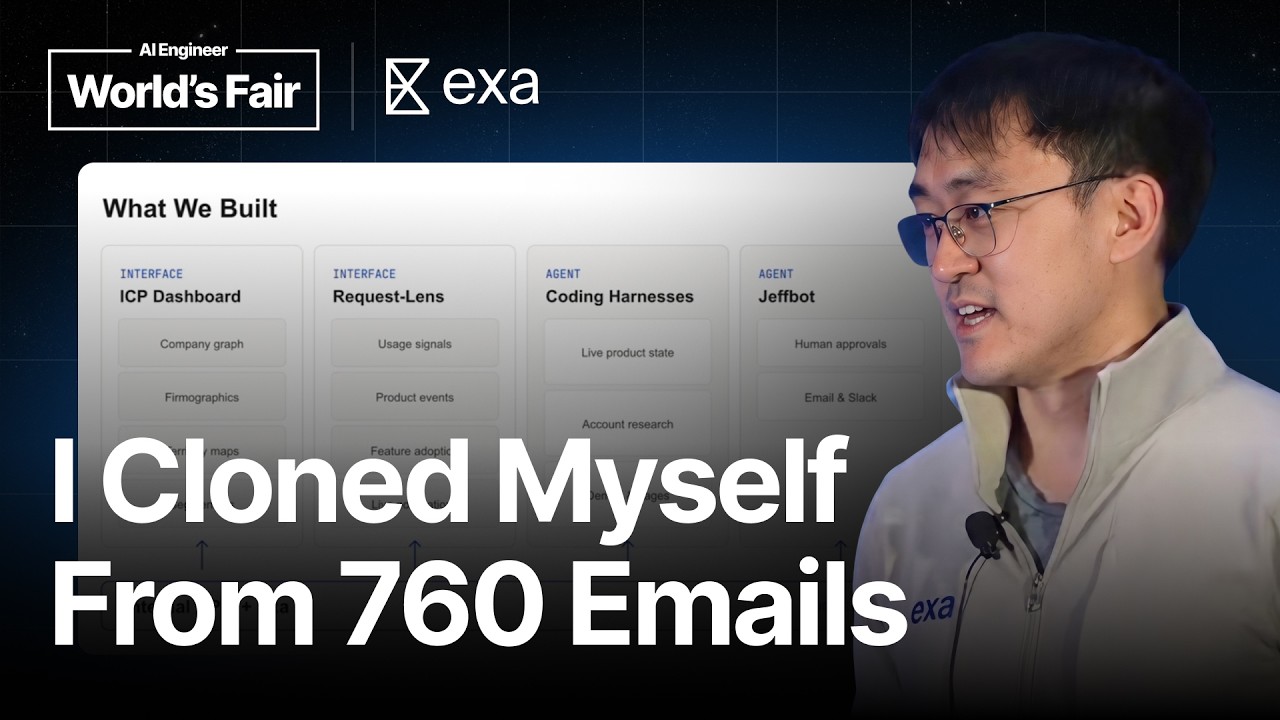
Jeffrey Wang argues that go-to-market is an engineering problem because its work is mostly about collecting, organizing, and acting on data. Exa maintains a live model of its customers, prospects, product usage, and the wider web. Its ICP dashboard classifies nearly every company in its target market and attaches account data such as anticipated spend. Request Lens alerts the team when customer activity changes. Exa's go-to-market team also uses about a dozen agents in Slack, while Jeffbot drafts messages and decisions in Wang's style from his emails and past decisions. Wang's principles are practical: agent-first systems must be API-first, chatbots should not replace every stable interface, and buy versus build matters less than whether a system can be customized. The Q&A adds clear security limits around Jeffbot and describes forward-deployed engineers as people who support deals while building the tools that make that work easier.
Go-to-market needs product quality and distribution
Wang rejects the idea that a company can choose between product and distribution. A product has to be good, and it also has to reach customers. He describes the engineering bias as wanting to build the thing and make it "really really freaking good," while admitting that Exa was initially bad at marketing and sales. In 2026, he thinks engineers have a more direct way into go-to-market because AI can automate parts of the work. That makes research, sales support, and other go-to-market tasks feel closer to building systems than to traditional marketing.
Wang describes go-to-market work as a set of questions about customers and targets. Teams research prospects, find the right people, and build proofs of concept. The common thread is data. A company needs to understand both what its product can do and the much larger world of potential customers. Wang's proposal is to solve go-to-market from a data perspective, rather than treating each sales or marketing task as a separate manual process.
Agents need a live model of the company and its market
The system Wang wants is a live model of the world that agents can act on. That model includes internal data about customers, employees, and product use. It also includes external information about companies, people, news, and other events. He points out that the available world is large, with more than 60 million companies and more than a billion people on LinkedIn. Exa has approached its go-to-market system from an agent-first perspective since its launch in 2023, after GPT-4 made it possible to automate larger parts of the work.
The ICP dashboard classifies the addressable market
Exa's internal ICP dashboard answers the question of which customers and use cases matter. The team uses Exa to classify almost every company in its total addressable market. Categories include model providers, AI coding platforms such as Cursor, and go-to-market intelligence tools. Each company has metadata, and the team can open an account such as SpaceX to inspect the company and its anticipated annual spend. Wang explains the technical basis as embeddings over the internet, which allow semantic filtering and slicing across web data.
Request Lens alerts Exa when something significant happens with a customer. The signals include a new signup, a large increase in searches, a sudden drop in usage, or the appearance of a customer the team particularly cares about. Instead of waiting for someone to inspect every account, the system brings changes to the team's attention. The alert gives the go-to-market team an event it can investigate and act on.
Exa's go-to-market team works through agents in Slack
Exa's go-to-market team uses agents heavily, sometimes with very high spending on tools such as Devin. Account executives use agents to investigate accounts and build customer demos. The team has about a dozen agents inside Slack, and anyone on the team can use them. These agents have access to substantial internal data. Wang describes the team as lean and productive because agents help with account research, demos, and deeper customer work.
Jeffbot learns Wang's writing and decisions from company records
Wang built Jeffbot during a week off in Mexico while experimenting with Opus 4.5. He analyzed 760 emails to model his writing style, including an average of 18 words per email and his preference for signing off with "best" rather than "sincerely." He also examined hundreds of past decisions from Slack and email, turned them into evaluations, and calibrated the agent against them. Jeffbot has access to the systems Wang personally can access. Other employees use it to draft Slack messages, emails, answers, and decisions in his style.
Wang says an agent-first company must first make its data available through good APIs. This applies to the internal and external data used by both agents and graphical interfaces. Without programmatic access, agents cannot reach the information they need. He names MCP and CLI as examples of possible interfaces, while stressing that the specific format matters less than having a usable programmatic layer.
Stable interfaces and customizable software still matter
Wang does not think every workflow should become a chatbot. A generated interface can adapt to a question, but a consistent interface is useful when people return to the same task and learn how it works. He also calls buy versus build a false dichotomy. The important property is arbitrary customizability. Exa uses Salesforce as a database and benefits from decisions already made about sales workflows, while Salesforce MCP lets Exa's agents access and customize the system.
"I think there is something really nice about being able to visit the same consistent UX for the same use cases over time so that you can learn how to use some tool."11:36
Who should watch
Engineers at an early-stage company who are focused on building the product and need a concrete model for automating customer research and sales work.
Go-to-market leaders who want to connect account data, product signals, web data, and Slack-based agents into one working system.
Teams deciding whether to buy or build internal sales software and trying to set useful access and security boundaries for agents.