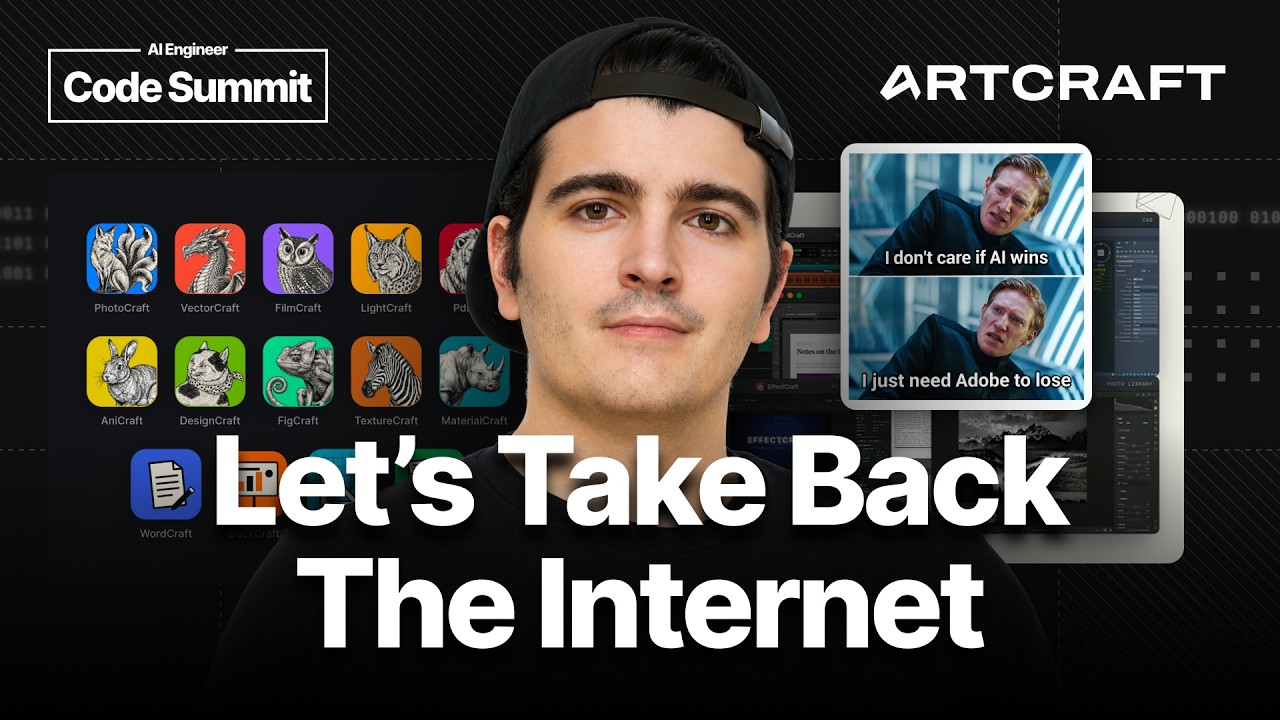
AI coding agents let ArtCraft build open source approximations of established creative and office applications.
2
Rust, native interfaces, MCP and CLI support allow these applications to run across operating systems and fit specific workflows.
3
Autocraft will automate issue triage, agentic development, evaluations and post-training while keeping humans focused on architectural decisions.
Summary
Brandon Thomas argues that software users have lost ownership as open protocols and customizable websites gave way to closed platforms, subscriptions and restricted APIs. ArtCraft is trying to reverse that change by building open source alternatives to Adobe tools, Microsoft Office, Figma and other applications. Thomas says a Photoshop approximation became functional within 24 hours of a large prompt, and the community has since expanded the project into hundreds of apps. The applications are built with Rust, native GUIs, MCP and CLI interfaces, with support for Linux, NetBSD, localization and collaborative infrastructure. Thomas is direct about the limits: the Photoshop replacement is still working toward full parity, and compile times and CI capacity are real problems. He proposes using agents with broad autonomy for relatively immutable desktop applications, while humans retain control over backend architecture and schema changes. Autocraft will package this process into an open source software factory.
Closed platforms replaced an open, programmable web
Thomas contrasts today's platforms with the web of the 1990s and early 2000s. IRC servers could be owned and automated, websites exposed APIs and data exports, and users could combine services such as Reddit, Flickr and Twitter. People bought MP3s and could customize sites such as MySpace with HTML and CSS. As broadband and smartphones brought more people online, protocols and platforms became easier to use but less open. APIs disappeared, distribution became controlled by large providers, and subscriptions replaced a stronger sense of ownership. Thomas uses Adobe's cancellation charge as an example of a product relationship that can become extractive for people who need software only occasionally.
Artists started coding their own workflows when the tools were open
ArtCraft began with professional creatives in mind, including filmmakers, rather than with a user-generated-content model. Its desktop applications kept generated files next to the editor on the user's machine. Thomas says his advisors doubted that artists would care about open source, but the team saw artists vibe coding workflows on top of the software. One example was a micro-drama production group handling $30,000 to $50,000 of fulfillment each month with a large team and no existing product that matched its process. People who knew Claude Code could use APIs to create their own interface. This led ArtCraft to test fully open source applications and infrastructure with its customers.
A large prompt produced a functional Photoshop approximation in 24 hours
ArtCraft started its Adobe work with Photoshop. Thomas says the team prompted an agent to build a photo-editing application, separate its UI and UX, make the tools MCP- and CLI-compatible, describe each tool's plan, and account for data structures and file-format importers. Within 24 hours, the result was a functional and familiar approximation. It was not complete Photoshop, and Thomas says the team had passed 60 percent parity after reaching 50 percent earlier. The immediate goal is to preserve the interface and muscle memory familiar to Adobe users. Later applications can have new, more agentic interfaces. ArtCraft also built versions of InDesign and Premiere.
Thomas says he did not expect the project to spread so quickly. After it appeared on Reddit, the New York Times requested an interview, and ArtCraft's Discord grew from 3,000 people to a larger community than those of several named AI products. He says artists who had pushed back against AI began using the applications, sending feature requests and bug reports. Their response gave the project more direction. Thomas wants these users to learn what MCP is and how agentic creation works, while reducing interfaces that he considers bloated. The aim is to give artists faster tools that fit their work rather than asking them to accept a fixed application surface.
The open source effort has expanded beyond creative software
ArtCraft has moved past Adobe-style applications into CAD, Flash, digital audio workstations, Microsoft Office applications, Google Docs and Figma. Thomas says the Figma work includes a server component and multi-user collaboration based on Raft and Paxos. The project also includes open infrastructure and data models. Engineers in the community are working on Solid Craft, which has an open engineering kernel and can support projects such as 3D printing through MCP. Thomas attributes much of the expansion to the community rather than to his own team. He says 300 applications are being developed by community members, with reusable UI and UX libraries being decomposed into components and primitives.
Rust and native applications make the cross-platform approach possible
Thomas credits Rust with helping the project build high-quality creative applications outside Electron. He says the language starts quickly, supports multiple operating systems, can deploy to the web through WebAssembly, and works on platforms including NetBSD and tablets. Team members do not all need prior Rust experience because their agents can drive the language. The main drawback he names is compile time. The project has also encountered permissions, GitHub scaling and CI problems. Thomas says CI was falling over as the community grew, so the team began setting up its own infrastructure and found co-located servers as a source of RAM. The technical choice is tied to the goal of shipping native applications across platforms.
Agents can run desktop development with less human supervision
Thomas separates work that needs human direction from work that can be delegated. Humans should handle backend tasks such as schema migrations and API design. Desktop applications, games and other largely immutable projects can be given to agents with much wider autonomy. He describes a community member using 40 machines to rebuild Unreal Engine in Rust, without requiring constant manual intervention. Autocraft is intended to package this approach as an open source autonomous software factory. It will ingest and triage issues, perform agentic development, and post-train models on the decisions made during the process. Those decisions will also provide data for evaluations and decision-tree training.
"Autocraft is a completely autonomous software factory that we're going to open source."18:05
Who should watch
You are building desktop or creative software and want to understand why Thomas chose Rust, native GUIs, MCP and CLI support.
Your team is exploring coding agents for application development and needs a boundary between tasks agents can run independently and backend decisions that need human review.
You care about open source alternatives to subscription software, especially on Linux or other platforms that commercial vendors have underserved.