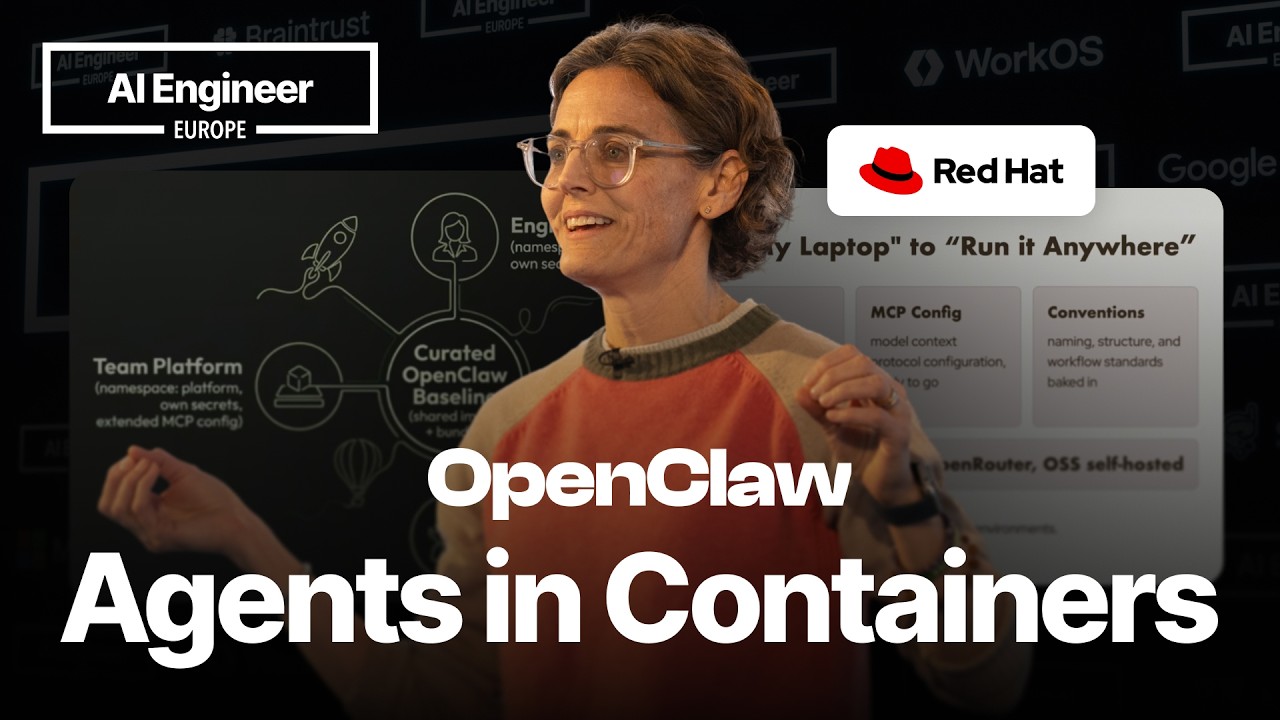
Containerizing OpenClaw gives Sally Ann O'Malley a reproducible setup that can move from a laptop to Kubernetes without rebuilding the agent environment.
2
Podman secrets and OpenClaw secret refs keep API keys outside the container configuration, while volumes and Kubernetes PVCs hold runtime state for backup and recovery.
3
A container image can become a team's approved OpenClaw baseline, with company MCP servers, skills, authentication, and access to work systems ready for new hires.
Summary
Sally Ann O'Malley explains why she runs OpenClaw in containers instead of installing it directly on her computer. A container gives her a predictable environment, isolates access and secrets, and lets the same setup run locally, on OpenShift, or in Kubernetes. Her setup uses Podman secrets for API keys, OpenClaw secret refs inside the agent, and volumes for persistent state and recovery. She also describes a workplace model where a curated OpenClaw image contains approved MCP servers, authentication, team skills, and access to systems such as Google Drive. New hires could start from that baseline and then personalize it. The talk includes a live Podman demo with provider selection, an optional OpenTelemetry and Jaeger setup, an SSH sandbox, and a second OpenClaw instance. O'Malley then shows that the same approach works with Kubernetes and OpenShift. She cites an Nvidia team running ten OpenClaws for model evaluations, which freed engineers to spend more time on other work.
O'Malley treats containerized execution as the normal way to run OpenClaw
O'Malley says native installs feel messy because they leave files and dependencies on her computer. She prefers containers because the environment is clean, predictable, and isolated from operating-system quirks and stale dependencies. OpenClaw can run on her laptop, on x86 hardware, on a Mac, or in Kubernetes from the same general setup. The container also creates a sandbox: access from the host has to be granted explicitly. She backs up her own persistent OpenClaw every night and uses the container boundary to keep the runtime separate from the host.
A container can package an agent's tools and configuration as one portable unit
O'Malley keeps an agent directory containing tools, skills, and MCP servers, then mounts the whole directory into the container. That means the pieces are available when the agent starts instead of being installed manually each time. Her example uses a personal OpenClaw called Shubra with two sub-agents, Joy for Jyotish astrology readings and Bruno for daily Boston Bruins briefings. The examples are personal, but the same packaging approach can apply to work agents with a defined set of tools and skills.
Two layers of secret references keep API keys out of ordinary container settings
O'Malley's local setup uses Podman rather than Docker and stores API keys as Podman secrets. The container receives a reference to the secret instead of an exposed environment value. OpenClaw adds a second layer through its own secret-ref feature, so the agent configuration points to the outside secret. She uses the same pattern with Kubernetes secrets, where an environment value can also come from a secret reference. O'Malley is clear that this is not perfect, but says it gives her more confidence that keys will not appear in logs or ordinary configuration.
Kubernetes lets the same local agent pattern run across many workloads
O'Malley expects AI workloads to run in many places and communicate with each other, especially for business use. Her normal workflow is to develop locally and then lift the result to Kubernetes. She says Kubernetes supplies the security and operational model needed to run these applications at scale. The container image stays the same while the execution environment changes. In the demo, she later accesses an OpenClaw running in a kind cluster and another running in OpenShift.
An Nvidia team uses separate Kubernetes OpenClaws for model evaluations
O'Malley cites a friend at Nvidia who told her that a team of about ten engineers runs individual OpenClaws in Kubernetes. The agents periodically check in on model evaluations. According to the account she shares, the setup did work that previously took six engineers. O'Malley says the result gives the team more time for creative and unusual work rather than removing everyone from the process. She connects this example to her own change in practice: she has started using AI to write code because she considers it much better at that task than she is.
Volumes make the agent's runtime state easier to preserve and restore
O'Malley keeps her runtime state in a contained Podman volume. She describes this as a clean backup and recovery story because the state remains separate from the container image itself. On Kubernetes, the corresponding mechanism is a persistent volume claim, or PVC. This separation allows the image to be replaced or redeployed while the agent's data remains available. It also fits her practice of backing up her personal OpenClaw regularly.
A curated OpenClaw image could give each team a shared starting point
O'Malley imagines a workplace OpenClaw baseline that includes company-approved MCP servers, approved authentication, team-specific skills, and access to systems such as Google Drive. The image could be distributed to a whole team, then personalized by each person. That replaces the current onboarding pattern where a new hire sits with someone, finds a repository, and assembles the setup by hand. In her view, the container approach supports shared team standards, portable environments, and reproducible onboarding.
The local installer turns provider, secret, and sandbox choices into a short Podman command
In the demo, O'Malley runs a local installer and gives the instance a name. She changes the default port because another instance is already running. The installer maps existing Podman secrets and can turn environment values into OpenClaw secret refs. She selects OpenRouter with Gemma as the starting provider and Anthropic as a fallback, while also showing that a local model endpoint can be configured. An optional OpenTelemetry collector with Jaeger is available. She then enables an SSH sandbox, which runs commands in a chosen workspace using supplied SSH keys and known hosts.