Open models are easier to trust because their weights, code, data, and training methods can be inspected and validated.
2
Post-training an open model for a specific harness or business task can produce better results at lower cost than a general frontier model.
3
Owning an open model also lets a company keep its usage traces, train on its outputs where the license permits it, and build a data flywheel.
Summary
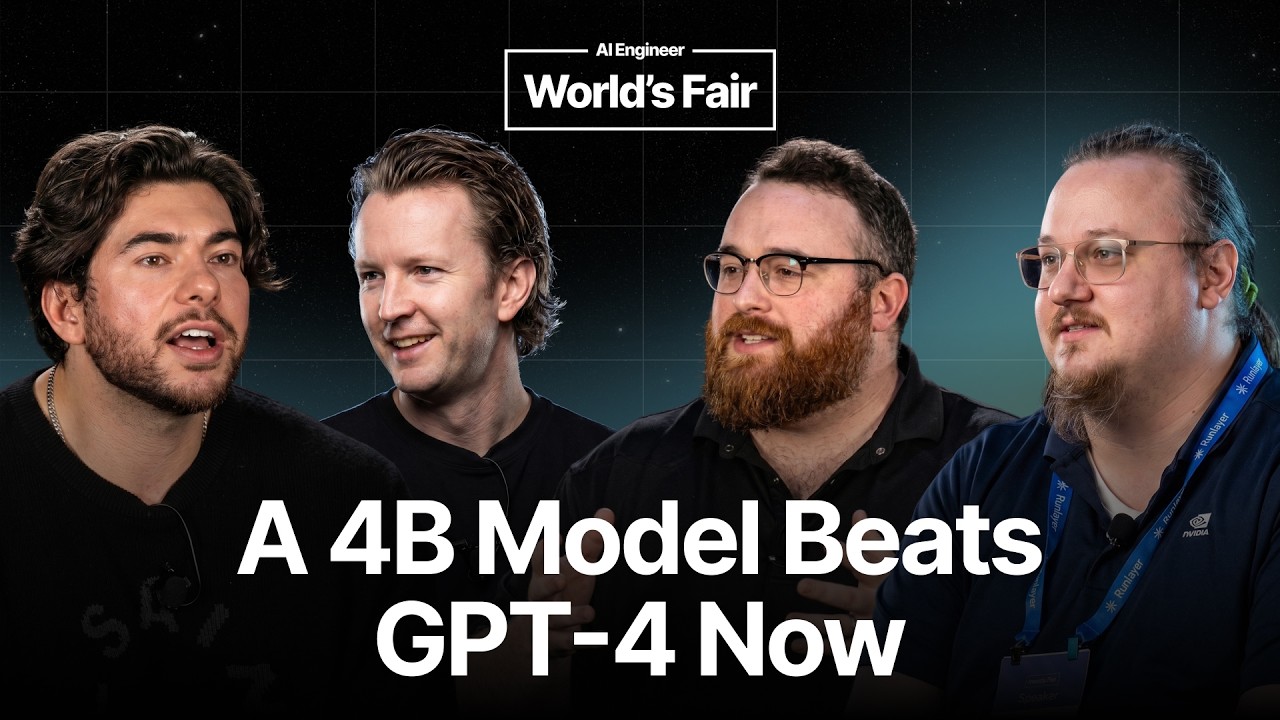
This panel argues that local and open models give builders control over more than model weights. Lucas Atkins defines trust as knowing what you are running and having confidence that it will behave as expected. Open models expose files, code, and data information that closed APIs cannot make fully verifiable. Vincent Weisser focuses on control through the training stack, especially post-training and reinforcement learning for specialized agents. A model tuned for a particular harness can outperform a general model on that task while costing less to run. The panel also connects ownership to data. Open models let teams retain interaction traces and use them to improve future systems, subject to the license. The speakers do not dismiss closed models. They expect both approaches to remain useful, with local models becoming more capable as hardware improves. Their predictions include capable models running on laptops, specialized agents for knowledge work, and agent-oriented computer operating systems.
Lucas Atkins separates trust from safety. He argues that open models let users inspect the files and matrices inside the model, read the code that runs it, and compare implementations such as Prime RL, vLLM, and SGLang. A closed API offers no equivalent way to verify what happens after a request is sent. Safety still requires judgment and safeguards because model outputs are random systems. For Atkins, trust means knowing what is running and being as sure as possible that an input will produce the expected kind of output. He says the strongest assurance currently comes from running an open model yourself or working with a partner that validates it.
Atkins says enterprises moved toward Chinese open models after Anthropic had to put Fable away and access to frontier systems no longer looked universal. The reason was not necessarily higher benchmark performance. Companies could trust that the models would remain available. He uses this example to define trust in practical terms: a business needs confidence that its model will continue to exist, that its behavior can be checked, and that access will not depend entirely on another provider's decisions. He also says Western companies were losing leadership in open models, which led Arcee AI to reorganize around building permissive models that customers could own, customize, and run wherever they wanted.
The open stack has to include training and post-training
Vincent Weisser says open access must cover the full path from pretraining through mid-training and post-training. Prime Intellect built infrastructure around reinforcement learning, environments, and evaluations because post-training is an economically accessible way to customize an existing model. The goal is to let enterprises take models such as Trinity or Nemotron and specialize them for their own agents. Weisser describes customers automating finance work in a week or two after specializing an open model. He says the result was better performance than Opus at a fraction of Haiku's cost. The practical advice is to start with a strong open model, then post-train it for the harness and use case that matter.
A specialized model can beat a general model on its own task
The panel rejects the assumption that choosing an open model always means accepting weaker performance. Weisser says a company can build a reinforcement-learning environment for a particular task, deploy the agent to users, and improve it from production traces. A financial agent, for example, has a better chance of reaching high autonomy when it is trained and deployed in a banking context than when it remains a general chatbot. This approach creates a feedback loop: real usage supplies traces, traces improve the environment and model, and the improved agent returns to production. The same pattern can apply to computer-use systems and other specialized knowledge-work domains.
Open weights prevent the model from becoming a mismanaged genius
Chris Alexiuk says the strongest AI products combine the model, harness, and product instead of treating the model as a universal endpoint. He points to Deep Research as an example of a product shaped by reinforcement learning and test-time compute for longer research tasks. A general model is designed to perform across many harnesses, but a builder usually uses one harness for one product. Open weights allow that builder to post-train the model for the tools and environment it actually uses. Alexiuk calls the unused capability in a model that has not been fitted to its harness a 'mismanaged genius.' He says open models make deeper customization possible than changing prompts or skills alone.
The panel connects model ownership to control over generated data. Lucas Atkins says closed providers' terms of service restrict training on outputs from systems such as Claude, Fable, or GPT-5. With an open model, a company can save the traces produced inside its own harness. Those traces can support fine-tuning a smaller model or help identify signals for new verifiers and reinforcement-learning environments. This gives builders a path toward continuous improvement based on their own users and tasks. Chris Alexiuk adds that NVIDIA releases datasets and environments with its models, including information about the token sources used in training. The Open MDW model data weights license is intended to make permission to train on model outputs explicit.
Alexiuk argues that local models become faster and more capable through contributions from builders working in the open. He compares this to Linux, whose efficiency comes from sustained work by people optimizing systems under real resource constraints. NVIDIA's Nemotron work follows the principle that 'faster models are smarter models,' with attention to hardware outside large data centers. The other speakers connect openness to lower training and inference costs because the ecosystem can optimize models and runtimes together. The panel still expects closed frontier systems to remain useful for easy consumer tasks and some demanding applications. Its claim is that engineers need another layer beneath those APIs, where they can control cost, deployment, and specialization.
"The only way currently to be 100% sure that what you are getting is what you were expecting is by hitting an open model either that you are running yourselves or you're working with a partner like Prime Intellect or Arcee AI or NVIDIA to validate."09:57
Who should watch
You are building an AI product and need predictable inference costs, control over deployment, or a model tuned to one harness.
Your team wants to keep interaction traces and use them to improve a specialized agent over time.
You are deciding how local models fit alongside closed APIs for enterprise or consumer applications.