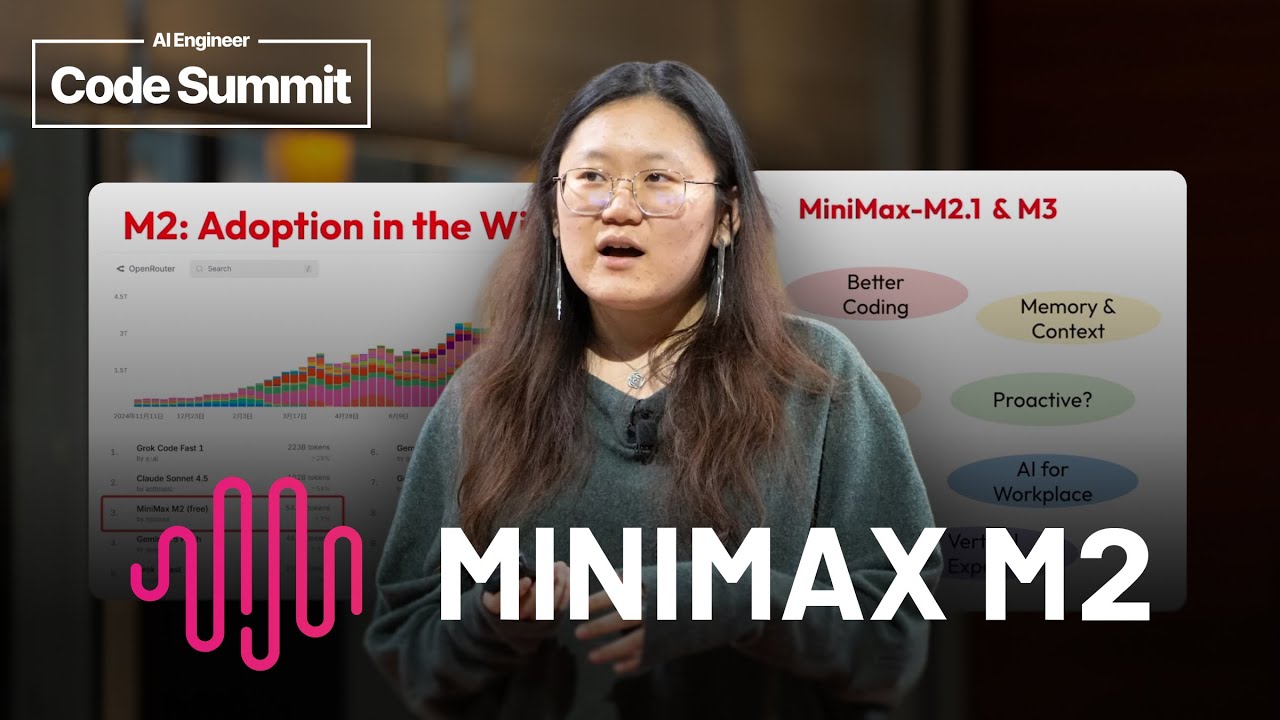
MiniMax M2 is a 10-billion-active-parameter open-weight model built for coding and workplace agent tasks.
2
MiniMax trains M2 with real coding environments, reinforcement learning, and feedback from expert developers who define and evaluate useful behavior.
3
M2 uses interleaved thinking between tool calls, perturbation pipelines for scaffold generalization, and its small size to support parallel agents.
Summary
Olive Song presents MiniMax M2, an open-weight model with 10 billion active parameters designed for coding and workplace agent tasks. She explains how MiniMax uses real coding environments, reinforcement learning, and feedback from in-house expert developers to shape the model's behavior. M2 is trained to work across programming languages and full-stack workflows, while interleaved thinking lets it reason again after tool responses instead of stopping after one tool call. Song also describes perturbations across prompts, chat templates, tools, environments, and responses to help the model adapt to different agent scaffolds. Its small size and lower cost make it suitable for running multiple copies in parallel, such as agents that research, write reports, and build front-end presentations. Future work includes better coding, memory, context management, proactive workplace AI, vertical experts, and possible integration with MiniMax's audio and video models.
M2 is a small open-weight model built for coding and workplace agents
MiniMax M2 has 10 billion active parameters and was designed specifically for coding and workplace agentic tasks. Song describes it as cost-efficient and says it ranked highly on intelligence and agent benchmarks. She also points to early community use: during its first week, M2 had the most downloads and reached the top three in token usage on OpenRouter. Her argument is that benchmark scores alone do not show whether a model works inside a real development environment, so MiniMax watched how people actually used it.
Real coding environments and expert developers shape the model
MiniMax scales the number of coding environments used during reinforcement learning so M2 can react to environments and pursue verifiable coding goals. The company also scales expert developers as reward models. In-house developers help define problems, fix bugs, refactor repositories, and identify behaviors that developers trust. They provide feedback and evaluations on the model's final deliverables. Song connects this process to M2's ability to work across many programming languages and full-stack workflows.
Interleaved thinking lets M2 recover from noisy tool interactions
Long-horizon tasks often require several tools and repeated interaction with a changing environment. Song says a standard tool-using reasoning model may think once, call tools, receive responses, and then produce a final answer. M2 instead thinks between tool calls. After receiving feedback, it can decide whether the information is sufficient, use another tool, or take a different action. Song says this process can involve tens to 100 turns within one user interaction, which helps with tool errors, unexpected results, and other environmental noise.
M2 can run workflows across several tools with little human intervention
The interleaved approach is intended for workflows that span tools such as Gmail, Notion, and a terminal. M2 can continue acting after each response instead of requiring a person to restart the process. Song presents a stock-market example in which the model remained stable amid perturbations, new information, and different trading policies. The broader claim is that repeated observation and action help M2 handle long-running tasks in environments that are not stable.
Agent generalization requires perturbing the whole operating setup
MiniMax initially treated agent generalization as a tool-scaling problem: train with enough tools and the model should handle unseen ones. Song says this worked at first, but changing the agent scaffold exposed failures. The team therefore perturbs multiple parts of the operational space during data preparation, including tool information, system prompts, user prompts, chat templates, environments, and tool responses. The goal is for M2 to adapt when the surrounding scaffold changes, rather than only when the tool list changes.
M2's low cost makes parallel agent systems more practical
Song describes a MiniMax agent application running several copies of M2 in parallel. One copy can research, another can write the results into a report, and another can create a front-end illustration. Because M2 is small and cost-effective, MiniMax can use it for long-running tasks that need parallelism. This is the main connection Song makes between the model's architecture and multi-agent applications: lower inference cost allows more agent instances to work together.
Future versions will focus on memory, context, and workplace use
For M2.1 and M3, Song names better coding, memory, context management, proactive workplace AI, and vertical experts. She also mentions the possibility of combining M2 with MiniMax's audio and video generation models. MiniMax plans to bring these resources together and asks the community for feedback. The talk ends with an invitation to try the model and the MiniMax agent application.
"Instead of just stopping after one round of tool calling, it actually thinks again and reacts to the environments to see if the information is enough for it to get what it wants."07:13
Who should watch
You are evaluating open models for coding agents and want details on how MiniMax trains for real development workflows.
Your agent breaks when tools, prompts, or scaffolds change, and you want to understand MiniMax's perturbation approach.
You are considering multi-agent systems and need a smaller model that can run several task-specific copies in parallel.