AI products need pricing that can keep up with changing model costs, product capabilities, and customer adoption.
2
Teams should choose a value metric that fits the product, from tokens and tasks to measurable outcomes.
3
Pricing simulations can test revenue and customer impact before a new model reaches the market.
Summary
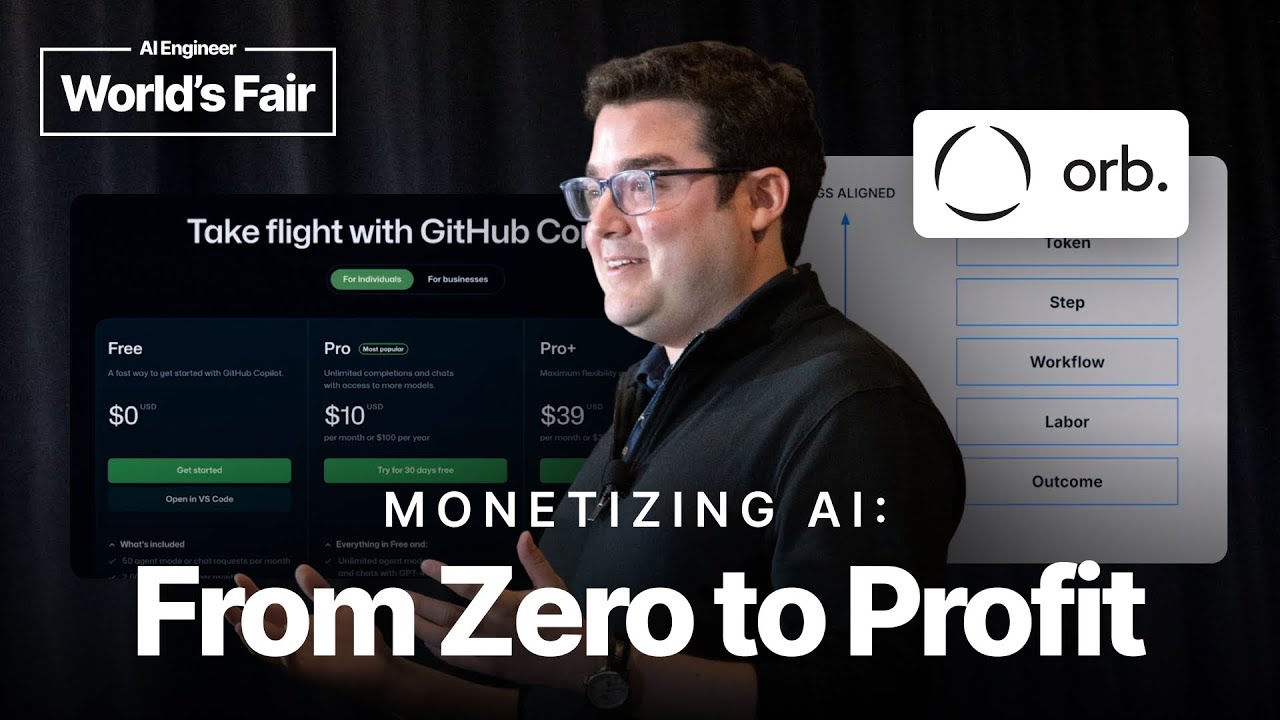
Alvaro Morales argues that AI companies cannot treat pricing as an afterthought. Model and inference costs can change quickly, customer adoption can be hard to predict, and buyers want to understand the return they get from AI products. He presents three decisions: whether AI should be monetized directly or indirectly, which value metric should determine the price, and how often the pricing should be tested and revised. His examples range from GitHub Copilot's add-on model to Expedia offering an AI travel feature for free to encourage bookings. He also compares token, task, workflow, labor-replacement, and outcome-based pricing. The talk ends with a demo of Orb Simulations, which uses historical usage data to compare pricing scenarios, revenue, customer-level changes, and revenue mix before launch.
AI pricing is difficult because costs and product value change quickly
Alvaro Morales gives three reasons AI pricing is unusually difficult. Model and inference costs, product capabilities, and new launches change quickly, so pricing teams struggle to keep up. AI also puts pressure on margins and cost of goods sold because bills from providers such as Anthropic and OpenAI can be significant. Customers add another constraint because they want to understand the return they receive from the technology. Unexpected adoption can make the problem worse. Morales points to ChatGPT Pro at $200 as an example that reportedly became a loss driver.
AI can be monetized directly or used to drive another business outcome
Morales uses a framework from Simon-Kucher to decide whether an AI feature should be charged for directly. A company can sell it as a standalone product or add-on, as GitHub does with GitHub Copilot. It can also bundle AI into a higher tier, as Notion did with Notion AI after first selling it as an add-on. A third option is indirect monetization. Expedia released an AI feature that turns Instagram reels into bookable trips without charging for the feature, accepting the serving and inference costs in the hope that it generates more travel bookings.
The price metric should track the value customers receive from the product
AI agents change the unit people use to judge software. A login or seat may be less meaningful when an agent performs work or delivers an outcome. Morales describes a spectrum that starts with resource-based or token-based pricing, moves through proxies such as workflow steps and tasks, and reaches labor replacement or outcome-based pricing. Vercel's v0 uses tokens, while Zapier charges for tasks in an automation. These metrics are easier to count than outcomes, but they may be less directly tied to the customer's return.
Outcome-based pricing is attractive but hard to measure outside clear support cases
Intercom's Fin charges 99 cents for a successfully resolved customer support ticket. The customer can indicate that the answer resolved the question, and the company can see whether the interaction escalated to a human. Morales says this makes the outcome relatively clear. Other uses are harder because the customer and vendor must agree on the outcome and measure it objectively. He sees outcome pricing as appealing because it charges for the return itself, while also saying that examples outside customer support are still limited.
AI pricing needs frequent experiments because model costs can move sharply
Traditional SaaS companies could sometimes launch with a guessed price and revisit it years later. Morales says that approach no longer fits AI products. A new model release can reduce or increase costs by ten times overnight, so a one-, two-, or three-year pricing cycle is too slow. The teams he considers strongest build a habit of testing and evolving their pricing. That work includes the price point, feature packages, tiers, rate limits, volumes, custom terms, and the way the offer is explained to customers.
Orb Simulations compares pricing ideas against real usage data before launch
Orb connected its billing product to a real-time stream of product usage events. Customers began using that data to create pricing structures during closed betas without yet billing users, so Orb built Simulations around the workflow. A team can choose a time period and customer cohort, then compare scenarios such as a fixed $20 AI-agent fee, token charges, or tiered token pricing. The product back-tests those scenarios against usage data rather than relying on a guess.
A pricing simulation shows revenue impact and changes for individual customers
Orb's simulation report compares the topline revenue produced by different pricing scenarios. It also shows the average change for existing customers, which matters when customers already pay under an earlier model. The report includes the expected revenue mix, a scatter plot relating percentage change to revenue impact, and an exportable dataset with the impact on each customer. Morales's recommendation is to simulate first, so a team can understand the likely effect on its customer base before it launches.
"Nowadays with AI when new model drops can reduce cost by 10x or increase cost by 10x literally overnight, this one, two, three-year cycle of pricing iteration just doesn't cut it anymore."10:06
Who should watch
You are launching an AI feature and have not decided whether to charge for it, bundle it, or use it to drive another product's adoption.
Your product has usage or inference costs that can change faster than your current pricing process can respond.
You need to test a new pricing model against existing customer usage before committing to a public launch.