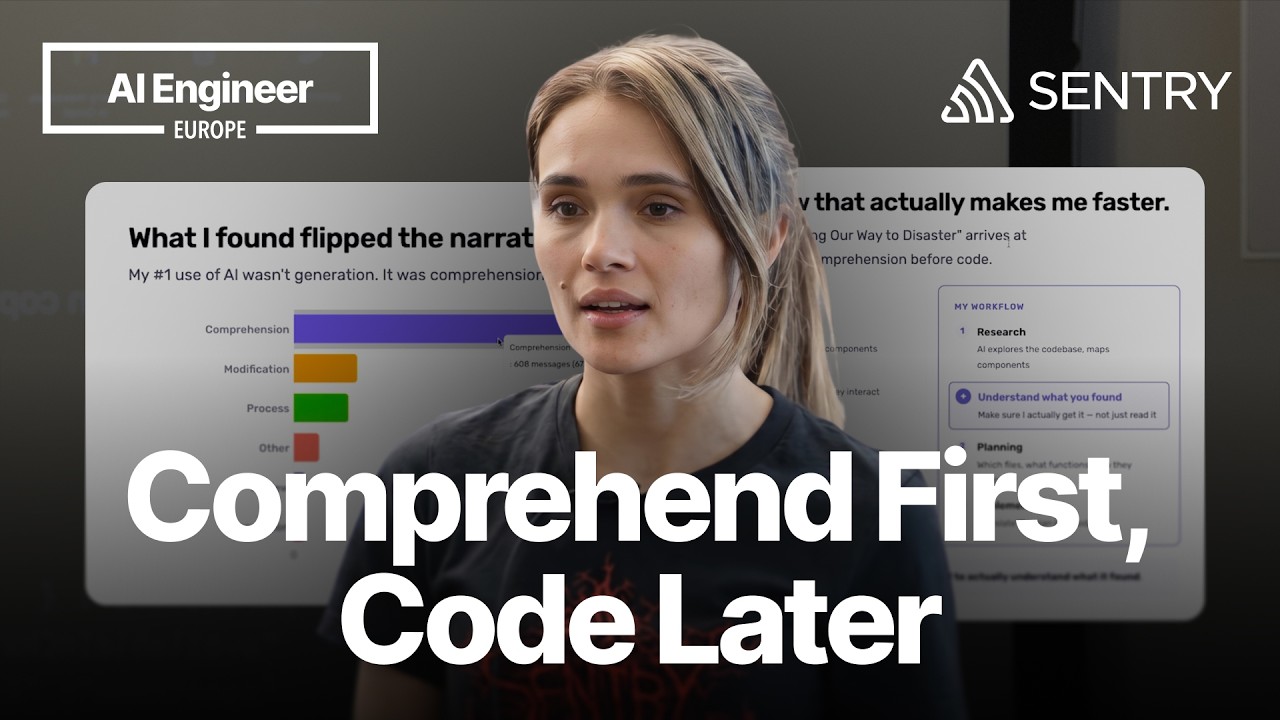
Priscila Andre de Oliveira uses AI mainly to understand a large, changing codebase, rather than to generate code.
2
Her local "Catch Me Up" skill organizes repository exploration into six modes: architecture, conventions, feature traces, syntax, testing, and history.
3
She recommends understanding the agent's research and correcting its direction before asking it to plan and implement changes.
Summary
Priscila Andre de Oliveira describes how she uses AI in Sentry's large and constantly changing codebase. Sentry has more than 15 years of code, around 100 PRs merged each day, and 100,000 organizations depending on it. After analyzing 116 of her own Claude sessions, she found that 67% involved comprehension and only 2% involved code generation. That result led her to create a local skill called "Catch Me Up." It gives her structured explanations of a repository through six exploration modes, with outputs such as architecture diagrams and tables. She uses it when joining unfamiliar projects and when reviewing PRs. Her main warning is that developers need to understand the research an agent performs before letting it plan and implement, since an incorrect mental model can lead to code they cannot explain or safely maintain.
AI has changed Priscila's daily work from coding to prompting
Priscila describes herself as a senior software engineer at Sentry, a maintainer of Verdaccio, and a co-organizer of Vienna JS. Since December 2025, she says she has not coded and has worked by prompting instead. She jokes that she has promoted herself to "agent manager" while orchestrating several agents across three monitors. AI also created the presentation itself. At Sentry, she has used Claude to create bug fixes, features, refactors, and contributions across repositories. Her experience is that this workflow is producing real changes, rather than being limited to toy examples or isolated experiments.
Sentry's codebase demands understanding before changes are made
Sentry has grown from an error and performance monitoring product into a broader observability platform with metrics, profiling, and tools for monitoring agentic platforms. Priscila describes its codebase as more than 15 years old, with about 400 employees and 100,000 organizations depending on it. Around 100 PRs are merged every day, and the code keeps changing through new components, deprecations, lint rules, and contributions from outside the company. After a vacation, she may return to a PR full of conflicts. In that environment, she says she cannot safely ship code without first understanding how the system works.
Priscila says AI has made her faster mainly by answering questions that previously required manual investigation or waiting for colleagues. When an incident occurs, she can ask AI to trace a regression instead of opening GitHub and using git blame herself. When she needs to understand why a product decision changed, she can ask AI instead of waiting for a colleague in another time zone to reply in Slack. The speed helps her work, but she keeps returning to the need for understanding. If the agent interprets the codebase incorrectly, she has to recognize that and steer it toward the right path.
Her own usage data showed that comprehension dominates generation
Priscila asked Claude to analyze her cache of 116 sessions from daily work. It classified the sessions into comprehension, modification, process, review, generation, and other categories. The result surprised her: 67% of her AI usage was comprehension, while only 2% was code generation. Her repeated comprehension prompts suggested that she needed a reusable structure instead of asking the same kinds of questions manually. That observation led to her personal "Catch Me Up" skill. The talk's central claim comes from this measurement of her own work: the main benefit she gets from AI in a large codebase is finding and understanding information.
Catch Me Up turns repository exploration into six repeatable modes
"Catch Me Up" is a local skill made from a detailed prompt stored in an MD file. It organizes questions into six exploration modes: architecture, convention, feature trace, syntax, testing, and history. Priscila says the skill has clear goals and presents information visually because she prefers diagrams and structured explanations. Its output can include an organizational view of the code and tables that make the repository easier to understand. She built it for her own use, though she could share it. The point is to make the first pass through unfamiliar code systematic and repeatable.
A short repository briefing can replace hours of manual orientation
Priscila demonstrates the skill on an AI SDK testing repository that was new to her. She asks it to catch her up as a new contributor and clarify that the project simulates a Sentry envelope and intercepts it during tests. Claude explains the repository's flow and answers a specific question about whether it simulates envelopes or intercepts real ones. Priscila says this information would otherwise require her to investigate the repository herself. She also uses the skill while reviewing colleagues' PRs, when she has some context but needs more information before she can approve a change.
Agents need an understanding phase between research and planning
Priscila agrees with the research, planning, and implementation phases discussed by Jack Nation in a post about vibe coding and Rich Hickey's "Simple Made Easy" philosophy. She adds another required step: developers need to understand the research their agent performed. That understanding lets them notice when the agent is moving in the wrong direction, ask it to explore another area, and correct the mental model before planning begins. Only then does she recommend asking the agent to create a plan and implement it. Her concern is code that reaches production while its author no longer knows what is in the codebase.
Aligning the mental model is how she tries to avoid slop
Priscila closes by repeating that the biggest benefit of AI in a large codebase is comprehension, not generation. She encourages developers to track their own usage and see where AI is actually helping. She describes AI as a teammate that never gets tired of questions, which makes it useful for basic questions as well as difficult investigations. Her practical advice is to align the mental model before prompting for changes, because implementation will follow more naturally once the developer understands the system and the agent's direction. She also warns against shipping code that the team cannot explain or maintain.