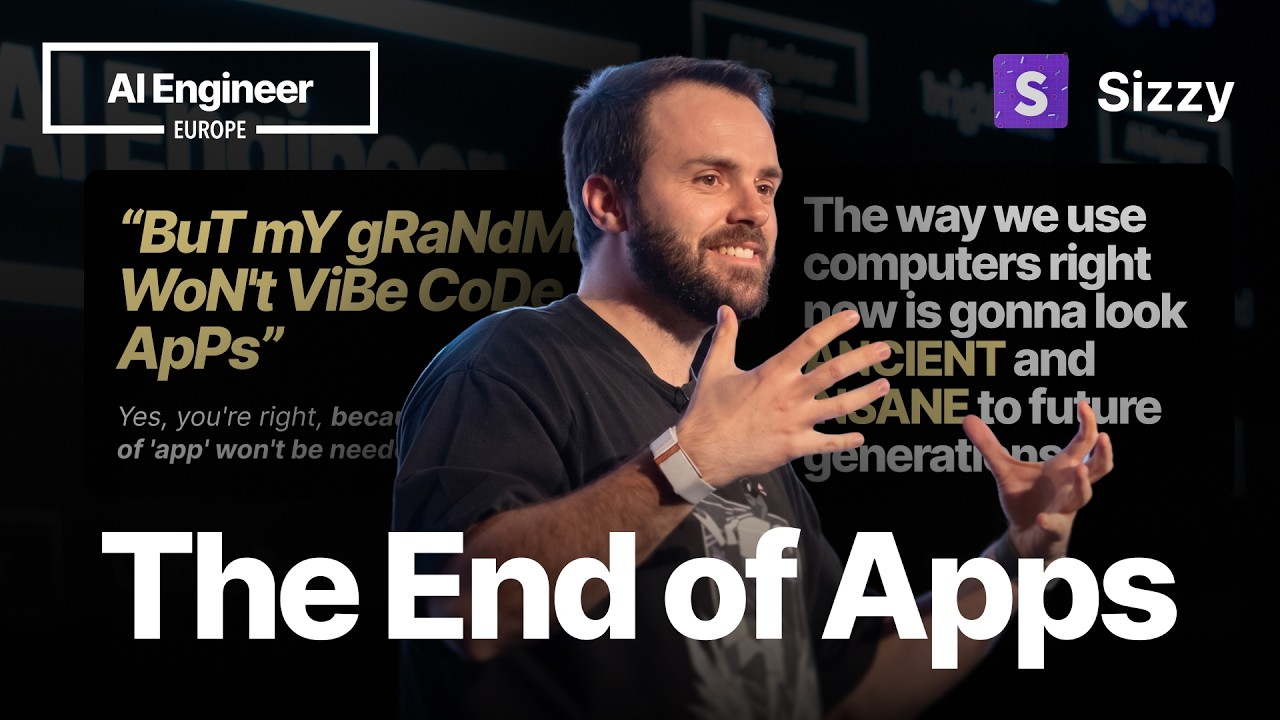
Kitze argues that personal agents need direct access to a person's files, notifications, and tools instead of forcing people to manage separate apps.
2
He found packaged agents unreliable for important work because cron jobs, multi-agent conversations, memory, and messaging interfaces often fail.
3
He predicts that most people will use computers through agents that decide what needs attention and generate the interface for each task.
Summary
Kitze traces his attempts to build a personal productivity system from childhood to Benji, an app that combines to-dos, habits, planning, events, and other parts of daily life. ChatGPT and later agent tools convinced him that a personal assistant could act across his files and services, but using agents through Discord or Telegram created new problems. His setups became complicated, unreliable, and hard to maintain. He now experiments with Wolfer, a focused interface for multiple agents, nested topics, explicit context, workspaces, visible tool calls, and predictable cron behavior. Kitze is honest that his own life is still chaotic and that Wolfer is not ready for general use. His broader prediction is that computers will increasingly prompt people with the next task instead of waiting for commands. Most consumer apps may disappear behind a local agent and an operating system that generates task-specific interfaces.
Kitze wanted a life operating system rather than another to-do list
Kitze says his first to-do list was a handwritten note at age 10, complete with a checkbox for eating string cheese. Years later, he used text files, Tasker, contextual reminders, Google Home, and IFTTT because existing to-do apps never felt right. He gradually concluded that he wanted a life OS that could hold tasks, habits, planning, events, and other personal information together. His projects moved from To Do Do It to Better and then Benji. Benji was intended to combine many tools into one place, although Kitze admits it did not fix his life and remains unfinished.
Input friction keeps personal productivity systems from becoming habits
Kitze says the hardest part of a life OS is entering information through forms. He alternates between periods when he records everything in Benji and periods when he ignores the system entirely. The same pattern applies to tools such as Notion. He wants to offload thoughts without having to decide which app, subscription, or platform should receive each item. Benji's voice feature moved spoken input into the app while showing the calendar and to-dos changing live. It attracted attention online, but Kitze did not turn the viral feature into a shipped assistant.
Agents made Kitze believe that his existing files could become useful context
When Claude Code gained tool calls and skills, Kitze began loading it with personal skills as well as coding skills. He then discovered ClaudeBot, which let him communicate through WhatsApp or Telegram, and that changed how he imagined using an assistant. He wanted an agent that could work across Google Drive, iCloud, presentations, photos, unfinished business ideas, and other accumulated material. Kitze moved toward local hosting, putting data on his NAS and machine so an agent could work on it without depending entirely on cloud services. He even returned to Android because he wanted an agent that could read notifications, clear them, and install or uninstall apps.
A single chat agent is a poor structure for a complicated life
Kitze asks people in his community which of their OpenClaw use cases cannot already be handled with Claude Code or Codex, and says the list usually shrinks dramatically. He also questions the value of putting every part of life into one one-on-one chat. Business, personal, and family information should not all be mixed into one conversation with one agent. He prefers specialized agents with their own purpose, model, system prompt, tools, and permissions. His own setup grew into five Discord servers with many channels, threads, and nested structures, while his life remained chaotic.
Agent systems fail where dependable automation matters most
Kitze says his agent setup became unreliable around cron jobs, multi-agent communication, and context retention. Agents would forget what had been said in the previous message, and scheduled work could fail. He also argues that Discord and Telegram were never designed to function as a life OS. They can be adapted, but they do not provide the right interface for managing a person's life. He criticizes the personality of some cloud agents too, comparing conversations with them to talking to a box of oatmeal because they repeatedly ask whether a task is ready or complete.
The agent market will split between convenient cloud products and customizable systems
Kitze sees two competing directions. Products such as OpenClaw and Hermes appeal to people who want to tinker, self-host, and control models, but they require too much setup for people with busy lives. Cloud agents should work out of the box and reach a much wider audience, yet Kitze says they will not satisfy users who want ownership and extensive capabilities. He is personally trying OpenClaw, Hermes, Paperclip, and Codex-based tools, but none has resolved the tradeoff. His own experiment, Wolfer, is deliberately narrow and is intended for his needs rather than mass adoption.
Wolfer uses explicit topic context instead of trusting agent memory
Wolfer organizes work through nested topics such as work, projects, Benji, and Benji customer support. When Kitze opens a conversation in a child topic, the system includes the descriptions of its parent topics in the first prompt. The agent can therefore receive the relevant context directly instead of searching a separate memory system and hoping it retrieves the right information. Wolfer also has workspaces, visible and controllable tool calls, predictable cron messages, an interface for managing each agent's model and capabilities, and a knowledge base made from Markdown documents, passwords, or skills.
Computers may prompt people with tasks instead of waiting for prompts
Kitze predicts that an agent-driven computer will ingest notifications, email, to-dos, and other information about a person's life. When the user returns, it could present the next task, suggest a break, or ask for a missing decision. People would delegate most work and answer questions or complete small forms when the agent needs them. In this model, users would stop thinking about which app handles a task. The interface could appear when needed. Kitze expects a small number of specialist applications to remain for work such as color grading, filmmaking, or music production, while most consumer software sits behind the operating system.