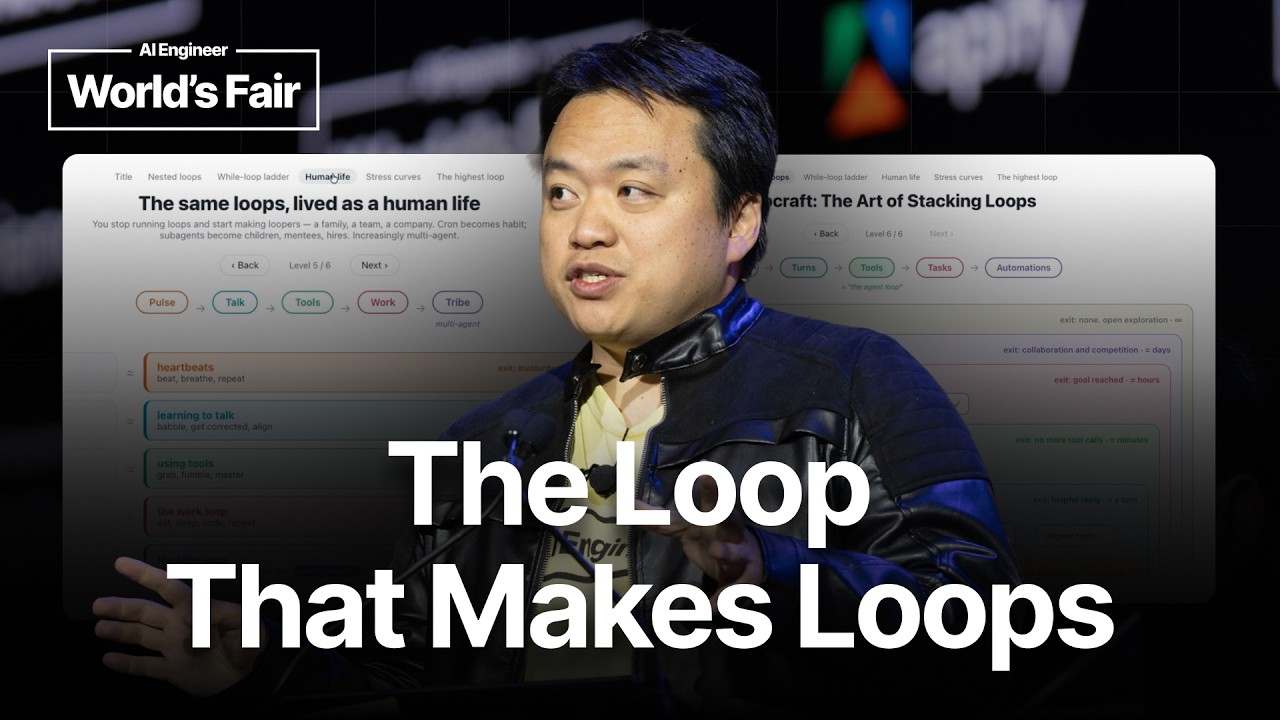
AI engineers should move up and down a stack of loops, choosing higher-level abstractions for productivity and lower-level ones for reliability and debugging.
2
The human loop grows from basic life and personal work into teams, companies, and the larger project of human civilization.
3
A conference is the highest loop because people come together to decide what loop to build next, then carry that process into their teams and daily work.
Summary
swyx describes AI engineering as work across stacked loops. The progression runs from tokens and chat to tools, goals, automations, cron jobs, and software factories. Engineers should move up the stack when they need more productivity and scale, then move down when they need to inspect failures and improve reliability. He applies the same idea to human activity, from heartbeat and speech through tools, work, families, teams, and the wider project of civilization. The conference itself is the highest loop in this model. It brings people together to decide what the next loop should be, while the World's Fair acts as a summit of smaller summits. swyx also connects this model to AI spreading beyond coding into healthcare, finance, go-to-market work, and forward-deployed engineering. He closes by asking attendees to carry their process for generating loops into their teams, personal workflows, and lives.
AI work has progressed through increasingly capable loops
swyx sketches a progression from tokens to chat, tool use, goals, and automations. Current work includes cron jobs, software factories, and stacked loops. He says AI engineers need to understand which loop they are operating in and whether it is the right level of abstraction. The point is practical: choose a higher loop when you need more productivity and scale, then go lower when a system needs debugging or better reliability.
Moving between abstraction levels is a core engineering skill
swyx describes moving up a loop to find the next level of productivity and scale inference. When problems appear, engineers should move down to inspect the lower-level behavior and fix bugs. He compares the structure to a stack of nested loops, an analogy he expects programmers to understand. This gives engineers a way to decide where to work instead of treating every problem at the same level.
The human loop expands from individual activity into collective work
The human version of the loop begins with a heartbeat, then develops through speech, tool use, and work. swyx describes the everyday cycle as eating, sleeping, coding or prompting, and repeating. People then form small groups and families, which connect to teams and larger human projects. He asks the audience to extend its view from personal, family, country, or company contexts to the collective intelligence of human civilization.
swyx says that agents developed in one domain are beginning to generalize. AI Engineer's program now includes vertical tracks for healthcare, finance, and go-to-market work, alongside forward-deployed engineering. He presents these tracks as evidence of AI moving beyond coding. The same loop ideas therefore apply across different kinds of work, rather than only inside software development.
The conference has grown from a small event into a large gathering
swyx reviews the growth of AI Engineer events. He describes the first World's Fair in 2023 as having a roughly linear sales curve, then mentions about 2,000 attendees in 2024 and a 2025 target of 6,000. At the event, attendance had passed that target and reached 7,000. He uses the figures while asking attendees to gather earlier for future events.
The highest loop is where people decide what to build next
swyx defines the highest loop as the place where humans come together to figure out the next loop. He calls it the loop that makes loops. In this model, regional Engineers Summits feed into the World's Fair, which he calls the summit of summits. The event is therefore a coordination layer for deciding what processes and systems should be built and spread afterward.
Attendees should propagate useful loops into their own work
swyx closes by asking attendees to find their own generative process for producing loops. They should carry it into their teams, personal workflows, and lives. His final request treats the conference as a starting point for action rather than an isolated gathering. The value comes from taking the process developed at the highest loop and applying it at lower levels.
"I think this is something that is basically a core skill of AI engineer, defining what loops you're working in and figuring out whether that's the right level of extraction."01:51
Who should watch
You are designing agent workflows, automations, or software factories and need a way to choose the right abstraction level.
Your team is deciding how to apply AI outside coding and wants to connect individual experiments with wider organizational work.
You are attending or organizing an AI engineering event and want swyx's explanation of why these gatherings exist.