The strongest companies redesign software work around one- or two-day agent cycles instead of adding AI tools to two-week sprints.
2
They use smaller pods, merge role responsibilities, curate context and skills, and prepare the wider organization before scaling agents.
3
Faster code generation can lower quality and move bottlenecks to requirements, release, governance, and measuring business value.
Summary
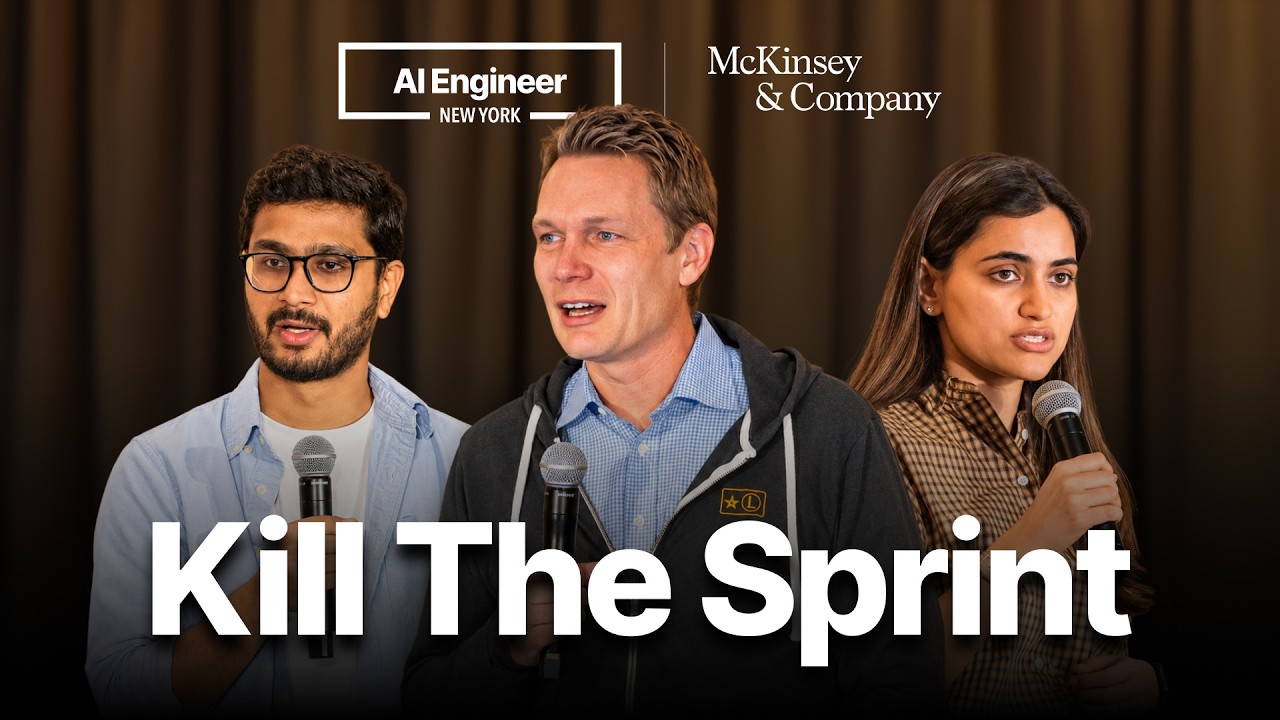
Martin Harrysson and Prakhar Dixit describe patterns McKinsey sees among large companies using AI agents in software development. Most companies report modest gains, while the top 20 to 25 percent report roughly 2x end-to-end improvements. These companies change the flow of work instead of placing more tools inside the old process. They run one- or two-day cycles, with agents working between human reviews, and organize engineers into smaller pods with broader responsibilities. They build a context and trust layer from standardized artifacts, internal knowledge, policies, and governance rules. They curate a small set of useful skills from a much larger supply. The speakers also warn that faster code generation can increase defects unless teams improve review and encode examples of good work. As build and test accelerate, requirements, release, compliance, and measurement become the harder parts. The talk is practical about the organizational work required beyond pilots.
A small group of companies is beginning to see major end-to-end gains
Martin Harrysson says most large companies initially reported modest performance improvements despite using AI in software development. A later survey of several hundred clients and large enterprises showed a top 20 to 25 percent beginning to see much larger benefits. These gains went beyond coding being 10, 15, or 20 percent faster. The companies were reporting roughly 2x improvements across the end-to-end process. Harrysson says expectations had previously become much larger than the results, so he sees this group as evidence that companies may be moving out of the trough of disillusionment. He does not suggest that every organization has reached this point. The difference comes from changing how the work is organized around agents.
The speakers identify four areas that need to change: the operating model, talent structure, technology stack, and change management. Martin Harrysson says many companies have tried to add more tools to the existing process, but that approach has not worked well. Prakhar Dixit describes a move away from traditional two-week Scrum sprints toward Kanban-style workflows that last one or two days. Agents can run a night shift, humans can validate the output, and the loop can run again. Teams decide where human review is required and remove it from parts of the flow as confidence grows. The same agent loops are expanding beyond build and test into product and release work.
Smaller pods change responsibilities without necessarily reducing headcount
Prakhar Dixit says companies are shrinking team size while creating more teams. The pods he sees commonly contain two to four people. This does not necessarily mean fewer employees. It changes what each person does. In large enterprises, banks, and similar organizations, several layers of roles are being consolidated into broader definitions. Product roles are moving toward what Dixit calls a definer role, while development and QA roles move toward a builder role. Manual activities that once occupied separate roles can now be identified and absorbed into wider responsibilities. The speakers present this as an organizational response to agent-driven work, where a small team can cover more of the product development flow.
Context and trust matter more than choosing another coding tool
Dixit says the market's basic tooling is largely solved for the moment. The harder question is how an organization arranges the tools into a stack that fits its own work. Companies need a semantic layer containing their internal context, knowledge, and intellectual property. Much of that information still sits with subject-matter experts who have worked in the organization for many years. Agents need that knowledge documented so they do not repeatedly depend on those people. Dixit also stresses a trust layer. Organizations need governance, security, and stability controls that make sure agents build things in the approved way. Standardized artifacts such as product requirements documents and specifications help agents work from consistent inputs.
Scaling agents requires preparation beyond successful pilots
The speakers distinguish between proving an agent in a small pilot and changing work across hundreds or thousands of engineers. Dixit says front-runner teams can produce impressive results in a new project, but those examples do not prove that an enterprise can scale the approach. Before releasing an agent-driven process across the organization, companies need to define the operating model, talent structure, technology stack, and agent costs. He also names AI FinOps as an increasingly important part of that preparation. Change management is difficult because people are being asked to change how they work. The speaker's point is that scaling depends on preparing the surrounding organization, not simply distributing an agent to more teams.
Shilpa says the supply of agent skills and frameworks is no longer the main constraint. Companies can access hundreds of thousands of skills, but only a small number will fit a particular organization's teams and context. She describes curation as the harder task. One client looking for skills to write a product requirements document found about 1,700 downloadable options for that single task. The abundance created decision paralysis. Organizations therefore need to select the skills that fit their own processes instead of accepting every available framework. Curation also has to keep changing because the supply is growing quickly. The problem is choosing what belongs in the company's working system.
Martin Harrysson says the data they are seeing points to an inverse relationship between code-generation speed and quality. More frequent commits and pull requests can naturally create more opportunities for incidents and defects. He says the decline also appears when measured per developer and per pull request. Developers and testers need training in reviewing generated work, not only in using AI to produce it. The speakers recommend feeding agents curated golden examples rather than an average sample of the codebase. Teams should encode what good work means at each checkpoint, including maintainability, complexity, and how well a change merges with other branches. Quality rules need to guide the process before the final gate.
Acceleration moves bottlenecks into requirements, release, and governance
Build and test are receiving much of the early acceleration, so the bottleneck moves elsewhere. Harrysson and Dixit describe pressure in the upstream work of writing requirements and in the downstream work of releasing software. Agents need access to enterprise context such as logs, customer logs, and emails, along with a clear connection between requirements and the build work. Release acceleration requires mapping enterprise release requirements early. Bottlenecks also appear in parallel groups such as risk, compliance, governance, and design. Dixit gives a banking example where a customer-facing application had rules about color schemes and whether color-blind users could distinguish buttons. Such requirements need to be encoded into the agent-supported process rather than discovered late.
Martin Harrysson says companies are investing in tokens, tools, and retraining without always knowing whether the investment is working. There is still a gap between adopting AI and feeling confident that the right outputs are being measured. He says software organizations can start with established measures and then add AI-specific approaches. Some clients are using AI to score the value of what they build and identify intent, with the aim of directing resources toward higher-value work. Harrysson is honest that this is difficult and has been a long-standing software development problem. He also describes a short-term comparison: make pods half the size or smaller, create twice as many teams, and compare the resulting delivery against the old mental model of larger teams working for longer periods.
"As we get code generation faster and faster, a lot of the reports and data that we're seeing is actually pointing towards quality not going in the same direction."Martin Harrysson11:44
Who should watch
You lead software teams and need to decide whether agents require a new delivery model rather than another tool added to the current one.
Your organization has successful AI coding pilots but has not worked out how to scale them across teams, roles, governance, and costs.
You are seeing more generated code while defects, release delays, or unclear value measurements remain unresolved.