AI agents need the same accountability structures used for employees, including an identity, a team, and a named human sponsor.
2
Agent authority should be limited to the lowest scope, while role definitions describe purpose, responsibilities, budget, and success.
3
Administration should combine scorecards, guardian agents, and graduated recourse that can restrict or suspend agents when their behavior falls out of bounds.
Summary
Tim Tyler argues that software controls alone do not govern AI agents well because agents act within organizations, take on work, and make decisions. He proposes treating them as a digital workforce through the Agent Accountability framework. Assignment gives each agent a unique identity, team context, and named human sponsor. Alignment defines the agent's role, mission, authority, and success criteria, with access limited to the lowest necessary scope. Administration checks both rule-following and work quality through scorecards. Guardian agents can monitor models, incoming context, and produced work at machine speed. When an agent goes wrong, the response can move from correction to restricted authority, escalation, or suspension. Tyler is clear that inherited model alignment and outside agent context are beyond a sponsor's direct control, so organizations need explicit contracts and ongoing oversight.
AI agents are being hired without the controls expected for human workers
Tyler opens with a deliberately bad job posting: no identity documents, no manager, shared passwords, constant availability, and no consequences for mistakes. Nobody in the room would hire that worker, yet he says companies are already deploying AI agents in comparable conditions. Software standards and protocols still matter, but Tyler argues they do not cover the organizational accountability needed when agents perform work. His framework applies lessons from how enterprises govern human employees to what he calls a digital workforce.
Assignment gives every agent an identity, team, and sponsor
The Assignment stage establishes an agent's presence in the organization. Each agent needs one unique ID in a known shared registry, which becomes the reference point for the rest of the framework. The agent also belongs to a team, even when that team is only one human and one agent. It should receive the team's goals, decisions, and history, then return context about its actions and learnings. A named human sponsor owns the agent's purpose, cost, and response when something goes wrong.
An agent needs a defined role and a separate runtime mission
Alignment describes what the agent is meant to do and how success is judged. Tyler's basic role definition includes a purpose, responsibilities, and some form of budget, with more detail handled by the framework's controls. He separates onboarding scope from runtime mission. The sponsor defines the role and changes it rarely. The agent defines its mission for the task currently underway, such as making a call to an MCP tool. This distinction connects a stable job description to moment-by-moment work.
Authority should be limited by the lowest scope in the delegation chain
The sponsor decides what data and tools an agent can access, even if an IT team or another service technically provides that access. Tyler's rule is to work at the lowest scope. In his example, Agent 203 can access C and D, while Agent 409 can access D, E, and F. When 203 delegates work to 409, 409 can use its own scope, but it can return only information that remains available through the delegation lineage. Authority must not expand as a task moves between agents.
Organizations cannot assume that inherited model or outside context is aligned
Tyler separates alignment defined by the organization from alignment inherited from other sources. A model has its own rules and definitions, a team context may come from somewhere the sponsor cannot easily change, and an outside agent may bring context into the system. He compares an external agent to a contractor entering a workplace: it needs an identity and explicit authorization. Defined alignment becomes a contract for the agent. Deterministic rules form the floor, while intents describe probabilistic goals that need evaluation.
Administration must measure both behavior and successful work
Administration checks whether an agent stays within its authority and whether it actually accomplishes its role. Tyler says these are different questions. A rule might prohibit payment approval or limit writing to a ledger. An intent might ask whether the correct purchase order was matched or whether reconciliation time meets expectations. The result should be a scorecard rather than one metric, with weights derived from the role and authority definitions. Rules can be checked directly, while intents are judged with a confidence level.
Guardian agents provide the continuous oversight that agents need
Tyler says people dislike micromanagers, but agents need them. Oversight should cover the model, the context entering the agent, and the work product coming out. Guardian agents can apply these checks at machine speed instead of waiting for periodic human reviews. Humans still adjust the role and authority definitions when the agent needs coaching. In Tyler's model, the machine monitors and restricts behavior, while the sponsor uses judgment to improve the agent's setup.
Recourse turns uncertain judgments into concrete actions
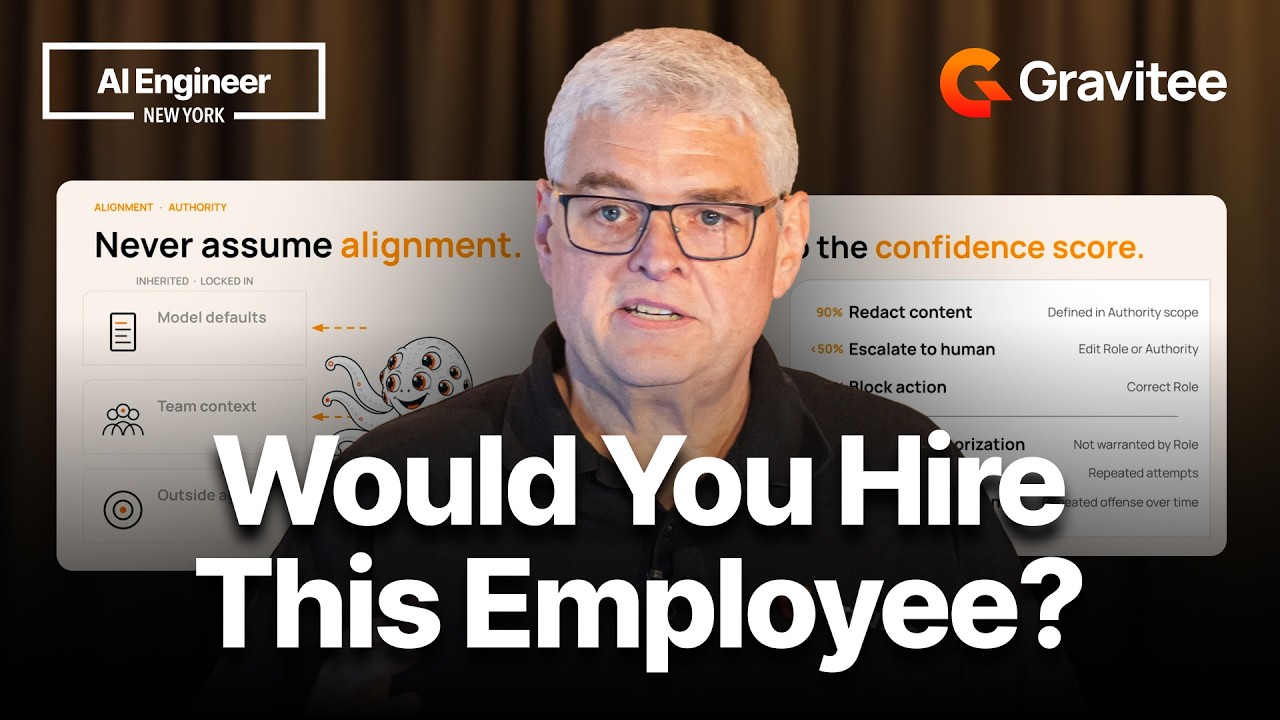
When an agent goes wrong, Tyler proposes graduated responses rather than immediate termination. A correction can come first, followed by reduced authority, escalation, or suspension. Confidence thresholds can make probabilistic judgments actionable. In his example, a high-confidence issue might trigger content redaction, a lower-confidence result might go to a human, and a very low-confidence result might be blocked. Repeated unauthorized access can restrict permissions, then suspend the operation. A zero-trust approach starts with heavier controls and relaxes them after repeated success.
"We have assignment. We need to name every agent. We have alignment. We need to bound every action. And we have administration. We need to trace every outcome."17:03
Who should watch
You are deploying agents with access to business systems and need a clear owner for each one.
Your team has defined permissions, but has not separated an agent's role, runtime mission, and success measures.
You need machine-speed monitoring and a documented response when an agent exceeds its authority or produces unreliable work.