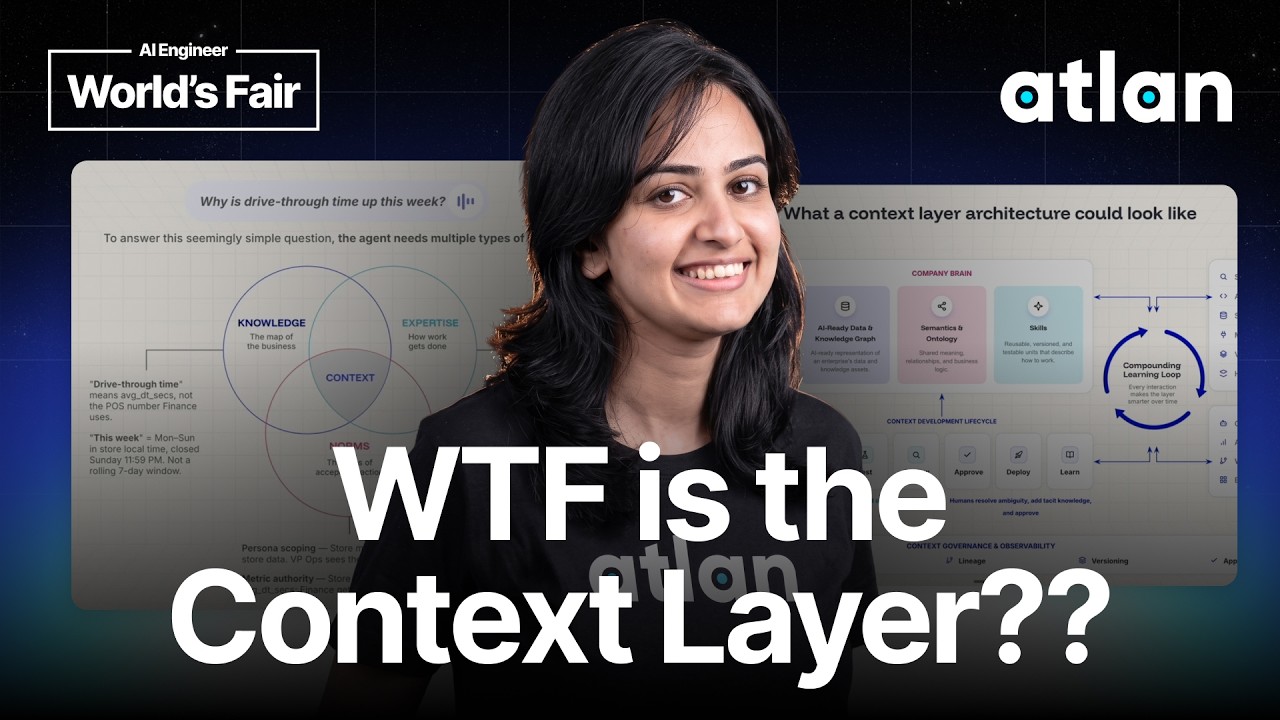
Agent performance depends on both model intelligence and the business context that defines how work gets done.
2
A context layer gives agents shared, versioned, testable business knowledge, skills, norms, and memory across systems and agent frameworks.
3
Production traces can feed a maintainer loop that reviews agent behavior and improves shared context over time.
Summary
Prukalpa Sankar argues that model intelligence has advanced much faster than the business context agents need to work reliably. A human analyst can answer a simple operational question because they understand definitions, time periods, diagnostic playbooks, organizational norms, and lessons from past mistakes. Agents usually lack that shared understanding. Sankar describes Atlan's progression from narrow, task-specific agents to a shared company brain connected to general-purpose agents. This context layer contains skills, data relationships, business semantics, metrics, entities, and organizational structure. It also needs versioning, dependency management, ownership, security, and portability across agent tools. Sankar describes traces as another input: systems can review what agents did, then route approvals and corrections back to skill maintainers. Her argument is practical and grounded in deployment problems, including stale context, disconnected agents, context sprawl, and conflicting business definitions.
Real-world performance depends on context as well as intelligence
Sankar separates model intelligence from the knowledge that makes someone effective at work. Model benchmarks measure cognitive horsepower, but a good teammate also knows the business, applies learned skills, responds to feedback, and delivers useful outcomes. She says only 10% of job performance variance is explained by IQ, then uses the example of a data analyst who can answer why drive-thru time increased only because she knows what the metric means, who is asking, how the week is defined, and which diagnostic checks to run. Models have improved rapidly on intelligence, while situated business knowledge has barely moved beyond dashboards, Slack threads, and individual employees' memories.
A simple business question contains definitions, expertise, and organizational norms
The drive-thru example shows why an apparently easy question needs more than data retrieval. Maya must establish whether drive-thru time means something different to finance and operations, decide whether the week runs Monday to Sunday or uses a particular time zone, and apply a diagnostic playbook. She knows to check seasonality and a recently launched product when investigating a spike. She also understands how to tailor the answer to the person asking, then provide the root cause instead of only reporting a number. Sankar groups this practical knowledge into facts, expertise and skills, and norms.
Narrow agents are easy to build but difficult to give enough business context
Atlan first mapped the jobs of its customer experience team and created focused agents for specific tasks. Documentation and meeting preparation looked suitable for automation, while relationship management did not. The team built agents such as Hermione for health intelligence and MoneyPenny for financial risk analysis. Sankar says building an agent became easy, taking about five minutes, but supplying the business context needed for accurate answers took much longer. Poor context engineering led to cases where stakeholders lost trust. The agents also operated independently, so changes made by one team did not reach related agents elsewhere.
Shared context is needed for teams of agents to work together
Sankar compares a team of agents with a human team that shares language, current facts, playbooks, decision rights, memory, and lessons from past mistakes. Atlan's new model puts domain skills into a common company brain and gives general-purpose agents retrieval mechanisms into that shared store. In the marketing example, specialists contribute skills for SEO and competitive intelligence while the system connects to data, social, advertising, and analytics platforms. The agents can include Claude Code, Co-work, Atlan's own Slack-connected agent, Qualified, and Artisan. The shared repository becomes a living source of business context.
A context layer needs business semantics and relationships, not only documents
The company brain grew to include a data graph, a library of skills, semantics, metrics, organizational structure, and entities. The data graph helps an autonomous ads agent identify which table to use for daily analysis. Business semantics define terms such as ARR and qualified lead in the company's own way. Sankar says Atlan created about 300 skills and 40 agents over six months, then found that this scale introduced management problems. Skills depend on one another, and changes to an upstream competitive intelligence skill can break a category positioning skill and a sales battle card skill downstream.
Sankar says context needs life cycle management, collaboration, versioning, quality controls, dependency management, ownership, and security. Skills can become outdated or drift as they evolve, so teams need to know who maintains and approves them and which other skills they affect. She describes hardcoded secrets in .env files and people downloading public skill repositories as governance problems. Portability is another concern because context became trapped when Atlan moved between Relevance, Google ADK, Glean, Claude Code, and Codex. Her proposed comparison is a GitHub for context, with profiles, contributors, maintainers, and self-learning loops.
Agent traces can turn interactions into a shared learning loop
Every AI interaction produces more potential context, but it needs a process that can capture useful lessons. Sankar describes a specialized harness that reads agent traces and reverse-constructs possible improvements. It sends those proposed changes to maintainers for an approve-or-reject decision, allowing skills and shared context to improve over time. This gives the system a way to learn from mistakes, edge cases, and successful behavior without leaving each agent to maintain a separate memory. The learning loop connects deployed agent behavior back to the people responsible for context quality.
Business systems can provide the starting point for a company brain
For organizations with many disconnected systems, Sankar recommends mining the context already present in those systems. She gives Salesforce, HubSpot, a data warehouse, and an application layer as an example. Connections between these systems often carry meaning that gets lost as information moves from one place to another. Reverse-constructing those relationships can produce a first version of the company's brain, after which AI can be deployed on top. Her final architecture continually mines business systems, feeds a shared context store, supports skill and context development life cycles, and offers retrieval through MCP, SQL, vector retrieval, and hybrid assembly.
Sankar closes by arguing that shared models and model intelligence will not distinguish companies on their own. The difference between a customer support agent at American Express and one at Amazon comes from how each company does business. Definitions, culture, operating norms, expertise, and accumulated lessons encode that difference. She calls context IP because it captures what makes a company special and can be used to shape autonomous systems. The warning is that hardcoded context will become unsustainable as autonomous systems scale, especially when teams use different definitions for the same business measure, such as revenue.
"Performance is a function of two things. It's a function of intelligence, which is cognitive horsepower. That's what the model benchmarks measure every day. But, it's also a function of context."03:12
Who should watch
You have deployed agents that worked in a demo but lose accuracy or trust in production.
Your agents use different definitions, memories, or playbooks and you need them to share business context.
You are deciding how to store, govern, version, and move context across multiple agent frameworks.