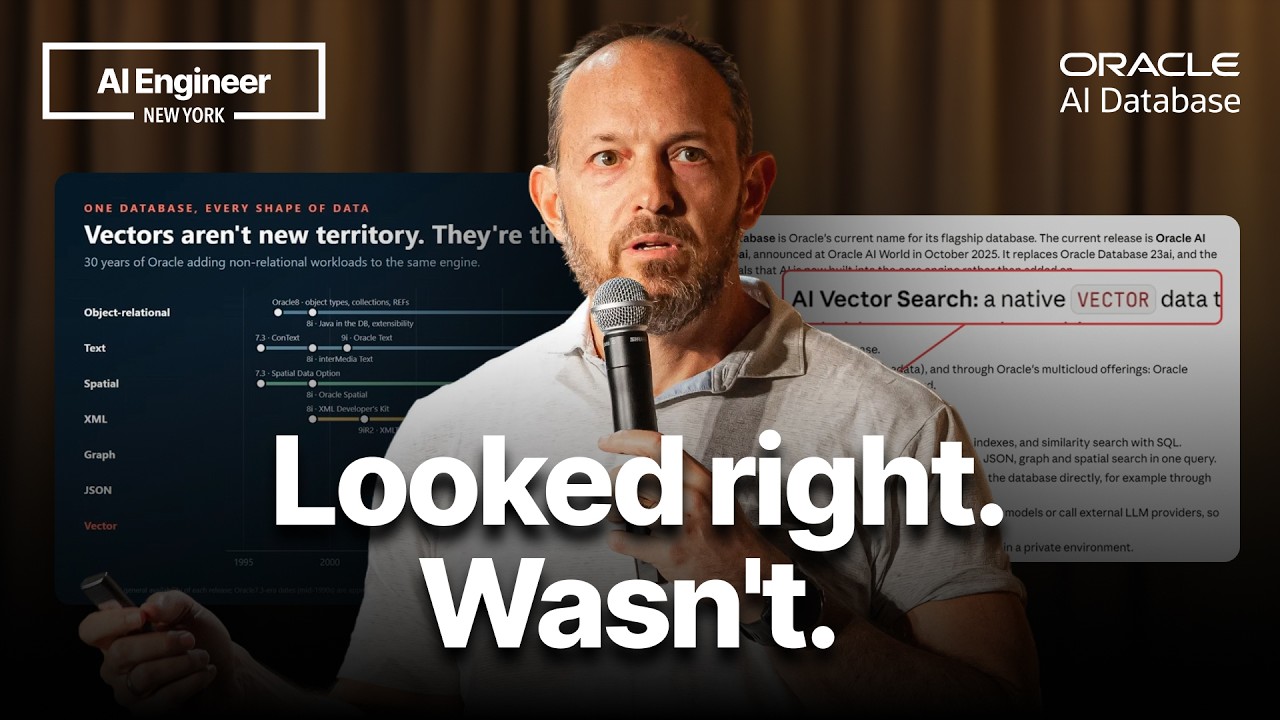
Oracle's AI Database keeps vectors, relational data, and graph data in one database with a single SQL interface and MCP server.
2
Vetted reports can be exposed as MCP tools so agents choose and run approved queries instead of generating arbitrary SQL.
3
Database-level security can identify the user through single sign-on and remove unauthorized rows before results reach the agent.
Summary
Jeff Smith explains why database access is useful for agents and why it needs controls. Oracle's AI Database stores vectors alongside relational and other data types, so an MCP server can give agents one route into the data. Smith is wary of unrestricted natural-language-to-SQL because a query can run successfully while answering the wrong question. He recommends exposing existing business reports as parameterized tools, with report descriptions and sample questions, while limiting the number of tools shown to the agent. For performance work, agents can inspect a read-only Data Guard standby instead of production. Schema annotations and compressed schema information give agents the business vocabulary they need without repeated dictionary queries. Smith puts authorization in the database. Organization single sign-on supplies roles, and deep data security removes rows the user cannot see before the result reaches the agent. Oracle is also working on MCP apps, skills, and automated retrieval pipelines.
Oracle's database can keep vectors beside business data
Smith describes the Oracle AI Database as a place where vectors live alongside financial, HR, ERP, shipping, retail, government, and healthcare data. The database provides one SQL interface across the data, so teams do not need to copy information across many platforms just to support retrieval. Oracle also supports graph workloads inside the same instance. Smith's practical point is that one MCP server can connect an agent to these database capabilities without creating a separate access path for every kind of data.
Agents need database access because business questions never stop
Companies have many people asking questions such as how many products they sold, how a region is performing, or which discount might improve completed carts. Those questions often become spreadsheets and reports assembled by people who understand the business but may not understand SQL or the data model. Generative AI gives teams more capacity to ask these questions. That creates a problem because the answers still depend on data in the database, and an agent needs a controlled way to reach it without exposing personal information or causing a damaging action.
Natural-language SQL can return plausible answers to the wrong question
Smith compares generated SQL with the idea that code should ship if it compiles. A query can execute and return data while still failing to express what the user intended. Agents may choose the wrong joins or misunderstand the business model. Smith says he would not trust Codex, Claude, or Gemini to decide which business branch to fund based only on a prompt and a returned result. Unrestricted agents also spend tokens and time brute-forcing the database dictionary to discover where information lives.
Vetted reports reduce the ways an agent can generate a bad query
Oracle lets teams bring existing reports into the database or MCP server and present them as callable tools. Teams describe what each report means, provide sample questions, and define its parameters, while the underlying SQL remains mostly fixed. The agent can choose the wrong report, but it is less likely to generate incorrect SQL for the selected report. Smith describes two tools, list reports and execute reports, so a collection of 500 reports does not become 500 tools in the agent's context. Administrators can also disable arbitrary SQL and limit access to approved tools and reports.
A read-only standby gives agents a safer place to investigate performance
Smith does not want an agent changing a production database. Oracle Data Guard can provide a read-only standby where reports and read-only queries run, and performance problems may reproduce there. An agent can investigate that environment and try performance ideas without production access. Smith still wants controls beyond read-only access because a user may be allowed to read some data but not other data. His performance tools can expose several actions, such as collecting statistics or generating an AWR report, instead of creating a separate single-purpose tool for every action.
Schema annotations give agents the business vocabulary hidden from database names
Real schemas often contain obscure names and business conventions that are absent from a model's general training. Smith gives the example of sales data stored in a table with an old technical name rather than a table called sales. Oracle tools can consume Confluence pages and other documentation, then add plain-English context to schema metadata. A schema information tool returns a compressed JSON dictionary instead of making the agent list every table, column, comment, and sample row. It supports different levels of detail and keyword filtering. Another tool can retrieve context for vector search.
Authorization belongs in the database and must follow the human identity
Smith says the system must know who is asking before it returns database information. Agents using Claude, Codex, Gemini, or a homegrown framework go through organizational single sign-on rather than using a shared database identity. Azure AD can provide scopes and roles, allowing the database to apply rules such as permitting an HR manager to see everyone's salary while restricting that data from others. With deep data security, the database removes unauthorized rows when the SQL runs, before the result reaches the agent.
Smith says Oracle is building MCP apps that put a database interface directly inside an agent. He also mentions skills delivered through tools and automated retrieval pipelines. Documents can be loaded from the command line, while an MCP tool returns their vectors and text snippets to agents. He points people to oracle.com/mcp for more information. These plans extend the same approach from controlled database queries to document ingestion, retrieval, and an interface that agents can use directly.
"The LLM might screw up by picking the wrong report, but the LLM's not going to screw up by generating the wrong SQL."09:09
Who should watch
You are connecting an agent to operational or business databases and need a safer alternative to unrestricted natural-language SQL.
Your team has reports, schema notes, or internal documents that agents repeatedly rediscover instead of using directly.
You are responsible for database security or performance and want agents to investigate a read-only environment without receiving data a user is not allowed to see.