Pack · 10 talks · 3h 31m to watch, 58 min to read

Evals that survive production

An eval set assembled before launch can tell you whether a change helped on the cases you expected. It cannot tell you what frustrated users will try next, whether a judge agrees with the people doing the work, or what happened after an agent called a tool. A production eval loop starts by defining the actual range of user requests and locating failures inside the application. Traces and human explanations become regression cases; calibrated judges and simulations make more of them repeatable. Evaluation then stays connected to the running system, where changes to users, tools and agent behavior keep supplying new evidence. The suite survives only if the team continues to collect failures, test its graders and revise what good means after launch.

4
Rafal Willinski & Vitor Balocco, Zapier · 16:15 · AI Engineer World's Fair 2025
Turning Fails into Features: Zapier's Hard-Won Eval Lessons

Why here: Goyal describes the evaluation machinery. Willinski and Balocco feed it with failed runs, tool traces and signs of user frustration. They also find that narrow unit evals can punish a better model for taking a different route. Hetzel follows with a practical path from those observations to tested graders.

7
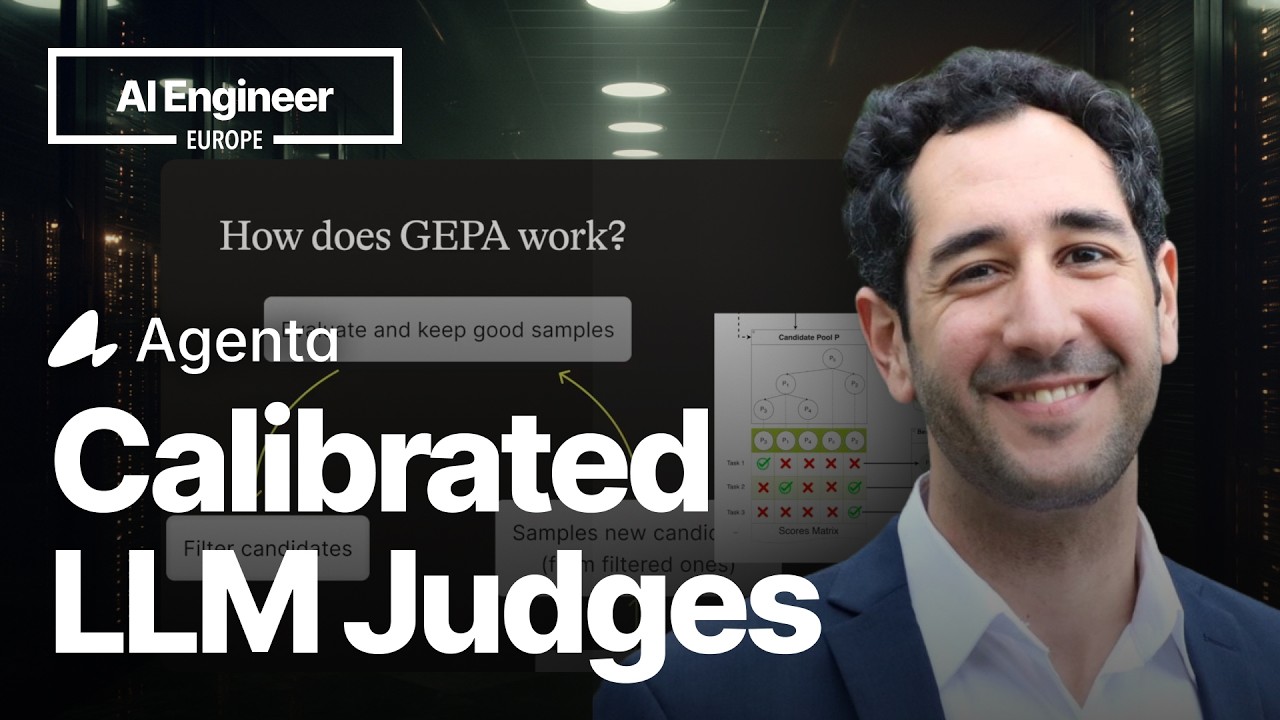
Mahmoud Mabrouk, Agenta AI · 40:51 · AI Engineer Europe 2026
Judge the Judge: Building LLM Evaluators That Actually Work with GEPA

Why here: Lyft validates a binary judge against held-out human labels. Mabrouk pushes further, showing that prompt optimization can improve measured agreement without making the evaluator trustworthy. Feyzkhanov widens the target from one judge to the complete environment in which an agent run can be repeated.

10
Vincent Koc, OpenClaw · 15:05 · AI Engineer Europe 2026
Malleable Evals: Why Are We Evaluating Adaptive Systems with Static Tests?

Why last: Gupta puts continuous evaluation around a production agent. Koc asks what happens when that agent, its tools and its users change. His answer is to draw new cases from traces while judging the outcome instead of prescribing one acceptable route. The pack ends with an eval suite that has to change because the product does.