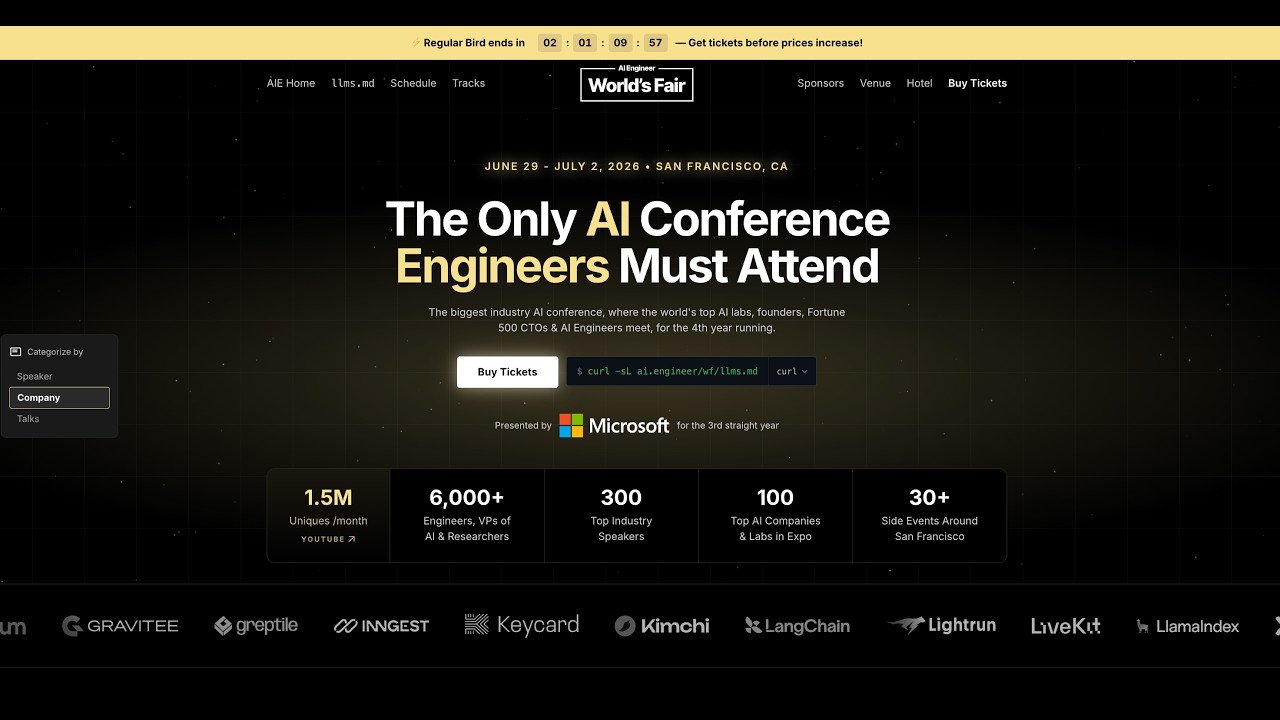
AIE World's Fair 2026 is larger than previous events, with an extra day of content and about half of its topics replaced with new tracks.
2
The expo floor is designed for wandering, conversations, product demonstrations, four expo stages, and a hallway track alongside the recorded talks.
3
The event adds leadership programming, AI verticals, poster sessions for tweets, side events, a new attendee orientation, and family programming.
Summary
Swix gives a practical tour of what is new at AIE World's Fair 2026. The event is larger than previous AIE gatherings, has an extra day of content, and replaces about half its topics with new material. Tracks include auto research, inference, pre-training, data quality, memory, continual learning, and several applied AI verticals. Swix describes the expo floor as the centre of the event, with four stages, product launches, robots, themed streets, and room for informal conversations. The programme also reaches beyond software builders. A dedicated leadership track covers enterprise workflows, token use, AI factories, and off-the-record meetings. The event connects industry with academic research through ACM-supported programming and an expanded poster format that includes tweets. Side events include a World Cup gathering, a new engineer orientation for people attending alone, a kids event, and a dating event. The talk is an invitation, but it also explains how the conference is being structured.
The event has grown while keeping a curated mix of topics
Swix says World's Fair 2026 is larger than all previous AIE events and will be the largest AIE yet. He describes the conference as a buffet, where one ticket gives attendees access to a curated selection of things they may care about. About 50% of the topics are returning evergreen material, while the other half is new. New or changed tracks include auto research, inference, post-training, pre-training and data quality, memory, and continual learning. The programme also has an extra day compared with last year. Swix specifically warns people not to leave on July 2, because some of the best content is scheduled then.
The expo floor is built around wandering and meeting people
The expo is intended to make talks optional. Swix says the hallway track and meeting people in person are central because the talks are recorded. Four expo stages will host people discussing what they are shipping and launching, while attendees can walk the floor with an Explorer ticket. Compared with 2025, the expo is roughly four times bigger. It is all located in Moscone West, with entertainment alongside business activity. The organisers are naming areas with terms such as Attention Avenue, Backdrop Boulevard, Context Crescent, and Diffusion Drive. Swix also mentions water stations, robots, and the logos from participating organisations.
The conference is trying to connect industry work with academic research
Swix says AI engineering should become an industry counterpart to academic conferences such as ICML and NeurIPS. He points to the ACM's conference on AI and Agentic Systems and an industry spotlight selection connected to the event. He values academic conferences partly because attendees can discover work by walking past a poster, rather than receiving only algorithmically recommended material. AIE is also changing the poster format. The organisers invited people to submit posts about AI, including tweets, which may be printed and defended alongside conventional posters. Swix says useful work can appear in a paper, blog post, product, talk, or tweet.
A large part of the programme is reserved for AI leadership
The entire third level is reserved for the leadership track, which Swix says takes about half of the breakout space. It is aimed at CTOs, VPs of AI, and people hiring and managing AI engineers. A new Token Billionaire programme will give high-volume model users a lounge for conversations with others operating at similar scale. Swix describes the group as spanning people trying to spend more intelligently and people trying to spend less. The leadership programme also has daily themes around real workflows, token use, and setting up AI factories. A networking room will allow attendees to book meetings with speakers and other attendees, and McKinsey will offer daily off-the-record sessions.
Applied AI verticals receive more attention than broad horizontal tracks
This year, AIE is putting more emphasis on where AI is deployed. Swix lists verticals including field-deployed engineering, genetic commerce, health care, finance, and go-to-market. He says design engineering and product management remain relevant from the previous year, but the larger themes now involve high-value industries. AI in finance gets special priority as the focus of a future AI Engineer New York conference. Swix says this will be the organisation's third New York conference and its first focused entirely on finance. He draws on his own background as a sell-side trader and buy-side hedge fund worker when explaining why finance is a likely area for AI adoption.
Side events are meant to help attendees find people and make the conference usable alone
The event website lists side events for people who want to continue conversations outside the main programme. Swix says 41 were listed when he recorded the video, with more being added. A new engineer orientation is for people attending alone, people who are new, and returning attendees who want to help others. It takes place the night before the first day, and about 300 people had signed up at the time of recording. Other activities include a Team USA World Cup event, a kids event organised by Neo4j, and a dating event in the expo on opening night. Swix says the organisers want people to talk to humans even while building an AI-focused community.
"There's something to learn not just from a paper that is published, although that is a very good artifact of work. There's something to learn from a blog post, from a product, from a talk, and even a tweet."08:15
Who should watch
You are deciding whether a larger, multi-track conference is worth attending and want to know what the expo ticket includes.
You lead an AI team and want access to other companies' workflows, token-use discussions, and private conversations with peers.
You are attending alone, bringing children, or looking for informal community events outside the main programme.