AI agents can connect and execute several workflow steps without a person intervening at every step.
2
Organizations need to document workflows and the context held in employees' heads before they can build useful agents.
3
Executives have to plan for changes in roles, reporting structures, adoption practices, and the ethics of autonomous systems.
Summary
Hubert Misztela argues that AI agents could change how large organizations operate because they can plan across several tasks, choose tools based on previous results, and act with limited human intervention. The first practical step is to map workflows and capture the context that employees currently keep in their heads. Job titles alone do not explain how work gets done, so Misztela proposes studying employee personas such as connectors, multipliers, silent achievers, and knowledge hubs. Agents may automate repetitive work, extend the reach of highly effective employees, and preserve the knowledge of people who leave. Misztela expects organizations to move from general assistants to personal assistants, team agents, and groups of cooperating agents. He is also direct about adoption and ethics: companies must decide when people are ready to delegate whole tasks, what values autonomous agents should follow, and how conflicts between people and agents should be handled.
An AI agent connects tools into an autonomous workflow
Misztela defines an AI agent as a language-model-based application with some autonomy. It plans step by step, uses different tools, and changes its next action based on earlier results. The capabilities he lists include reasoning, multi-step planning, adaptability, dynamic work control, persistent memory, retrieval-augmented generation, interactive workspaces such as sandboxes and canvases, and computer use through graphical interfaces. This matters because agents can handle cognitive steps expressed in natural language and connect several tasks without a person joining every step.
Every digital asset should become usable by an agent
Misztela says organizations should evolve their digital assets for use by AI agents. A digital asset could become a tool, a retrieval-augmented generation system, or an agent itself. The practical implication is that companies need to think about systems, data, transformations, and knowledge as parts of future workflows. He presents this as work that companies should already be doing, because agents need access to the organization's existing digital resources in order to perform useful tasks.
Workflow mapping starts with context that employees often keep in their heads
Before building agents, a company needs to identify its workflows and understand their detailed context. That includes the data and systems used, the transformations performed, and the steps carried out on machines. Misztela says this information is often not documented because employees work quickly, invent a process, and then repeat it. The context may also be spread across teams and systems. Without recovering it, a company cannot reliably decide which parts of a workflow an agent should perform.
Personas reveal work patterns that job titles hide
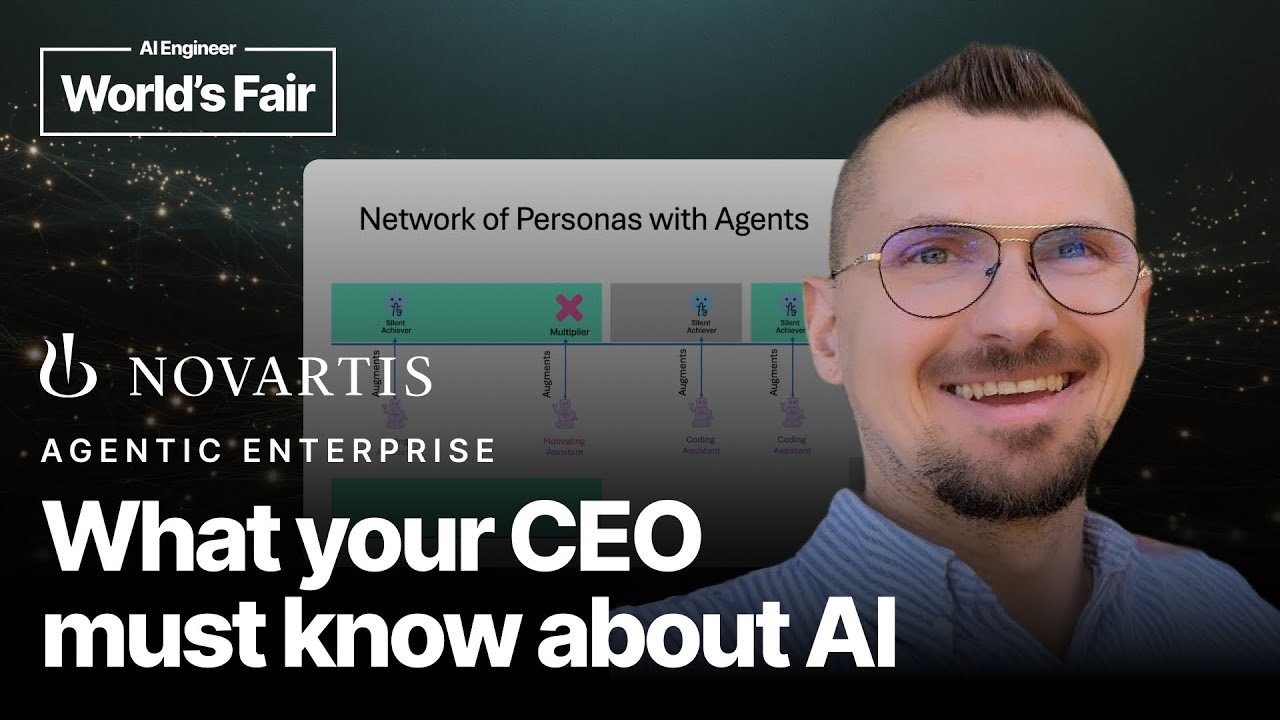
Misztela argues that traditional roles and job descriptions do not show enough about how people contribute to a workflow. He suggests viewing contributors as personas, including the silent achiever, the individual contributor, the connector, the multiplier, and the knowledge hub. A connector links non-adjacent teams. A multiplier increases the work of other team members. A knowledge hub provides domain information. Comparing these patterns across workflows can reveal repeated problems and suggest where an agent would help.
Agents can change workflows by extending individual and team capacity
In Misztela's example, a silent achiever with a coding assistant becomes productive enough to combine two workflow steps that previously required separate people. An agent can also extend a multiplier's communication from adjacent colleagues to the whole team. A knowledge-hub agent can distribute information across an entire workflow instead of supporting only one or two people. The point is that organizational change depends on how people actually contribute, because agents may merge steps, extend influence, or replace specific knowledge functions.
Repetitive work fits agents while ambiguous work may still need people
Misztela says companies should ask which tasks are better handled by humans and which by agents. Ambiguous workflows are harder to define and may remain with people, especially when subjectivity is intentional. Agents are more suitable when a task is repetitive, tedious, and expected to be performed the same way every time. He expects intelligence and domain knowledge to become cheaper and more available, increasing the value of context understanding, multidisciplinary knowledge, and deep specialization.
Employees will need to build agents from their own work
Misztela describes a progression from general assistants to individual assistants with memory and personal context, followed by agents that support teams and workflows, and eventually swarms of agents. He says employees should be able to build agents on the spot with coding assistants, no-code tools, low-code tools, or code agents. To do this, they first need cognitive self-awareness: they must notice the hidden steps they perform across systems and translate those steps into an agent or workflow.
Digital twins could preserve organizational knowledge after people leave
A digital twin could represent an experienced employee's knowledge and previous expertise. Misztela imagines asking this agent questions and reconstructing past decisions or practices instead of losing that history when the employee leaves. He calls this a form of time travel through organizational memory. The same idea can expand from one employee to several employees, then to a team or workflow. It depends on retaining context that documents and presentations may not contain.
Autonomous agents require adoption decisions and explicit values
Misztela separates technical problems such as hallucinations, groundedness, guardrails, and security from two organizational questions: adoption and ethics. People may accept agents assisting with tasks before they accept agents driving the interaction and delegating subtasks back to humans. Organizations also need to define the values agents should preserve, since people do not agree on every value. He raises the possibility of using another agent to resolve conflicts between humans and AI systems.
"If your strategy still makes sense when you swap AI agent with some other word like machine learning or data, it still makes sense after swapping that means that strategy is already outdated."26:39
Who should watch
Executives who need to understand what information and workflow mapping an agent strategy requires before approving deployments.
Engineering and operations leaders whose processes depend on undocumented employee knowledge or repeated manual steps.
People planning internal AI assistants who need to think about adoption, organizational roles, memory, and autonomous decision-making.