Enterprise agents need production controls such as permissions, audit logs, security, compliance, and cost tracking before they can handle real business work.
2
Teams should build agents for core products and competitive advantages, while using managed platforms for commodity workflows that need to ship in days.
3
A likely future has a small number of purpose-built agents alongside a larger set of business agents hosted on platforms.
Summary
Donald Hruska argues that companies are moving beyond chatbots and code generation toward agents that can operate inside production systems. An agent can be simple to build: an LLM runs in a loop, chooses tools, receives their results, and stops when it has an answer. Production deployment is harder because teams must handle access control, external integrations, audit trails, compliance, security, hallucinations, token costs, and evaluation. Hruska compares four approaches: building from scratch, using a framework such as LangGraph, adopting a managed platform such as Retool Agents, or choosing a vertical tool for one narrow task. He recommends building agents that sit inside a core product or create competitive advantage, while buying for commodity workflows that need to ship quickly. He expects companies to combine both approaches, with a few hand-built agents and a longer tail of platform-hosted business agents.
The next enterprise AI step is connecting agents to production systems
Hruska says half a trillion dollars has gone into AI infrastructure while many large companies remain stuck with toy chatbots and code generation. He expects that to change as enterprises build agents with guardrails and connect them to real production systems. He points to enterprise spending as a major source of growth for AI providers. Coding tools such as Cursor and Windsurf already show how developers work with models that prompt, write code, and support code review. For Hruska, this is evidence that agentic workflows are already useful in software development.
Vibe coding works because coding gives agents a task they can check
Hruska describes vibe coding as telling Cursor or Windsurf the gist of an idea and letting the system think, act, and write code. He distinguishes this from text completion or copying code from ChatGPT into an editor. Code has semantics, is testable, and can be validated, which makes it easier to tell whether the model did the job correctly. He asks whether the same approach can extend beyond code to business problems. That would require general-purpose agents that can operate through tools and business systems.
A basic agent is an LLM inside a tool-using execution loop
Hruska says a basic agent can be built in about 100 lines of JavaScript or Python. Using the ReAct framework, the agent repeatedly reasons and acts until it reaches a final answer. Its tools are functions that can call external services or code in the company's codebase. The loop sends a prompt to the model, lets the model request a tool, passes the tool result back, and detects when the model has finished. A maximum iteration count prevents the agent from looping indefinitely and consuming OpenAI costs.
Production agents need controls that quick prototypes do not have
The hard part begins when an agent has to run in an enterprise. Hruska lists single sign-on, role-based access control, secure connections to external services, audit logs, SOC 2 compliance, secrets management, and internationalization. Models can hallucinate, return inaccurate or made-up results, access too much, or consume too many tokens. Evaluations help make a non-deterministic agent more predictable. Hruska also warns that teams cannot safely rely on automatically generated code for every production concern.
The four implementation choices trade control against engineering effort
Hruska groups agent development into four options. Building from scratch gives a team full control and a purpose-built system, but requires work on every supporting component. A framework such as LangGraph offers flexibility and features such as different memory modes with a medium engineering lift. A managed platform such as Retool Agents provides opinionated defaults, hosting, connectors, and observability with less work, though the team becomes tied to the platform. Vertical agents focus tightly on one use case and allow little flexibility beyond it.
Core product work usually deserves a hand-built agent
The build-versus-buy choice depends on the agent's role and the company's constraints. Hruska recommends building when the agent is part of the core product or gives the business a competitive edge. Regulated data and hard service-level agreements require a more careful assessment of both options. For commodity workflows that need to ship in days rather than quarters, he would generally buy. He also tells teams to count token, infrastructure, engineering, and observability costs, then inspect individual runs and estimated costs.
Companies will likely use a few custom agents and many platform-hosted ones
Hruska compares future agent architecture with how businesses buy software. Stripe builds its core billing logic and customer-facing applications, while using external platforms for its long tail of software. He expects companies to follow the same pattern with agents. Cursor would build an agent for its core product because it needs control and speed, but the company might later use a platform for tasks such as billing chargebacks or customer support. The distinction depends on whether the work is central to the product.
Falling inference costs make more business automation practical
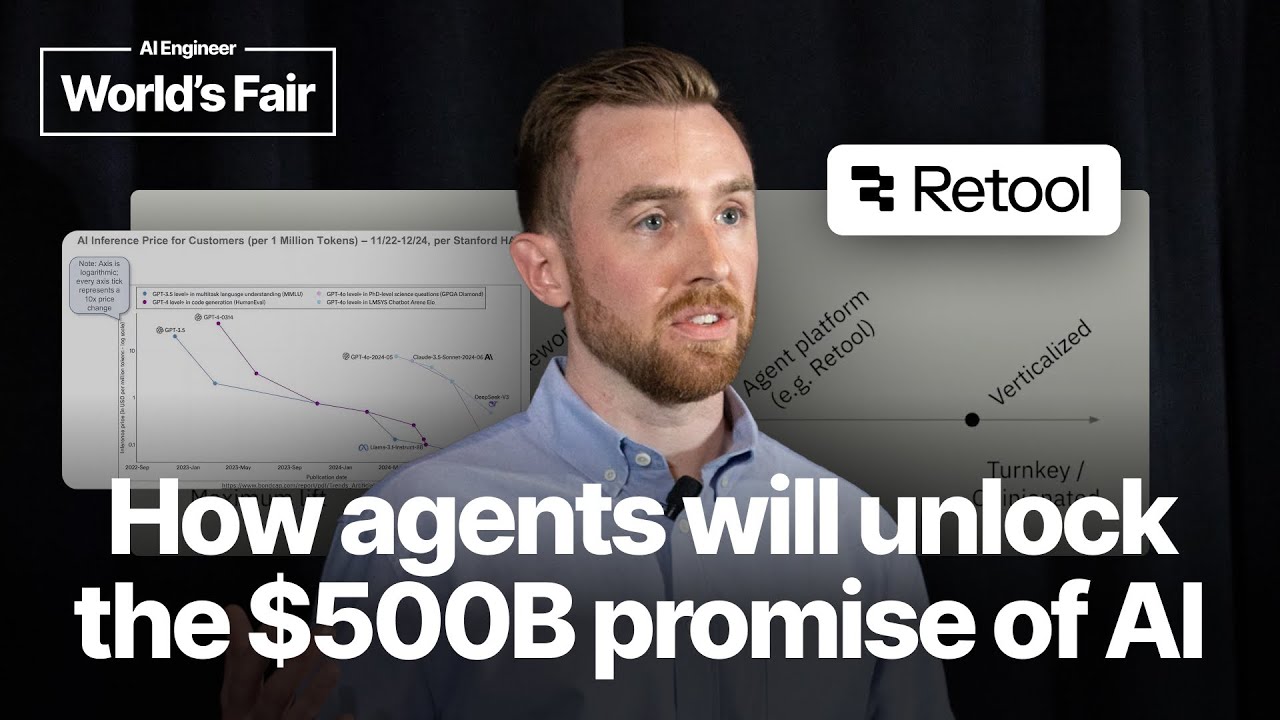
Hruska cites an AI trends report that says cost per token fell 99.7% from 2022 to 2024. He says Retool charges $3 per hour for its cheapest agent and expects that cost to keep falling. He also cites a large increase in searches for AI agents. In customer examples, ClickUp saved more than $200,000 in vendor costs and hundreds of thousands of dollars in headcount, while Dscript estimated hundreds of hours of work saved each week through 50 apps. Retool says its customers have automated more than 100 million hours of work.
"The question isn't what is the single golden ticket way to put everything in my business on autopilot. It's where can I help my engineers create the most leverage and what's the right tool for the job."13:50
Who should watch
You are deciding whether an internal workflow should use a hand-built agent, a framework, or a managed platform.
Your team has an agent prototype and needs to think through permissions, integrations, evaluations, compliance, and operating costs before deployment.
You build business software and want examples of where an agent platform may fit alongside custom product engineering.