Coding agents have made writing code nearly free, so code review, operations, and security become the next constraints.
2
The work agents are least likely to replace is finding out what people need and defining what good software means for a specific business.
3
Engineers need to become product engineers who understand users, write specifications, and use agents to build and ship software.
Summary
Laurie Voss argues that coding agents have changed the constraint in software development. Developers can produce far more code, but shipping has not sped up by the same amount because review is still slow. Even when code review, operations, and security become more automated, Voss expects the hard human work to remain in understanding a business problem and deciding what a good solution looks like. That knowledge is usually not in training data. It has to be drawn out of customers and turned into a specification. He calls the resulting role the product engineer, a combination of product judgment and engineering execution. Voss also warns that the traditional junior developer path is collapsing because agents now handle the well-specified tasks that used to train beginners. Engineering leaders need to create new ways to train people in customer conversations, problem definition, specifications, and evaluation. He is direct that the transition will be painful for people who mainly love programming as a craft.
Agents have made code generation almost free compared with the time engineers used to spend writing it. The work after coding has not sped up at the same rate, so the constraint has moved to code review. Voss cites a study showing that humans' ability to understand code falls sharply beyond about 450 lines per hour. A 10,000-line agent-generated diff could take about a week to review properly, which means teams often approve code without doing that work. His prediction is that review will eventually be automated too, after which the constraint will move again.
AI review is useful, but it does not yet agree with itself
Voss says AI reviewers already handle a significant share of reviews on GitHub, and some teams let them approve changes before production. The problem is reliability. Four AI reviewers in the data he found each identified real bugs, but none agreed on an individual bug. A benchmark that asked whether a maintainer would merge a change produced a much lower pass rate than a test-based benchmark because maintainers also consider style, side effects, external systems, and repository history. Those factors are often held in the maintainer's experience rather than written in the codebase.
The constraint keeps moving through operations and security
Voss uses Eliyahu Goldratt's theory of constraints to explain why faster coding does not automatically produce faster delivery. Every system has a bottleneck, and fixing one causes another to become visible. After code review, he expects deployment, scaling, and security to become the next constraints. He thinks these areas can eventually be automated because humans have accumulated extensive procedures and data about them. He estimates that operations, scaling, and security may take five to ten years to sort out, rather than arriving all at once.
Understanding what good means remains outside the code
The work Voss thinks agents will struggle to replace is deciding what to build, defining what good means, and making the result fit a real user's situation. A request such as keeping track of orders can lead to very different software for a bakery, an auto parts store, or a manufacturing company. The relevant knowledge is in the business owner's mind, so engineers have to talk with that person to extract it. Voss says this knowledge does not transfer cleanly between similar products. Configuration-heavy software often fails because it tries to serve many situations without understanding any one of them deeply.
Specifications turn human judgment into something agents can use
Voss connects his argument to Fred Brooks's distinction between accidental and essential complexity. Tools can reduce the accidental difficulty of syntax and typing, but they do not remove the difficulty of the underlying problem. He also cites Sean Grove's description of code as a lossy projection of a specification. Once a team writes down what good means, that information can become training data or an evaluation. Cognition's mergeability benchmark and Cursor's BugBot rules illustrate the same process. When maintainers record decisions that previously lived in their heads, the bottleneck can move again.
The product engineer combines customer understanding with delivery
Voss argues that product and engineering roles are beginning to collapse together. He compares the emerging role with the systems analyst of the 1960s, who talked to a business and worked out its problem before code was written. He calls the new role the product engineer: someone who finds out what people need, defines what good looks like, and ships the result with agents doing the typing. He says forward-deployed engineering roles resemble this pattern, although companies use many different titles. In this model, being a software developer is no longer the same as being a programmer.
The old junior developer ladder no longer trains the needed skills
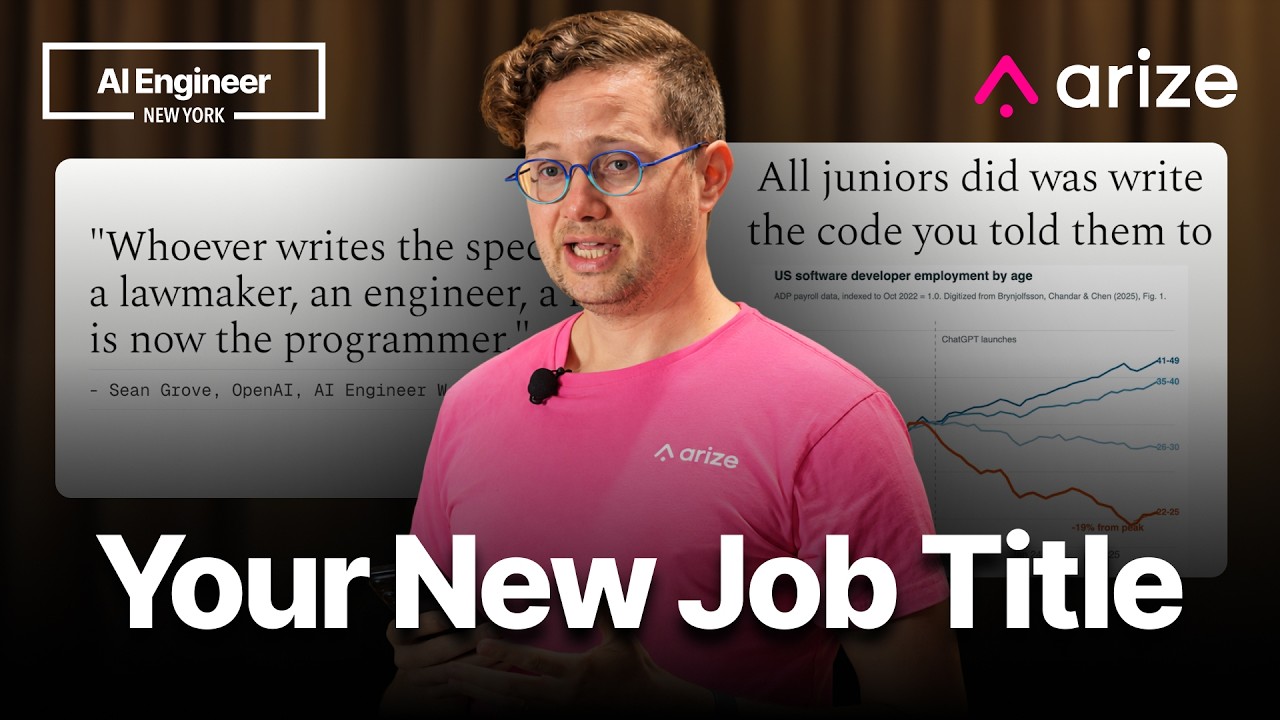
The traditional junior role involved implementing well-specified tickets and receiving feedback from a senior engineer. Coding agents can now perform much of that work, so companies need a different way to train new engineers. Voss points to labor data showing falling employment for engineers aged 22 to 25 while employment for older engineers has risen. He says existing programs produce far fewer product-oriented engineers than the market may need. Universities teach technical foundations and boot camps teach frameworks, but few programs teach someone to spend time with a customer and return with a useful specification. Engineering leaders will need to build that training themselves.
Programming can remain a craft even if it stops being the paid job
Voss acknowledges that many people entered software because they enjoy clean abstractions, difficult bugs, and making a machine do exactly what they intended. He does not offer a way to preserve that work as the main paid job. He suggests that some programmers may actually value the moment before typing, when they understand the problem and see how to turn it into a repeatable system. Programming can continue as a personal craft, much as woodworking continued after furniture factories appeared. His prediction is that the transition will be ugly because the junior ladder is disappearing before replacement training exists.
"The bottleneck moved from writing code is really slow and all of this other stuff happens at roughly the same speed to writing code is super fast and now we get stuck behind new things."01:14
Who should watch
You lead an engineering team and need to decide what code should still receive human review as agents produce more of it.
You are designing hiring or training plans and need to replace the old junior path of implementing tightly specified tickets.
You are an engineer who wants a concrete account of how customer conversations, specifications, and evaluations may become part of the job.