Long-running agents need a stateless harness, durable sessions, separate execution containers, and credentials kept outside those containers.
2
Independent verifier contexts let agents check their work and continue iterating until they reach a measurable outcome.
3
Agents can write their own memories, but offline dreaming is needed to find and correct memories that were locally useful and globally wrong.
Summary
Lance Martin describes how Anthropic is building agents that can work for much longer without constant human steering. He traces the shift from short model interactions to coding agents and managed asynchronous agents, then focuses on the architecture needed for this setting. The harness, or agent brain, should be separate from execution containers, or hands. A persistent append-only session protects work when either process fails, while a separate credential vault limits exposure. Martin also recommends independent verifier contexts for checking work, rather than asking the same context to build and grade. He describes model-written memory and an offline dreaming process that reviews past sessions and corrects bad memories. Finally, he argues that shared organizational harnesses will let many people use common context, identity, connectors, and proactive workflows.
Longer task horizons require different product surfaces
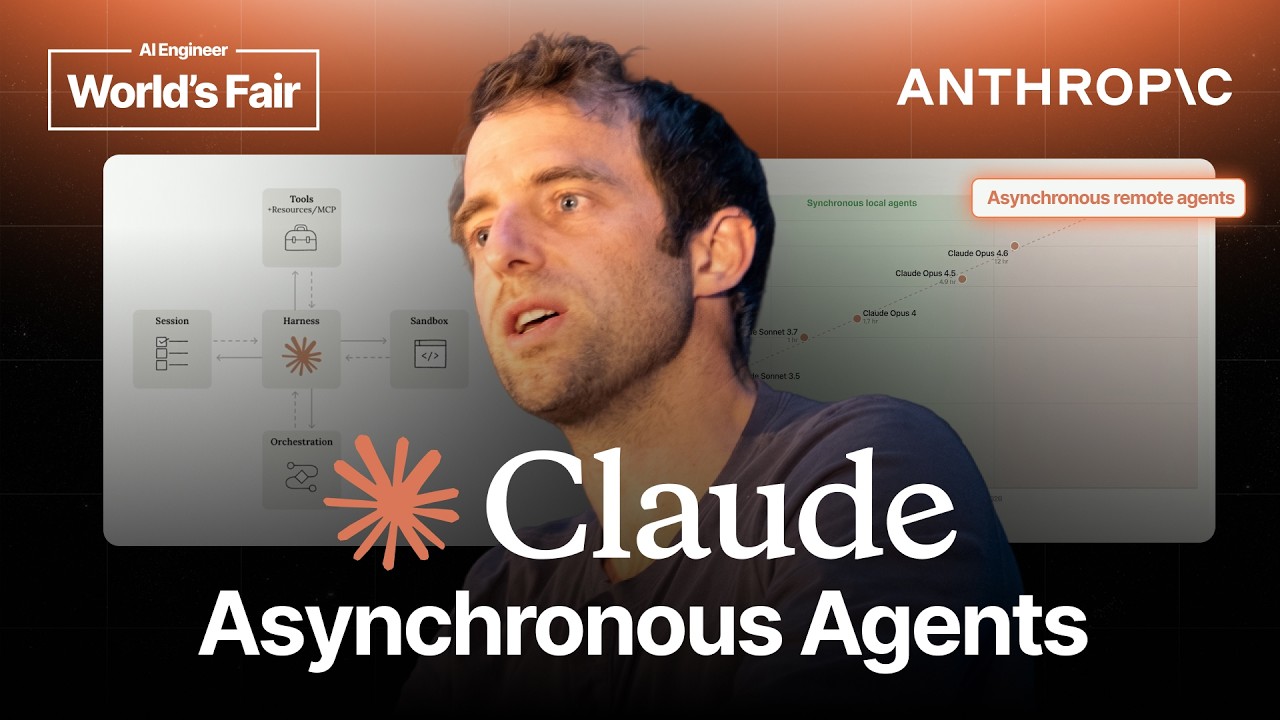
Martin compares Claude models with the products built around them. In the Opus 3 period, models could work autonomously for roughly 10 to 20 minutes, so autocomplete and chat made sense because a person stayed closely involved. Coding agents later extended that horizon to about an hour and usually ran locally, where users could steer them. As models began working for longer periods, Anthropic introduced Managed Agents, which packages an agent harness with managed deployment infrastructure. The product surface changes as the amount of autonomous work increases.
The harness should be separate from the environments where work happens
Martin calls the harness the agent's brain and the execution containers its hands. An early Managed Agents design put both in one container, so a container or harness failure could destroy the session. It also placed credentials too close to an agent that might run unattended for many hours. The newer design makes the harness stateless and connects it to a session backed by an append-only event log. That session can reach multiple sandbox containers, while credentials stay in a separate vault. A failed harness or sandbox can therefore be replaced without losing the work.
An append-only session gives the model durable context
The session is also an external context object that the model can query. Martin connects this design to recursive language model work and to context engineering. Compaction normally discards context that is not retained in the compacted result. With a persistent append-only session, the original context remains available, so the model can fetch older information later. The context object is non-destructive: new events are added, while earlier events are not overwritten. Martin says this is useful for managing context across long-running tasks.
Independent verifier contexts make agent loops more reliable
Martin warns that a model asked to do work and then grade that same work from the same context can produce confabulation and other odd behavior. A separate verifier context can be tuned for critical checking and given a specific goal or rubric. The build context produces the work, and the verifier checks the result in a loop. The loop ends only after the independent verifier confirms the requested outcome. In Claude Code, the primitive is described through goals, while Managed Agents uses outcomes, but both establish a measurable end state.
Feedback from the environment lets strong models self-correct
Martin describes using a verifier loop on Parameter Golf, a benchmark that asks a model to conduct machine-learning research under a small-model, limited-time setup. He configured the agent to continue until it completed the required iterations and met the benchmark's experimental criteria. His point is that the environment carries the correction signal instead of requiring a human to steer every step. The model receives feedback from the verifier, changes its work, and keeps iterating. Martin presents loops paired with high-capacity models as a general primitive for long asynchronous tasks.
Model-written memories improve as models learn to abstract
Martin compares in-band memory with the hippocampus writing short-term traces during the day. In his examples, Claude receives simple memory tools that let it write files in a memory directory. In a Pokémon task, older models wrote tactical notes and made limited progress, while newer models wrote more strategic notes and progressed further. He also describes a continual-learning benchmark involving sequential questions over a SQL database, where performance improved across model generations. The difference between lower- and higher-capacity models was the ability to distill reusable abstractions instead of saving only isolated facts.
Offline dreaming can repair memories that fail later
In-band memory can contain incorrect information or notes that help with the current task while harming future tasks. Martin describes an offline dreaming process that reviews the memory store and earlier sessions, then consolidates and corrects what was written. In a Pokémon example, an incorrect location memory repeatedly caused the agent to fall through a trapdoor. This happened in five out of five raw-memory runs. With dreaming, the memory error was corrected and the agent advanced. Martin uses the example to show why memory writing needs a later process that can review consequences across sessions.
Shared organizational harnesses will make agents multiplayer and proactive
Martin describes Claude Tag as an organizational harness rather than simply a Slack bot. A personal coding agent has one user's local context, identity, and configuration. An organizational harness has shared access, its own identity and credentials, and organizational context. That can support checking another person's work, deduplicating findings, conducting internal research, and giving new employees a developed harness immediately. Martin expects these systems to work across many users and to run longer asynchronous tasks. They can also proactively alert people based on organizational context, instead of waiting for a direct request.