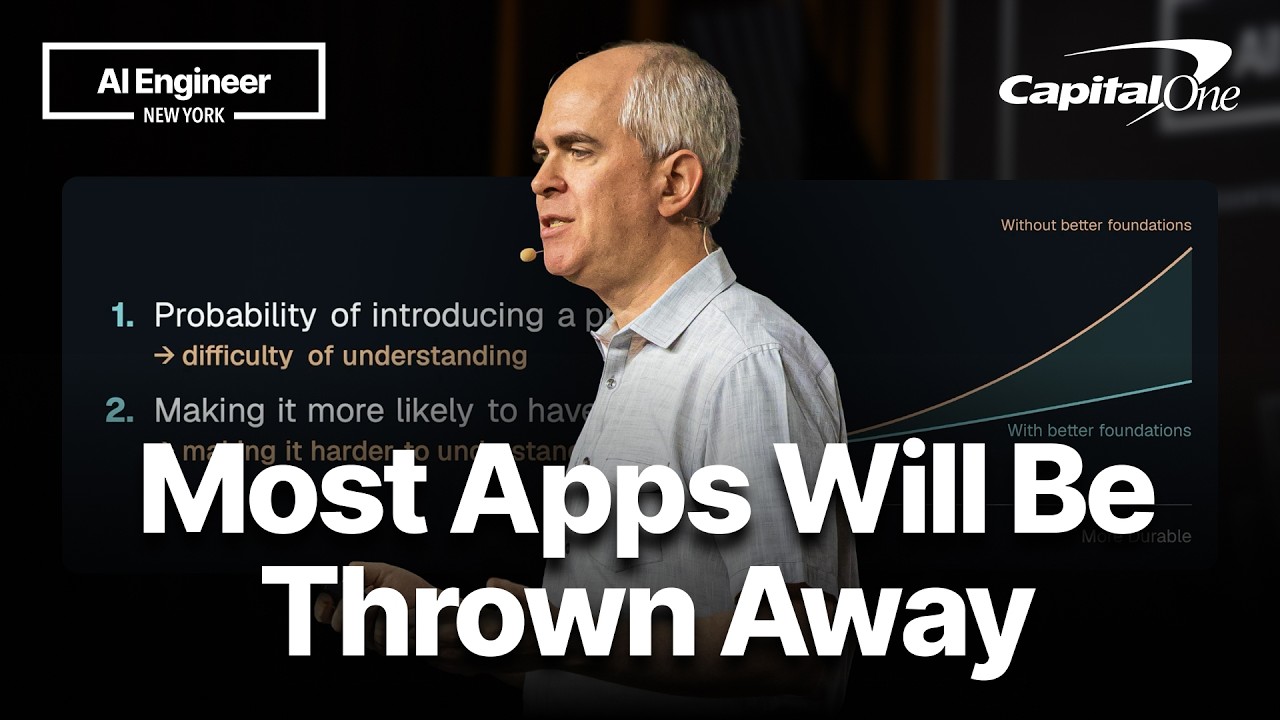
Code quality exists to help engineers understand a system and safely change it.
2
Disposable software has few dependents, low failure consequences, cheap replacement, and little maintenance cost, so code quality matters less for it.
3
Durable software still needs engineering rigor, but standardization, automatic tooling, easy testing, and strict rules can make that rigor cheaper.
Summary
Max Kanat-Alexander argues that code quality has always served two purposes: understanding what a system does and changing it safely. Structure makes complex software understandable, while poor understanding creates immediate problems and makes future changes riskier. AI is increasing the amount of disposable software, where failure has limited consequences, few systems depend on the code, replacement is cheap, and maintenance costs little. In that case, quality work may not be worth its cost. Durable software is different and will remain important, especially where many people or systems depend on it. Teams can make some software more disposable through isolation, independence, redundancy, and narrow scope. They can also reduce the cost of rigor through standards, automatic in-workflow tools, fast deterministic tests, shared fakes, and strict lint rules. The answer depends on the software's position on the disposable-to-durable spectrum.
Code quality helps engineers understand systems and change them safely
Max Kanat-Alexander reduces software success to understanding and executing on that understanding. For engineers, the most important questions are what the system actually does and how to modify that behavior correctly and safely. Debuggers, observability, evaluations, and tests support one or both of these abilities. He argues that code quality has no separate purpose beyond improving understanding or making safe execution easier.
A tiny program can be explained directly, but a large system has too many possible interactions to describe as a whole. Chromium illustrates the problem: its components can have effectively infinite combined behaviors, while individual parts such as its URL parser can still be understood. Two programs may both print 'Hello World', yet one has recognizable structure and the other is only an unorganized sequence of instructions. At large scale, structure matters more than readability or testability considered in isolation.
Every change risks causing a problem and increasing future risk
Every modification carries two risks. It can cause an immediate problem, such as a bug, a missed user need, a schedule overrun, or a budget overrun. It can also make future changes harder and increase the chance of later problems. These risks come from difficulty understanding the current system and from making the system harder to understand after the change. Max describes a compounding cycle in which understanding gets worse until almost every modification creates trouble.
Disposable software has conditions under which quality work has little value
Disposable software has minimal consequences if it fails, few people and systems depending on it, little change management, near-zero replacement cost, and almost no maintenance cost. In that setting, the risks that code quality normally controls do not build up over time. Max gives examples such as making a calculator for one person's use or writing a party planner for a single event and then throwing it away. For this category, code quality does not matter much.
Durable systems live for years, support many people or systems, can cause serious business consequences when they fail, and require substantial maintenance. Max expects these systems to remain important and says their total amount may increase because AI coding tools make it easier to create them. The difference between disposable and durable software is a spectrum, measured by consequences, replacement cost, dependencies, and maintenance cost. He advises engineers to assume more durability than they initially expect.
Teams can make software more disposable through isolation and limited scope
Software becomes safer to treat as disposable when it runs in an isolated environment with access only to its own data, has no inbound calls from production systems, and has limited scope. Redundancy also helps. A new front end can be allowed to fail if an older, durable system remains available as a backup. These controls reduce the consequences of failure and the number of dependencies, which moves the software toward the disposable end of the spectrum.
Cheap rigor makes it easier to change your mind about durability
The amount of engineering effort should vary with the software's durability, but Max says teams should also reduce the cost of applying rigor. If a system thought to be disposable later needs to become durable, cheap rigor makes that change easier. Standardization removes choices and therefore removes work, such as deciding which PHP linters, practices, and security fixes to use. Limiting frameworks and protocols has the same effect.
Automatic tools and strict defaults reduce the ongoing cost of quality
Max recommends tooling that runs automatically inside the programmer's workflow, without requiring a separate decision or deep knowledge of how it works. It should be fast, reliable, and have few false positives. Testing infrastructure should make tests fast and deterministic, with shared in-memory fakes for services. He also recommends maximum strictness in linting. Turning strict rules on early avoids a large backlog of violations later, as long as false positives are limited and the consequences are manageable.