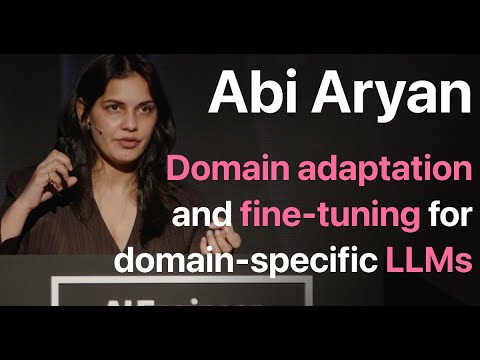
Domain adaptation choices range from prompting and RAG to full or parameter-efficient fine-tuning, and the right option depends on the task, domain, data, and resources.
2
Adapter tuning, prefix tuning, and parameter-efficient methods such as LoRA reduce the cost of adapting large models by changing only a small part of the model.
3
Fine-tuning quality depends heavily on data preparation and task-specific evaluation, so teams must assess the whole production pipeline rather than compare a tuned model directly with GPT-4.
Summary
Abi Aryan presents a practical framework for adapting large language models to enterprise and hobby use cases. He compares prompting, retrieval-augmented generation, and fine-tuning, then explains adapter tuning, prefix tuning, LoRA, and QLoRA. Full fine-tuning updates every model weight but needs far more compute and storage. Parameter-efficient approaches reduce those requirements, though their support and testing vary across devices. Aryan connects each method to a different need. Adaptive fine-tuning suits several tasks within one domain, while behavioral fine-tuning targets one task. He is direct about the role of data quality: cleaning, normalization, deduplication, tokenization, and augmentation can determine whether adaptation works. He also covers gradient checkpointing, hyperparameters, early stopping, and four evaluation approaches. The talk's central advice is to treat adaptation as a system decision involving data, model choice, storage, drift, cost, and business risk.
Large language models need adaptation because their training coverage is uneven
Aryan says general models such as ChatGPT and open-source LLMs are not trained for every use case. Some domains have little representation, while compliance or other constraints can limit the available training data. Teams therefore need a way to adapt a model or use an alternative such as a knowledge base, RAG, or prompting. He also points to transfer between related languages. Because models learn structural relationships through embeddings, a model may move into a previously unseen language more easily when that language has semantic similarities with one it already knows. This reduces the need to collect entirely new data for every domain.
Fine-tuning changes model parameters, but updating every weight is expensive
Aryan describes fine-tuning as improving a pretrained model for something it has not learned before. The standard process updates weights and biases through the model's layers. Updating all weights can work, but it requires substantial computation and storage. Earlier transfer-learning and teacher-student approaches fit this pattern. As model parameter counts grow, Aryan says teams increasingly need methods that update only part of the model while aiming for comparable performance. He cautions that these methods should not automatically be expected to match ChatGPT. His distinction is practical: the adaptation method must account for the available hardware and the performance target.
Adapter and prefix tuning add small changes while leaving the main model intact
Adapter-based tuning adds a small number of parameters to an existing Transformer. The original model remains in place, while adapter components hold the extra weights that expose the model to new information. Aryan cites the original paper's result that the approach could match model performance with 0.15% of the parameters. He recommends this approach when learning a new domain, such as biochemical engineering. Prefix tuning takes a different route. It adds learned prefixes or an embedding layer before the attention layer, so the model can mimic a desired behavior without changing its existing weights. Aryan compares this to water flowing through a tap: the underlying supply remains, while the added interface shapes access to it.
LoRA and QLoRA reduce adaptation size for limited hardware
Aryan presents LoRA as a low-rank adaptation method for compressing the changes needed during fine-tuning and running models on lower-resource devices. Its basic idea is to identify redundant structure in weight matrices and avoid storing layers that duplicate information already present. This reduces model size and memory use. QLoRA extends the approach by changing model weights to 4-bit precision. The process starts with a pretrained model and labeled data, trains an adaptation matrix, and combines it with the main weight matrix to reduce the distance between source-domain and target-domain outputs. Aryan is more cautious about QLoRA's practical readiness. It depends on bitsandbytes and other libraries that are not available on every device, while LoRA has not been tested equally across all models.
Prompting, RAG, and fine-tuning solve different adaptation problems
Aryan groups domain adaptation into prompting, RAG, and fine-tuning. Prompting can use zero examples, one example, or several examples, with around 10 examples described as a useful rough answer for few-shot prompting. It costs less, needs less training data, and suits more generalizable demonstrations, but usually performs worse than fine-tuning. Fine-tuning itself can be adaptive, behavioral, or parameter-efficient, and these methods can be combined with prompts and RAG. Adaptive fine-tuning fits several tasks inside one domain, such as multiple legal tasks for a legal company. Behavioral fine-tuning targets one task and optimizes its label space and prior probability distribution. Parameter-efficient fine-tuning freezes most parameters and updates a small amount through methods such as LoRA.
Data preparation determines whether fine-tuning works
Having the right adaptation method is not enough. Aryan says results depend on how data is collected, tokenized, cleaned, normalized, and sanitized. Teams also need to remove noise, deduplicate examples, and consider data augmentation. He cites research arguing that memorization is mainly driven by duplicated data. Repeated examples can create a bias toward particular outputs, so removing duplicates can lower the probability that the model memorizes a task. This makes dataset construction an operational part of model adaptation rather than a preliminary chore. Even a carefully selected base model can underperform when its training examples contain duplication, inconsistent formatting, or irrelevant noise.
Model comparisons and dynamic examples matter when data changes
Aryan warns against comparing a fine-tuned model directly with GPT-4 on complex tasks. A general model may capture nuances in the data used for comparison while missing nuances from a new domain. He recommends in-context learning with dynamically loaded examples to respond to data drift and model drift, while also helping with cost management. He also suggests breaking a large language task into smaller, more specific tasks instead of training one model for an entire language or broad problem. Gradient checkpointing is another memory tradeoff. It recomputes values during the backward pass, increasing computation but reducing memory consumption. For teams with limited hardware, Aryan considers that tradeoff worthwhile.
Evaluation must match the business use case and include more than one signal
Aryan calls evaluation the hardest part after fine-tuning because generic benchmarks do not describe every business need. He proposes four components. Metric-based evaluation can use measures such as BLEU and ROUGE. Tool-based evaluation can catch issues such as compilation errors, with Weights & Biases libraries mentioned as an example. Model-based evaluation uses a smaller model to assess another model, which could standardize and automate evaluation but is difficult to make reliable. Human review remains part of the picture, although Aryan questions its efficiency. He also recommends regularization and early stopping, and says teams should inspect a training batch when performance declines rather than assume that more training is the answer.
Production adaptation is a pipeline decision, not a single fine-tuning choice
Aryan closes by widening the decision beyond the fine-tuning algorithm. Teams need to plan data collection, storage management, base-model selection, and the handling of data drift and prompt drift. A method that works for a one-off demo may fail in a sustained application. The production system also needs checks that reduce reputational and compliance risks before they reach an enterprise. Aryan does not give one universally best adaptation method or a fixed testing period. His position is that performance comes from the whole pipeline, including the data and evaluation process. Fine-tuning can be useful, but it cannot compensate for weak operational choices around the model.
"My goal is to sum up all the literature for you to be able to make an informed decision on how to be able to do domain adaptation for your particular Enterprise use case or for your hobby use case."00:39
Who should watch
You are choosing between prompts, RAG, and fine-tuning for a domain-specific application and need a practical comparison.
Your team wants to use LoRA or QLoRA on limited hardware and needs to understand the tradeoffs before implementation.
You have a tuned model but lack a business-specific evaluation plan or a clear approach to data drift and production risk.