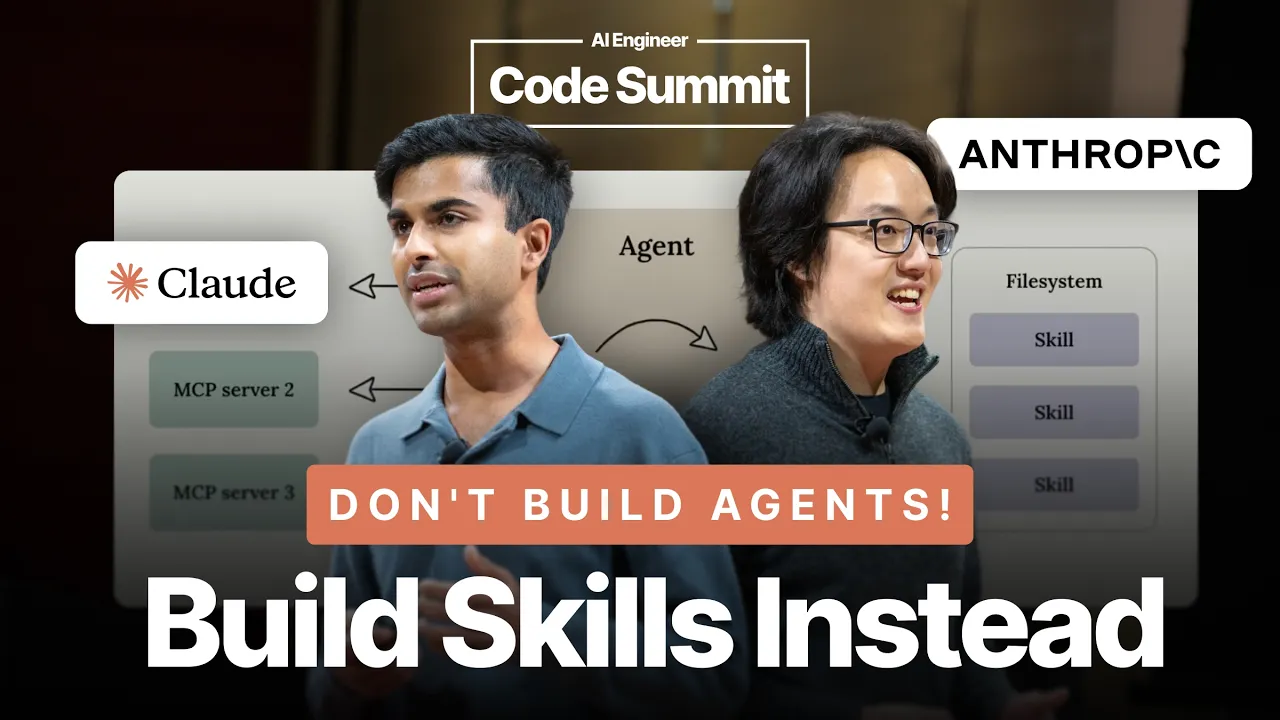
General-purpose agents can use code, a file system, and a runtime to work across domains, but they still need packaged domain expertise.
2
Skills are portable folders containing procedural instructions, scripts, and supporting files that agents load progressively when a task requires them.
3
Skills can spread organizational knowledge, improve through feedback, and eventually be created and maintained by agents themselves.
Summary
Barry Zhang and Mahesh Murag argue that many teams should stop creating separate agents for every domain. A general agent with a runtime, file system, code execution, and connections through MCP can already work across many tasks. Its main weakness is domain expertise. Skills address that gap through simple, shareable folders containing instructions, scripts, assets, and other files. An agent sees only a skill's metadata until it needs the skill, which allows many skills to coexist without filling the context window. The speakers describe foundational, partner-built, and enterprise skills, including examples for office documents, scientific research, browser automation, and internal company practices. They also discuss testing, evaluation, versioning, dependencies, and distribution. Their longer-term goal is an evolving knowledge base where people and agents add procedural knowledge, then reuse it across a team or community. Skills give this knowledge a concrete format that future versions of an agent can read and apply.
Code and a runtime make the underlying agent more universal than expected
Anthropic initially expected agents in different domains to need separate tools and scaffolding. After building Claude Code, Zhang and Murag found that code can act as a general interface to the digital world. A model can call an API, organize data in a file system, analyze it with Python, and write a report. The core scaffolding can therefore be as thin as Bash and a file system. This lets one general-purpose agent work across many use cases, while domain-specific customization moves into the surrounding files and capabilities.
General intelligence does not provide the procedural expertise needed for reliable work
The speakers compare two people doing taxes: Mahesh as a mathematical genius and Barry as an experienced tax professional. They would choose the tax professional because they need consistent execution based on the current tax code. Agents are similarly capable of impressive work when given extensive guidance, but they often lack important context at the start. They do not absorb a user's expertise well and do not automatically learn from repeated work. Skills were created to package the expertise that a generally capable agent still lacks.
A skill is deliberately simple: an organized folder of procedural knowledge
Skills are collections of files that package composable instructions for an agent. The files can be versioned in Git, stored in Google Drive, zipped for sharing, or created by either a person or an agent. The folder can contain a skill.md file, scripts, executables, binaries, code, assets, and other supporting material. The simplicity is intentional. Anyone with a computer can create and use one without adopting a new specialized storage system or agent framework.
Scripts inside skills can turn repeated model behavior into reusable tools
Traditional tools can have ambiguous instructions, and an agent usually cannot change a tool when it is struggling with it. Code gives the agent something self-documenting and modifiable that can remain in the file system until needed. The speakers saw Claude repeatedly write the same Python script to style slides. They asked Claude to save the script inside the skill for its future use. Later, the agent could run the saved script, producing more consistent and efficient results.
Progressive disclosure lets agents use large skill libraries without filling their context
Skills can contain substantial information, so the runtime initially shows the model only metadata indicating that a skill exists. When the agent decides that a skill is relevant, it reads the rest of skill.md. That file contains the main instructions and points to the rest of the folder. The remaining files stay organized for access when needed. This design allows an agent to have hundreds or thousands of skills available while loading detailed instructions only for the task at hand.
The skill ecosystem includes foundational capabilities, partner integrations, and internal company knowledge
The speakers describe several types of skills. Anthropic built document skills that help Claude create and edit professional office documents. Cadence built scientific research skills for EHR data analysis and Python bioinformatics libraries. Browserbase created a skill for Stagehand, its open-source browser automation tool, and Notion created skills for understanding a workspace and researching across it. Enterprises are using skills to teach agents organizational practices, internal software, code styles, and developer workflows.
Skills add expertise around MCP connections rather than replacing those connections
MCP servers provide connections to external tools and data, while skills provide the expertise for using them. Developers are building skills that orchestrate workflows across multiple MCP tools. In Anthropic's emerging architecture, an agent loop manages the model's context, a runtime provides the file system and code execution, MCP servers connect the outside world, and a library of skills supplies task-specific knowledge. The same agent can then be adapted to a domain by changing its MCP servers and skill library.
Skills could turn organizational feedback into knowledge that every agent can reuse
The speakers envision a shared, evolving capability base curated by people and agents inside an organization. When users give an agent feedback and institutional knowledge, the resulting skills can improve the other agents on the team. A new employee could start with an agent that already knows the team's practices and priorities. Community sharing could extend this effect beyond one organization, just as an MCP server built elsewhere can make an agent more useful. The value grows as more reusable procedural knowledge is added.
Agent-created skills provide a concrete path toward transferable learning
Skills are designed to capture procedural knowledge that an agent can apply to specific tasks. When Claude writes information in the standardized skill format, a future version of Claude can use it efficiently, making the learning transferable. Skills do not record every kind of memory. They focus on procedures. Claude can already create skills with the skill creator skill, acquire capabilities, update them, and discard obsolete ones. The speakers want Claude on day 30 of working with someone to perform better than it did on day one.
"Our goal is that Claude on day 30 of working with you is going to be a lot better than Claude on day one."14:28
Who should watch
You are building separate agents for different business domains and want to know whether a general coding agent can cover more of the common runtime work.
Your team has internal procedures, software conventions, or specialist workflows that are difficult to pass to an agent through one-off prompts.
You build MCP servers or agent products and need a format for packaging the instructions and scripts that explain how those connections should be used.