Pack · 7 talks · 2h 04m to watch, 41 min to read

Coding agents on real codebases

Coding agents look capable in a fresh repository and come unstuck in a ten-year-old one. The context window fills with irrelevant code, regeneration erodes the design, and the engineers who know the hidden constraints stop trusting the tool. These talks turn that failure into a working method. Research, planning and small verified changes keep the agent oriented; skills load house rules only when the task needs them. Amazon's experiment with 50 teams then shows why the same tool produces very different gains when working habits differ, while Figma treats skeptical senior engineers as the people best placed to improve verification. Formal verification raises the bar for code that cannot tolerate a plausible mistake: humans define the specification, while machines supply both code and proof.

1
Dex Horthy, HumanLayer · 20:31 · AI Engineer CODE 2025
No Vibes Allowed: Solving Hard Problems in Complex Codebases

Why first: Horthy names the constraint behind the rest of the pack. The agent's next move depends on what is in its context window, and he sees quality drop once that window is about 40 percent full. His research, plan and implement workflow tries to stay below that line. After this, the other talks sound less like unrelated advice.
3
Barry Zhang & Mahesh Murag, Anthropic · 16:22 · AI Engineer CODE 2025
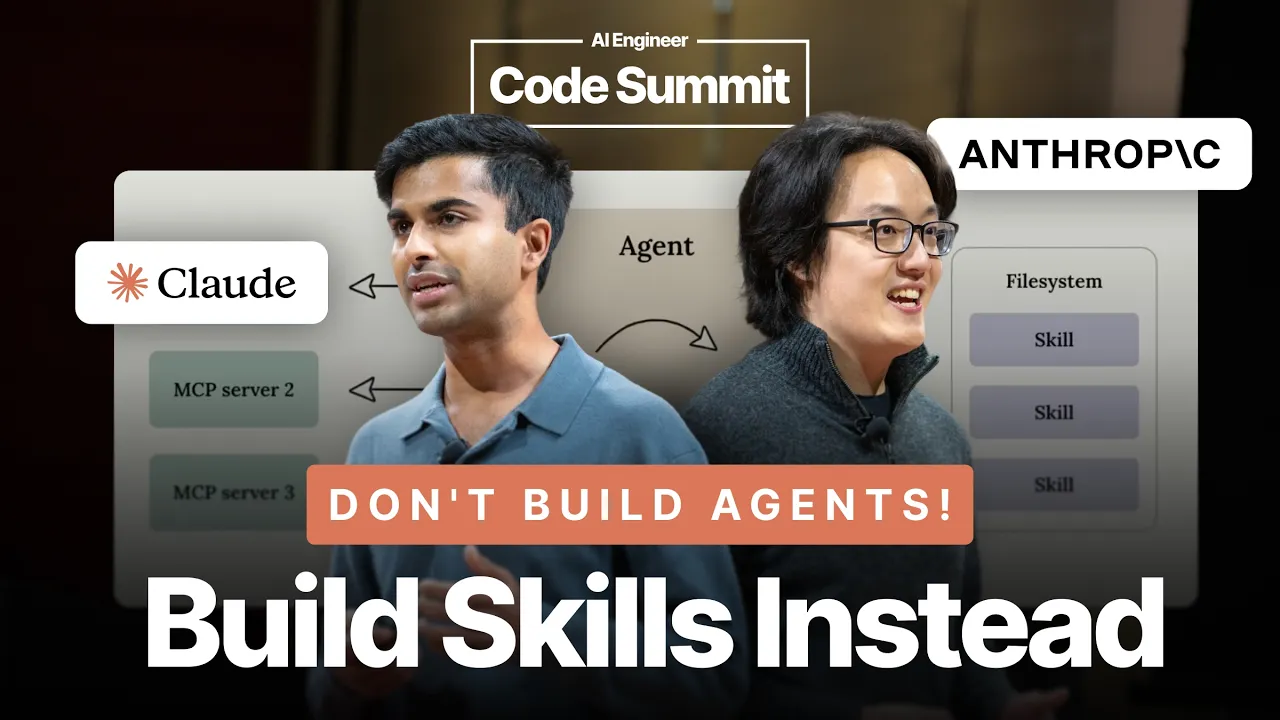
Don't Build Agents, Build Skills Instead

Why here: the first two talks arrive at the same practical answer: write down the house rules and load them only when the agent needs them. Zhang and Murag built that mechanism. The agent sees a skill's name first and reads the folder only when it becomes relevant, which saves its context for the work at hand.

4
Clare Liguori, AWS · 20:57 · AI Engineer World's Fair 2026
From AI-Assisted to AI-Native: Building a Frontier Development Team

Why here: the first talk about a team rather than an engineer. Amazon gave 50 ordinary teams the same tool. Half got under a 3x speedup and half got a median of 4.5x. The tool was the same; what changed was how each team worked. Liguori's five habits take what Horthy and Pocock do alone and apply it across a team.

5
Harald Kirschner, Microsoft · 19:35
How VS Code Went from Monthly to Weekly Releases with AI

Why here: Liguori shows across 50 teams that working habits decide the gain. Kirschner shows one team changing its whole delivery system on a codebase with more than ten years of monthly releases: agents.md files that map the repository, an accessibility skill, builds ten times faster, and agents that open VS Code and check their own UI work. The team now ships weekly.

7
Varun Pant, AWS · 10:07 · AI Engineer World's Fair 2026
Your Code Has Bugs. Lean4 Has Proofs: Formal Verification for Engineers

Why last: every earlier talk ends with a human checking the work, while admitting that humans cannot read pull requests as fast as agents write them. Pant checks a proof instead of reading the code. That only makes sense for the small part of a system where correctness justifies the extra work, so it belongs at the end rather than the start.

After this pack: Harness engineering →