AI adoption moves from simple wins through a loss of trust before teams learn how to add the right context, prompts, and guardrails.
2
The safest path is to improve verification first, encode repeatable checks into deterministic flows, and leave humans to judge product behavior and architectural choices.
3
Skeptical engineers often know exactly where validation is missing, so giving them ownership of the safety roadmap can bring them into the adoption process.
Summary
Eyal Blum describes AI adoption at Figma as a three-act process. Engineers first find small tasks where agents work well, then lose trust when they apply the same approach to larger problems, and finally learn to use better context, prompts, and guardrails. Adoption is uneven, so teams with different levels of confidence still have to work together. Blum says the strongest engineers often adopt last because they carry undocumented system knowledge and see the agents' failure modes first. His practical response is to improve verification, turn useful discoveries into deterministic tests and flows, and write detailed plans that agents can implement. He also argues for attention-aware communication. At Figma, PR descriptions begin with a short human-written explanation, followed by AI-generated text. Blum is candid about the costs, including reduced enjoyment of coding, longer communication, and the embarrassment of sending unmarked AI analysis to a skeptical senior engineer.
AI adoption passes through a loss of trust before teams learn how to use agents well
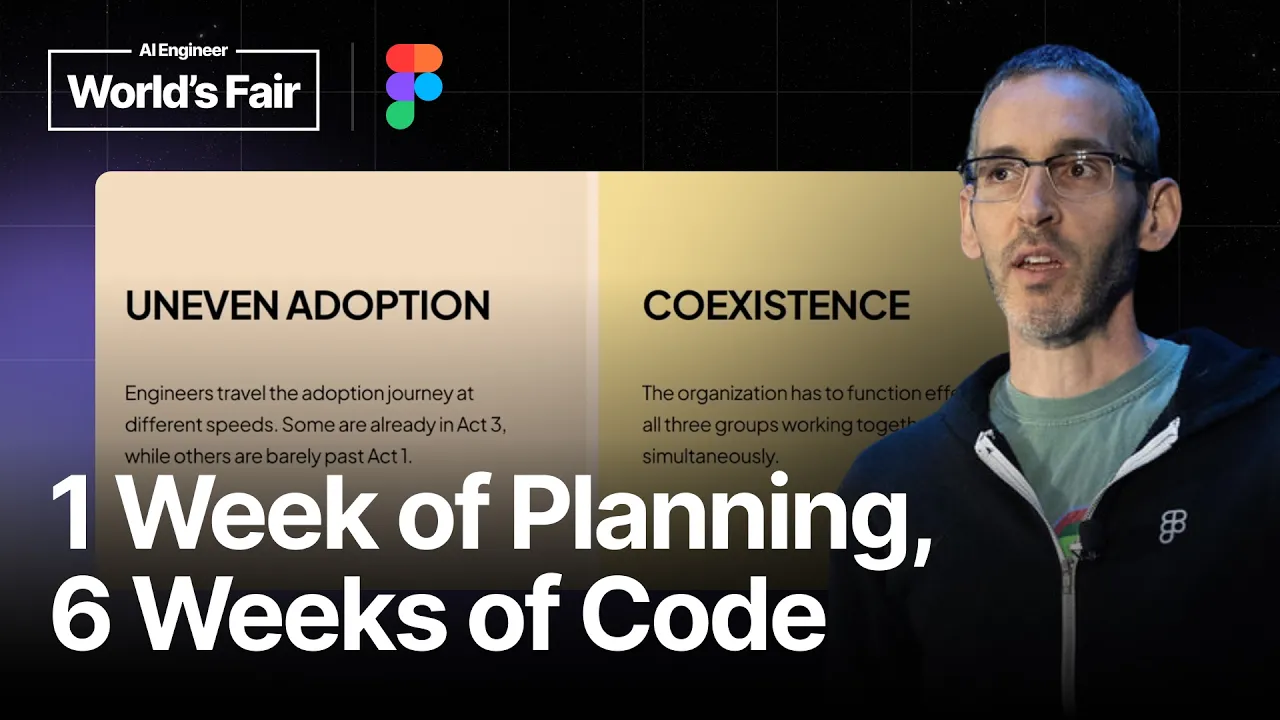
Blum describes three acts. People first pick up simple AI tasks and may get them to work very quickly. They then apply the same habits to larger problems, where the agent produces bugs and poor results, breaking the trust built in the first stage. The third act is learning how to use AI correctly, with suitable prompts, context, and guardrails. Figma has teams in all of these stages at once, so teams that have changed their workflows must work alongside teams that are still experimenting or have already lost confidence.
AI can reduce developers' sense of agency and make communication harder to read
Blum says engineers who enjoyed writing code can lose that satisfaction when their work becomes a cycle of prompting, waiting for output, and responding to the agent. He also says design documents, Slack messages, and emails have become three or four times longer while conveying roughly the same amount of information. The increase in volume makes it harder to tell which parts deserve attention. These costs sit alongside the productivity gains and need changes in working habits, not just new tools.
The strongest engineers often adopt last because they see the failure modes first
Figma's most experienced engineers carry institutional knowledge that was never written down. Blum compares them to people holding a codebase together with mental duct tape. They know where agents are likely to fail and stop bad changes from entering the system, which makes them bottlenecks and leaves them frustrated. Their reluctance is therefore grounded in direct experience. Blum's answer is to take their complaints seriously instead of trying to persuade them to use AI before the codebase is ready.
Verification should move from human effort into repeatable checks whenever possible
Blum calls investment in verification the highest-value work for the codebase. When Playwright and MCP allowed agents to explore code instead of requiring a human to navigate it, his teams gained productivity. He recommends turning useful discoveries into deterministic flows that can be repeated, saving time and tokens while reserving the language model for tasks that require reasoning. He also recommends test-driven red-to-green development with agents. Defining the goal and verification criteria first gives better results than writing code and fitting a test to it afterward.
Agent review should follow a testing pyramid, with humans handling product judgment
Blum applies the familiar testing pyramid to agent review. Linting, compiler checks, and unit tests should cover as much as possible through deterministic analysis. Criteria that can be encoded in the codebase, such as architectural standards, can be checked by an agent. Human review should remain at the top, where people decide whether the functionality is right and whether the team is building the right thing. This division leaves humans with judgments that cannot be reduced to simple checks.
Detailed plans give developers back some of the craft that prompting can remove
Blum recommends spending substantial time on a plan before handing implementation to an agent. At Figma, a plan may take a week to write, review, and refine, while the agent implements it overnight. He says this can restore some of the satisfaction of making decisions and shaping a solution. A good plan starts with a clear why, breaks the work into small independently verifiable parts, and gives every phase a validation gate or exception criterion. If the resulting PR would be too large to review in one sitting, the phase is too large.
Skeptics can own the roadmap for making agents safe
Blum says the engineers who are most skeptical can identify exactly where tools lack validation and where agents fail. Their feedback becomes a roadmap for improving agent interaction with the codebase. He recommends putting those engineers in charge of making AI safe in the organization rather than pressuring them to adopt it immediately. They are more likely to come along when the improvements they request make their own work easier. Blum shows a brainstorm result from a session with colleagues as an example of this approach.
Human-written markers help readers decide where to spend their limited attention
Blum argues that human attention is scarce when AI produces more communication. His team makes every pull request description begin with a short explanation written by a person. AI-generated description follows underneath. Readers can give more weight to the human-written section and treat the generated material with more suspicion. The same principle applies in Slack and email: people should say what they wrote, what the AI wrote, and which parts deserve close reading. Blum learned this after sending a senior engineer an unmarked AI analysis that was judged clearly sloppy.
Adoption can start in the tools and conversations people already use
Figma has many elaborate AI workflows, but Blum says simple access can be more effective for people who are not fully bought in. In Slack, someone can tag an agent in a thread and ask it to complete a task, then let it close the loop in that same conversation. A colleague can suggest trying the agent again without making the request feel aggressive. A good experience in an existing workflow can encourage people to try agents elsewhere. Blum says Figma is still working out how to use cloud agents with its system dependencies.