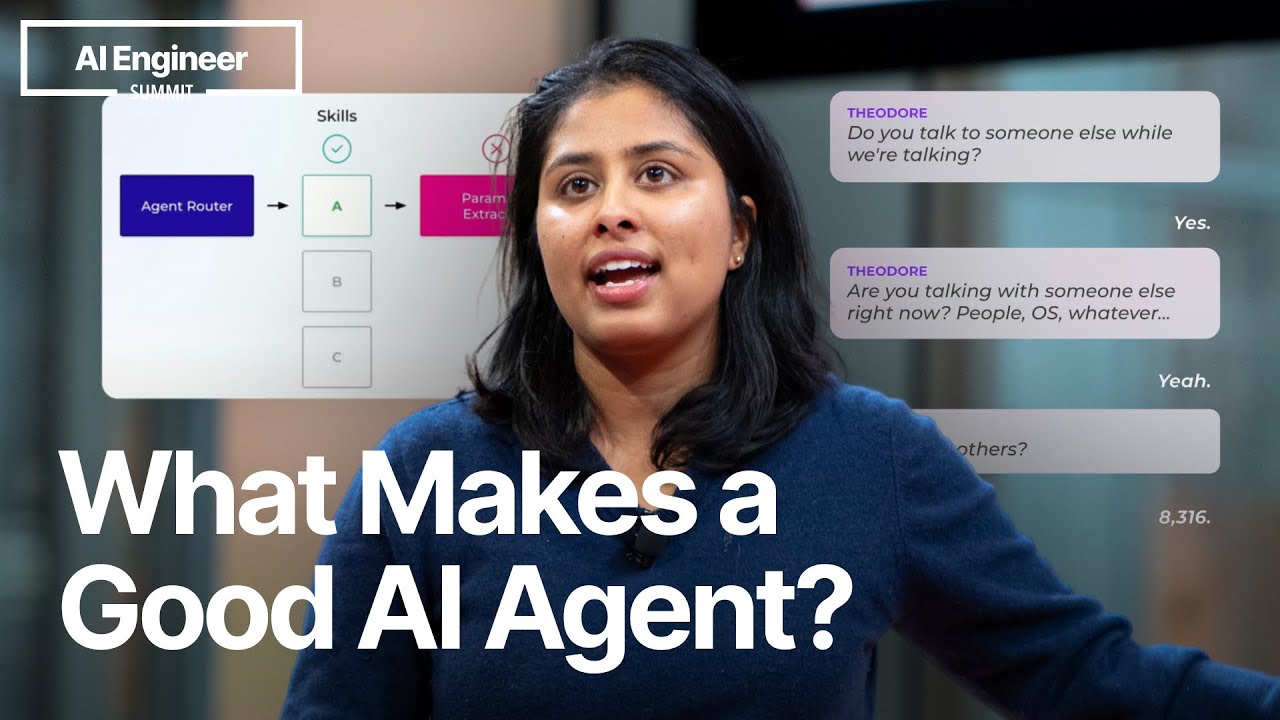
AI agents should be evaluated at each stage of their execution, including routing, skills, parameters, and task completion.
2
Agent teams need to measure whether executions converge on a reliable path instead of taking a changing number of steps.
3
Voice agents require evaluations for audio quality, transcription, intent, sentiment, and conversational tone in addition to text-based checks.
Summary
Aparna Dhinkaran explains how to evaluate agents once they move beyond demos and into production. She breaks an agent into a router that chooses the next action, skills that perform work, and memory that preserves state across turns. Each part can fail, so teams should evaluate routing decisions, parameters, retrieval quality, generated answers, execution paths, and final task completion. Dhinkaran calls the consistency of an agent's execution path convergence. She also describes why voice agents need extra checks for the audio itself, including speech-to-text accuracy, intent, sentiment, and tone. In a live example from Arize AI's own copilot, evaluations run across the trace rather than only on the final response. This lets engineers locate failures at the router, skill, or another point in the flow.
Agents share a structure even when their frameworks differ
Dhinkaran describes three recurring parts of an agent: a router, skills, and memory. The router decides what should happen next. Skills are the logical chains that do the work, using LLM calls, APIs, or both. Memory stores prior interaction state so a multi-turn agent does not forget what the user said. She says the same structure appears across LangGraph, CrewAI, LlamaIndex workflows, and agents built without a framework, even though their implementations differ.
Routing should be evaluated for both the selected skill and its parameters
A router can send a request to customer service, product search, or discounts and deals. Dhinkaran says teams should check whether it selected the right skill for the user's request. They also need to verify the arguments passed into that skill. A product search for leggings, for example, should preserve details such as material and price range. A router that selects the right destination but drops those details can still produce the wrong result.
Skills need checks for retrieval, answers, and the code path
A skill can contain several points of failure. For a retrieval-augmented generation skill, Dhinkaran recommends evaluating the relevance of retrieved chunks and the correctness of the generated answer. Teams can use LLM-as-a-judge evaluations or code-based evaluations. They should also inspect the path the agent took, because the same skill may complete in different numbers of steps depending on how it was built.
Convergence measures whether an agent completes work through a dependable path
Dhinkaran says a well-behaved skill should follow a consistent path when handling the same type of task. It might query the request, supply the right parameters, call the needed components, and produce the answer in a predictable number of steps. She describes cases where the same skill built with OpenAI and Anthropic takes wildly different paths. Counting steps helps teams assess whether the agent is concise and reliable rather than merely checking its final output.
Voice agents require evaluations for the audio layer
Voice applications add evaluation needs beyond the transcript. Dhinkaran says teams must inspect the audio chunks as well as the text generated after the audio is processed. Relevant checks include user sentiment, speech-to-text accuracy, conversational tone, intent, speech quality, and speech detection accuracy. The flow of the agent still needs evaluation, but the audio has its own failure modes that text-only tests cannot capture.
Dhinkaran demonstrates Arize AI's copilot and describes how the company evaluates its own production traces. The checks cover the overall response, whether a search question is correct, whether the search router was selected correctly, whether the router received the right argument, and whether the skill completed successfully. She argues that evaluations should appear throughout the application. When something fails, that placement helps engineers determine whether the problem occurred in routing, skill execution, or elsewhere in the flow.
"The goal here is how do you be succinct and how do you also make sure there's reliability in the number of steps that your agent takes to actually consistently complete a task."11:04
Who should watch
You are responsible for moving an agent from a prototype into production and need a way to locate failures inside its execution flow.
Your team evaluates final answers but does not yet measure routing choices, tool parameters, execution paths, or task completion.
You are building a voice or multimodal agent and need to account for audio quality and transcription alongside ordinary agent evaluations.