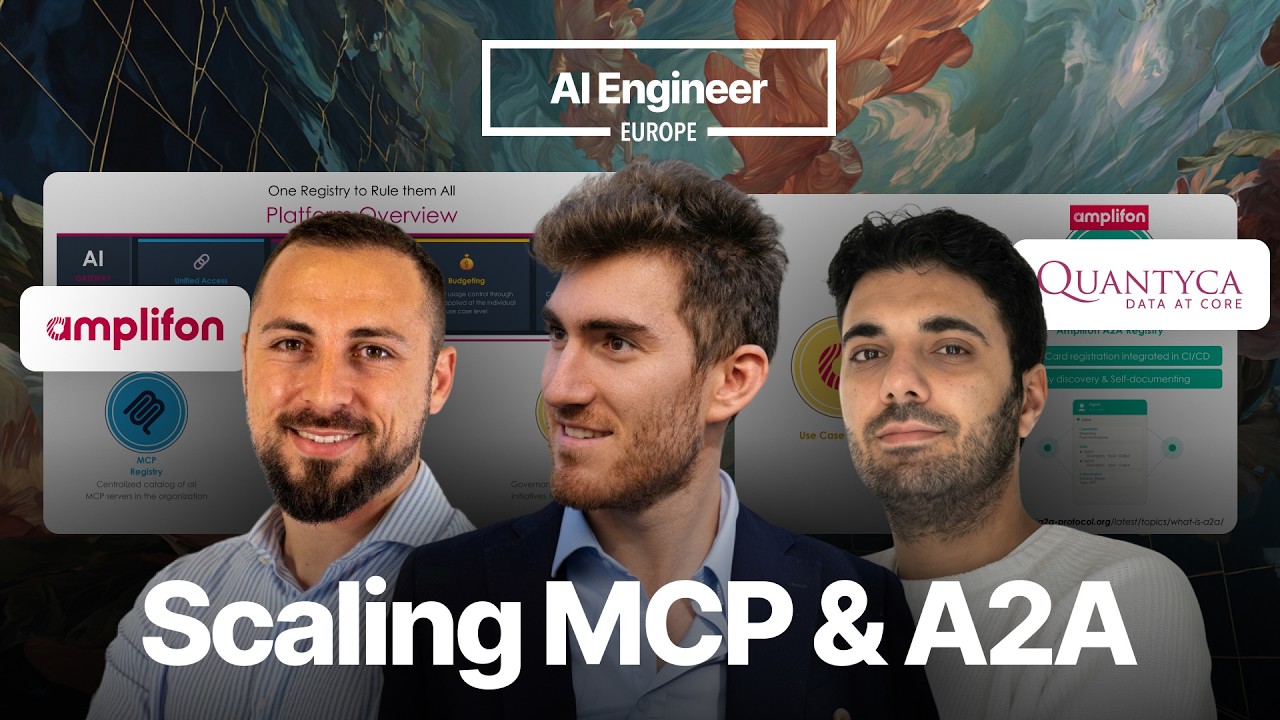
Amplifon built private registries for MCP servers, A2A agents, and use cases to govern AI assets across teams and countries.
2
Each registered asset carries ownership, environment, authentication, cost, and use case metadata that supports lineage and impact analysis.
3
Template repositories and CI/CD pipelines publish both deployable servers and their metadata, so developers can start from a standard production setup.
Summary
Amplifon launched its Amplify program in January 2025 to coordinate AI adoption across 26 countries, more than 20,000 employees, and over 10,000 stores. Sonny Merla describes the organizational problem: teams were building agents with separate connections, security models, and infrastructure. Mauro Luchetti and Mattia Redaelli explain the platform built with Quantyca. An AI gateway provides a common endpoint for models, authentication, budgets, and monitoring. Three registries then organize MCP servers, A2A agents, and the use cases that connect them. The registries store enterprise metadata such as ownership, environment, authentication, cost attribution, and dependencies. A web platform exposes catalogs, inspectors, forms, and lineage views. GitHub template repositories provide boilerplate, infrastructure, authentication, cost tracking, and observability integrations. When developers tag a branch, CI/CD publishes the Docker image and the relevant MCP or A2A metadata to the registry backend. The platform was still being expanded when the talk was recorded.
Amplifon created a central program to coordinate AI adoption across countries
Sonny Merla says Amplifon was facing the problem of many teams building AI systems independently. The company launched the Amplify program in January 2025 as a global, cross-functional effort to set rules for AI adoption. Its operating model has a control tower and a committee. The control tower defines security, legal, technology, strategy, and priority use cases. The committee runs that strategy in countries and corporate teams, including more detailed use case prioritization. The program focuses on governance, platform infrastructure, and a factory that develops solutions meant to scale across countries and domains.
The platform combines an AI gateway with three connected registries
Mauro Luchetti introduces the AI gateway as the common entry point for model access. Developers use one endpoint to reach models in Amplifon's catalog, authenticate through Entra ID, and work within budgets that can be set monthly or weekly. Requests and responses feed central auditing, monitoring, and analysis tools. Above the registries, the gateway provides the control layer. The MCP registry catalogs tools and integrations, the A2A registry catalogs available agents through agent cards, and the use case registry connects those assets with the models and systems involved.
The private MCP registry adds enterprise context to approved servers
Amplifon started from the community-maintained MCP registry and extended it for internal use. The private registry contains internal servers built for Amplifon systems and integrations, along with a curated set of public servers approved for Amplifon use cases. Each server includes metadata for its owner, running environments such as development, test, and production, authentication requirements, cost attribution, and linked use cases. Mauro says these fields support impact analysis, governance, and auditability. The organization can trace which tools exist and how developers use them.
The A2A registry is based on agent cards. These cards describe an agent's identity, endpoint, capabilities, supported modalities, and authentication requirements. Amplifon's deployment blueprints publish an agent card to the registry through CI/CD when an agent is deployed. Other developers and agents can then discover the new agent and interact with it. Mauro describes this as making agent development self-documenting. The use case registry links these agents and MCP servers to particular business use cases, along with the models, deployment systems, and related use cases that may be affected.
The catalog gives developers forms, inspectors, and lineage views
The platform demo shows catalogs for MCP servers, A2A agents, and use cases, plus the AI gateway's available models. A use case can include its status, version, description, linked assets, models, and lifecycle history. Developers can inspect the MCP server JSON or an A2A agent card, launch compatibility checks, and create metadata through forms instead of writing JSON directly. The lineage view connects a use case to agents, other agents, and models. In the example, the ticket optimization with AI use case has several connected assets, making it possible to identify an affected use case when part of the lineage has an outage or other problem.
Blueprint repositories standardize how teams build servers
Amplifon created separate GitHub template repositories for MCP and A2A servers. The templates include boilerplate, Docker files, package management, infrastructure, authentication, and cost tracking. Both server types are exposed as FastAPI servers. The platform also integrates with LongFuse for tracing, evaluations, and agent performance checks. The A2A blueprint does not require a particular framework such as LongChain or Agno. It defines interfaces and ports that teams can implement with their framework of choice, as long as they provide the interface specified by the blueprint.
CI/CD publishes both runtime artifacts and registry metadata
When a team tags a branch, a GitHub Action publishes the Docker image to the artifact repository and sends the agent card or MCP server JSON to the registry backend. Runtime calls go through an API gateway and separate MCP and A2A proxies. Those proxies look up the actual backend URL in the catalog, then the calling agent authenticates with the target server. This connects deployment, discovery, authentication, and catalog updates in one development flow. The result is a shared catalog, traceability across use cases, production-ready starting points, and pipelines that keep deployed servers and their metadata connected.
"We want to make easy the life of developers to focus on the business logic inside the use cases, avoiding to reinvent the wheel every time we need to take care about the security, but also the deployment and maintenance of the use cases."05:01
Who should watch
You are responsible for several teams deploying MCP servers or A2A agents and need one place to discover what exists.
Your AI platform needs ownership, authentication, cost, lineage, and environment metadata for audits or operational changes.
You are designing internal server templates and CI/CD pipelines that should publish deployment metadata alongside runtime artifacts.