MCP applications can package a user interface and model-facing tools in one server that works across clients such as ChatGPT, VS Code, and Cursor.
2
Agents in 2026 will need a connectivity stack that combines skills, MCP, and CLI or computer use instead of relying on one integration method.
3
MCP clients should load tools progressively and let models compose calls programmatically, while server authors should design interfaces specifically for agents.
Summary
David Soria Parra describes MCP as a way to ship applications, interfaces, and tools through a protocol that different clients can understand. He says the ecosystem grew from a small, local tools specification into a widely used standard, with 110 million monthly downloads and adoption by frameworks such as OpenAI's Agent SDK, Google's ADK, and LangChain. His main prediction is that 2026 will move agents from experimentation into production knowledge work, where connectivity to SaaS applications and shared drives matters more than local coding workflows. He recommends combining skills, MCP, and CLI or computer use according to the task. Client harnesses should use progressive discovery and programmatic tool calling to reduce context use, latency, and unnecessary inference. Server authors should design for agents rather than mechanically expose REST APIs. He also outlines work on stateless transport, asynchronous tasks, SDK revisions, enterprise login, server discovery, extensions, and skills over MCP.
MCP applications can ship interfaces and tools through one portable server
Soria Parra opens with an MCP application whose interface is served by an MCP server rather than supplied by a plugin, SDK, model-generated client UI, or hardcoded product code. The same server can be put into the cloud, ChatGPT, VS Code, or Cursor and continue to work. This requires a protocol so the client and server share semantics about the interaction and the UI. The server can also expose tools, letting a person use the application directly while the model interacts with the same system through tool calls.
MCP grew from a local tools specification into a broad ecosystem
Eighteen months earlier, Soria Parra says MCP was a small specification with a few SDKs, mostly local usage, and little more than tools. Since then, the project added remote capabilities, centralized authorization, elicitation, tasks, and experimental MCP applications. He says the ecosystem reached 110 million monthly downloads, including usage through OpenAI's Agent SDK, Google's ADK, LangChain, and other frameworks. Servers range from projects for WhatsApp and Blender to integrations with Linear, Slack, and Notion, while most servers connect private company systems to agents.
Production agents will depend on connectivity beyond local coding environments
He frames 2024 as a period of demos and 2025 as a period centered on coding agents. Coding agents have favorable conditions because they run locally, can call a compiler, and have a developer nearby to correct failures. General agents doing financial analysis or marketing work will need access to several SaaS applications and a shared drive. For that reason, he expects 2026 to begin a shift toward production agents whose central requirement is connectivity.
Skills, MCP, and CLI or computer use cover different connectivity needs
Soria Parra describes three parts of a connectivity stack. Skills package domain knowledge and specific capabilities in simple, reusable files. CLIs work well for local coding agents, especially when the agent has a sandbox or code execution environment, and they fit tools such as GitHub and Git that models may already know. MCP is better when an agent needs rich semantics, a UI for long-running tasks, resources, platform independence, authorization, governance, enterprise policies, or experiments such as MCP applications and skills over MCP. He expects agents to combine these methods.
Progressive discovery keeps large tool collections out of the initial context
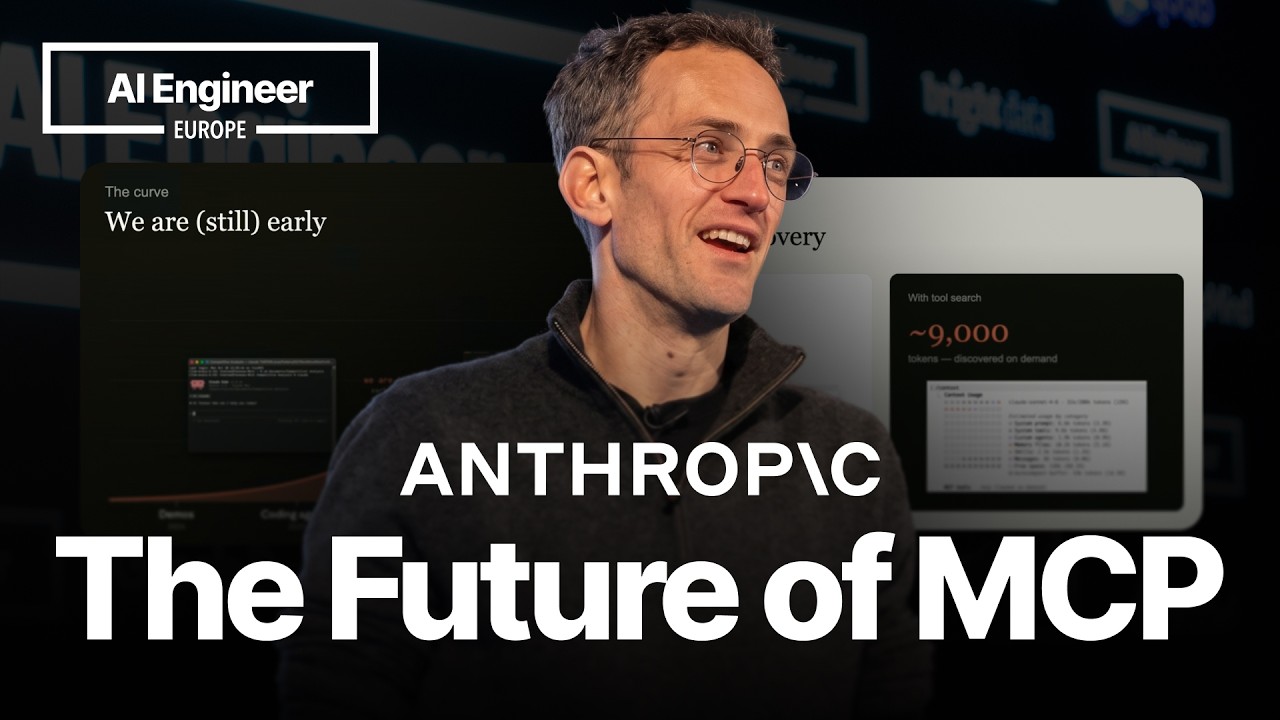
The client or agent harness should not place every available tool into the model's context at startup. Soria Parra calls for progressive discovery: a tool search or tool-loading tool lets the model look up capabilities and load them only when needed. Clients can implement this themselves by downloading tools on demand. He shows Claude Code before and after this approach and says the change produces a large reduction in tool context usage. The protocol carries information, but the client decides how to manage that information.
Programmatic tool calling lets the model compose operations in code
Calling one tool, reading its result, and then calling another makes the model orchestrate every step through inference, which adds latency and consumes context. Soria Parra recommends giving the model a REPL and an execution environment such as a V8 isolate, Monty, or Lua interpreter. The model can then write a script that composes MCP calls. MCP structured output provides return-type information that helps the model connect results between calls. This approach can also combine MCP tools with CLIs, APIs, and other executables.
MCP servers should be designed for agent workflows rather than copied from REST APIs
Soria Parra criticizes one-to-one REST-to-MCP conversions because they produce poor agent interfaces. Server authors should design around how a human would want to interact with the system, then add programmatic composition where several operations need to work together. A server can provide an execution environment instead of exposing every operation as a separate tool, as the Cloudflare MCP server does. Authors should also use MCP features that other approaches do not provide, including MCP applications, skills over MCP, tasks, and elicitation.
The protocol roadmap focuses on scaling, enterprise access, discovery, and extensions
The current streamable HTTP transport is difficult for large hyperscalers to scale, so Soria Parra describes a Google proposal for a stateless transport that would make MCP servers easier to deploy like stateless REST services on Cloud Run or Kubernetes. The project also plans improvements to asynchronous tasks and agent-to-agent communication, TypeScript SDK version two, and Python SDK version two. Enterprise work includes cross-app access through identity providers such as Google or Okta. Well-known URLs will let crawlers, browsers, and agents discover MCP servers automatically. Skills over MCP will let servers ship updated usage knowledge alongside large tool collections.
"Every time I see someone building another rest to MCP server a conversion tool, I'm it's a bit cringe because I think it just results in horrible things."12:14
Who should watch
You are building an agent that needs access to several SaaS systems, shared drives, or enterprise services rather than only a local codebase.
Your MCP client currently loads every tool into context at startup and you want to reduce context usage and orchestration latency.
You maintain MCP servers or SDKs and need guidance on agent-oriented interfaces, progressive discovery, programmatic tool calling, or upcoming protocol features.