Contour runs live A/B tests that compare analysts' research workflows with and without AI tools.
2
The fund tracks process measures such as analyst time, useful insights, and eventual P&L instead of waiting for immediate returns.
3
AI agents are used to combine alternative data, recover neglected ideas when market conditions change, and support trading, operations, and compliance.
Summary
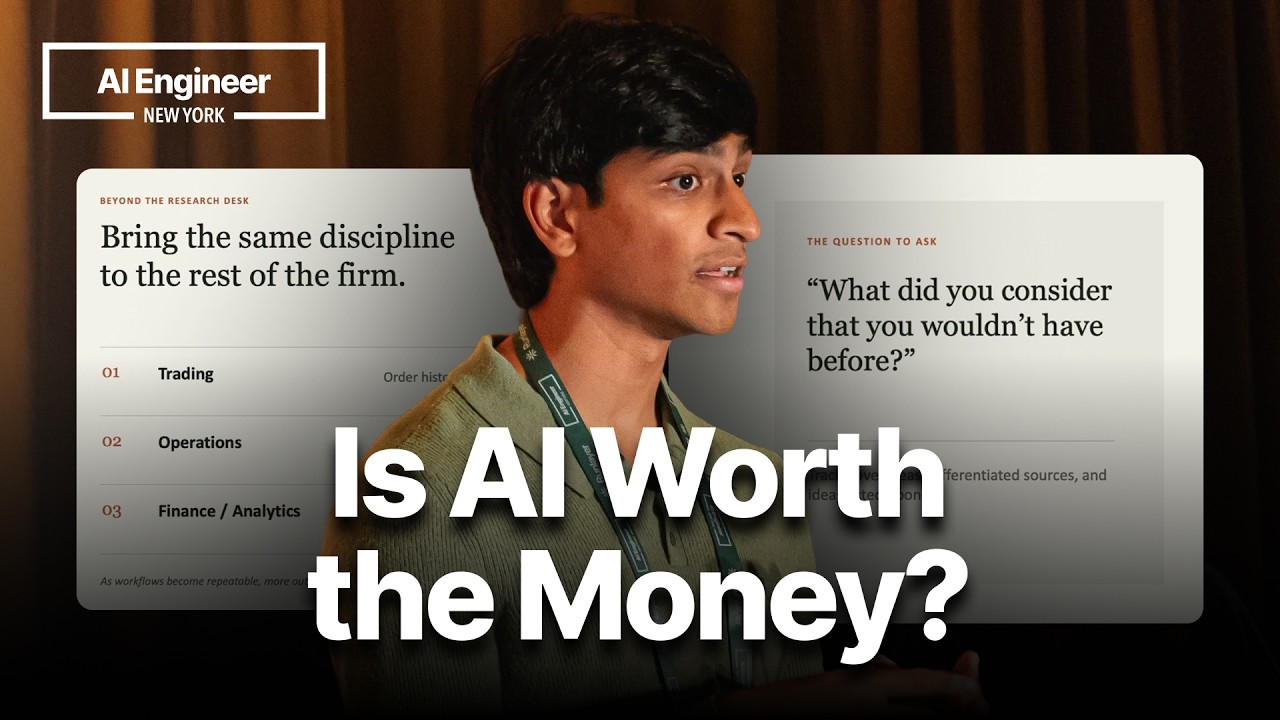
Hari Kumar explains how Contour Asset Management evaluates AI inside a fundamental long/short investment firm. The fund compares analysts' work before and after AI tools are introduced, sometimes for a single company across a three-month earnings cycle. It records data sources, conclusions, time spent, and eventual outcomes. Since investment ideas may take months or a year to affect a stock, Kumar argues that P&L alone cannot give an immediate answer. Contour therefore tracks process measures such as cost per useful insight and whether a tool changes how analysts work. The firm is also building agents that generate and revisit ideas, combine expert-call notes with alternative data, and alert analysts when an old idea becomes timely again. Kumar extends the approach to trading, operations, compliance, and existing data subscriptions. He is honest about a cost that is easy to miss: staff time spent repairing broken model calls and connectors.
AI ROI starts with comparing the same research process
Contour records how an analyst researches a company without AI and then runs the same process with selected AI workflows. One comparison covers the period from one earnings report to the next. The fund records the data sources used and the conclusions reached. It can also compare different ways of handling expert calls, such as having an agent conduct the call, having the analyst synthesize the notes, or asking the agent to synthesize them. This gives the fund a way to ask whether AI changed the work and how long the work took.
Investment research needs process measures because returns arrive late
A new investment thesis may show an effect in three months, six months, or a year. That delay makes immediate ROI hard to prove. Contour therefore measures whether AI improves activities such as consumer surveys and model updates, and whether the analyst's way of working actually changes. Kumar distinguishes between adding more work to an existing process and improving the process itself. P&L remains an eventual outcome, but it cannot answer every early question about an AI tool.
Kumar says fundamental investors need to avoid becoming too anchored to their first thesis. Contour is building idea-generation agents that add conclusions to an analyst's initial data and expert input. The agents also scan old notes and compare them with current market conditions. An idea that was ignored for weeks can become relevant after a price move or another change in the market. The system can alert the analyst, portfolio manager, and trader when the timing makes the idea worth revisiting.
Combining alternative data makes existing sources more useful
Individual alternative-data products often sit apart from an analyst's other research. Kumar gives credit-card panel data from Yipit as an example. Contour feeds that information into agents alongside expert-call notes, transcripts, and other data sources. The goal is to see how those sources interact rather than asking an analyst to inspect each one separately. Kumar also mentions satellite mapping and granular credit-card data as examples of specialized sources that become more useful when brought into the same workflow.
Cost per useful insight connects analyst time to outcomes
Contour tracks the insights an analyst generates each day, the time spent on each company, and where those ideas eventually land. Kumar calls one internal measure the 'cost per useful insight.' The fund records which ideas become interesting and what tools helped produce them. P&L provides an eventual success measure, but a fundamental fund may wait months for a trade to develop. Time spent and the path from an idea to its outcome provide information before the final financial result arrives.
AI workflows should cover trading, operations, and compliance
Contour is measuring trade entry and exit times and using agents to track names across industries. Kumar wants traders to contribute ideas to analysts and associates instead of spending all their time executing orders. In operations and compliance, many tasks are split across Bloomberg, order-keeping systems, and vendor tools. Contour is trying to bring order reconciliation, vendor information, and other workflow pieces into one internal platform. The aim is to reduce repetitive work and give staff more time for market and investment work.
Existing data subscriptions can feed an internal analyst-specific system
Contour uses or discusses products such as AlphaSense, Yipit, Rogo, and Kensho. Kumar describes a plan to bring data from these services into an internal platform that learns from each analyst's habits and model patterns. The system would be configured for individual analysts rather than treating the firm as one uniform user. APIs and MCPs can make more of a subscription's data available inside the firm's own workflows, including model updates and other analyst activity.
Broken connectors and model calls are part of the AI bill
Kumar includes maintenance time in Contour's ROI calculation. Model calls and connectors can break every few days, and someone has to repair them when the problem cannot be fixed by the technology team alone. That time reduces the value of the insights produced by the system. Kumar says this cost is decreasing, but Contour continues to measure it alongside time spent creating useful insights. The investment case therefore includes both the work AI saves and the work required to keep it running.
"Part of the ROI equation that we've been taking into account at Contour is trying to understand the time that is being taken away trying to fix bugs."17:03
Who should watch
You are introducing AI into investment research and need a way to compare assisted and unassisted work.
Your team waits months for financial outcomes and needs process measures that arrive sooner.
You run a fund or financial operations group where data is split across vendors and maintenance work is missing from the ROI calculation.