Production RAG depends on data parsing, chunking, indexing, and evaluation, not only on choosing a language model.
2
Enterprise teams should give developers room to build because AI techniques and workflows change faster than purchased software can adapt.
3
Longer context windows may reduce the need for fine-grained chunking, but retrieval, good parsing, and multiple data representations will remain useful.
Summary
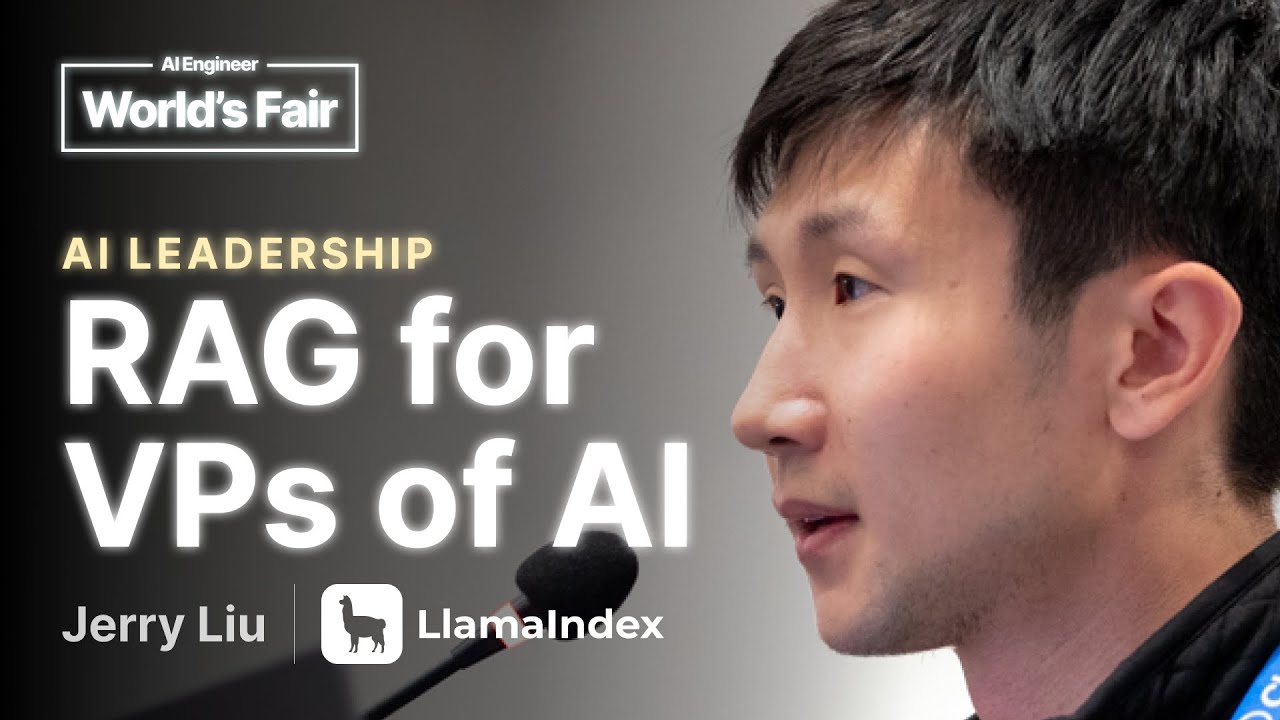
Jerry Liu explains where enterprise RAG projects become difficult. A basic question-answering system can be prototyped quickly, but production quality requires careful document parsing, chunking, indexing, metadata, evaluation, and support for many data sources. He distinguishes this work from traditional ETL because the right processing choices are difficult to judge without end-to-end tests against an evaluation set. Liu argues that enterprise AI leaders should invest in developer-built systems because the underlying models and techniques change quickly. He describes LlamaIndex's open-source toolkit, LlamaCloud, LlamaParse, and the early Llama Agents framework. In the discussion, he covers privacy deployments, audio ingestion, versioning, regional hosting, mixed data sources, support, table parsing, conversational memory, and multi-agent services. His view of RAG's future is measured: larger context windows may allow document-level chunks, but external retrieval still makes sense for cost, scale, and accountability.
Liu describes RAG as a question-answering interface over enterprise data. The system needs a language model for synthesis, an embedding model, and a storage layer such as a vector database, document store, graph store, or SQL database. It also needs a data processing stack for parsing and ingestion. A PDF may need to be split into chunks, indexed, and represented in several storage forms so a language model can access it. This differs from traditional ETL, which is mainly built for analytics workloads. For LlamaIndex, the data processing side is a major part of the problem.
The difficult step is moving from a working prototype to production
Liu says developers can build a RAG pipeline that works over their data in about 10 minutes, but production quality is much harder. The difficulty grows as documents become more complex, the number of sources increases, and the required answer quality rises. Teams have to tune many settings, resolve accuracy problems, and scale across data sources. Without that work, a project may fail when it reaches higher usage. Liu connects these failures to developer time and to a lack of knowledge about how to tune the system.
Data quality affects hallucinations even when the model is strong
Liu applies the familiar idea of garbage in, garbage out to language-model applications. Poor parsing or incomplete representations produce poorly represented information for the model. He says this can lead to hallucinations even when the language model itself is very good. His example is complex enterprise material such as financial reports, PowerPoint files, tables, images, and diagrams. LlamaParse is designed to preserve the document's structure more faithfully before the information reaches retrieval and generation.
Developers need room to adapt as AI techniques change
Liu recommends that enterprise AI leaders place a bet on developers and build more than they would with a pure out-of-the-box purchase. He gives the pace of change in AI as the reason. Developers can translate new techniques into value for a particular use case. A purchased tool may solve the current problem, but adapting it to new workflows can take longer. LlamaIndex aims to provide infrastructure for developers to build and maintain applications over enterprise data, while reducing the amount of manual data wrangling they have to do.
LlamaIndex separates application orchestration from data management
Liu presents LlamaIndex's open-source toolkit as a framework for building production language-model applications over data. It handles orchestration around retrieval, prompting, agentic reasoning, and tool use. He describes LlamaCloud as a centralized knowledge interface that unifies data sources, processes unstructured data, and manages pipelines. The intended division of work lets developers spend more time on the custom retrieval, prompting, and agent logic instead of repeatedly managing ingestion infrastructure. LlamaParse is a LlamaCloud component focused on complex document parsing.
Liu explains that RAG processing is different from traditional ETL because its intermediate choices are difficult to judge in isolation. A naive pipeline might split every 1,024 tokens, but that can divide a table, break a section across pages, or lose relationships between pieces of content. Developers need to join related material semantically and attach useful metadata. They also need an evaluation dataset and a rigorous end-to-end testing flow to decide whether a chunk size or indexing method works. In practice, companies often compare approaches in a bake-off on their own data.
Different source types usually need separate pipelines before retrieval is combined
For homogeneous sources such as financial reports, Liu says one set of parsing parameters can often work because the documents have roughly similar formats. Diverse sources require different treatment. PDFs, semi-structured data from Jira, and JSON from Salesforce may each need their own pipeline. The resulting sources can then be combined at the retrieval layer, with reranking applied across them. This approach allows a system to use different ingestion methods while still presenting a unified search and answer experience.
Longer context reduces fine-grained chunking, but does not remove retrieval
Liu expects larger context windows to reduce the need to split pages into many small chunks. In the future, entire documents may become the indexed unit because documents are often self-contained. He does not expect retrieval to disappear for systems with very large document collections. Feeding billions of documents into every inference call is expensive and does not provide enough accountability about which data influenced the answer. External vector or graph storage will still matter, while the smallest chunking decisions may become less important.
Multimodal systems can preserve several representations of the same document
Liu says parsing is inherently lossy because it extracts a document into a textual representation. As multimodal models improve, a PowerPoint page could be stored both as parsed text and as an image. Native image chunks preserve information that text extraction can lose, including layout and visual relationships. Multiple representations also let developers trade cost, performance, and latency according to the task. This gives retrieval more than one way to access the same source material.
"With traditional ETL, you know exactly what you want. Here it's really hard to tell what the chunk size you need to set is without having an eval data set and having a rigorous end-to-end testing and eval flow."13:23
Who should watch
You lead AI at an enterprise and need to decide how much RAG infrastructure to build versus buy.
Your prototype works, but document quality, evaluation, multiple data sources, or production operations are blocking deployment.
You are designing a future RAG system around longer context windows, multimodal documents, or agent-based workflows.