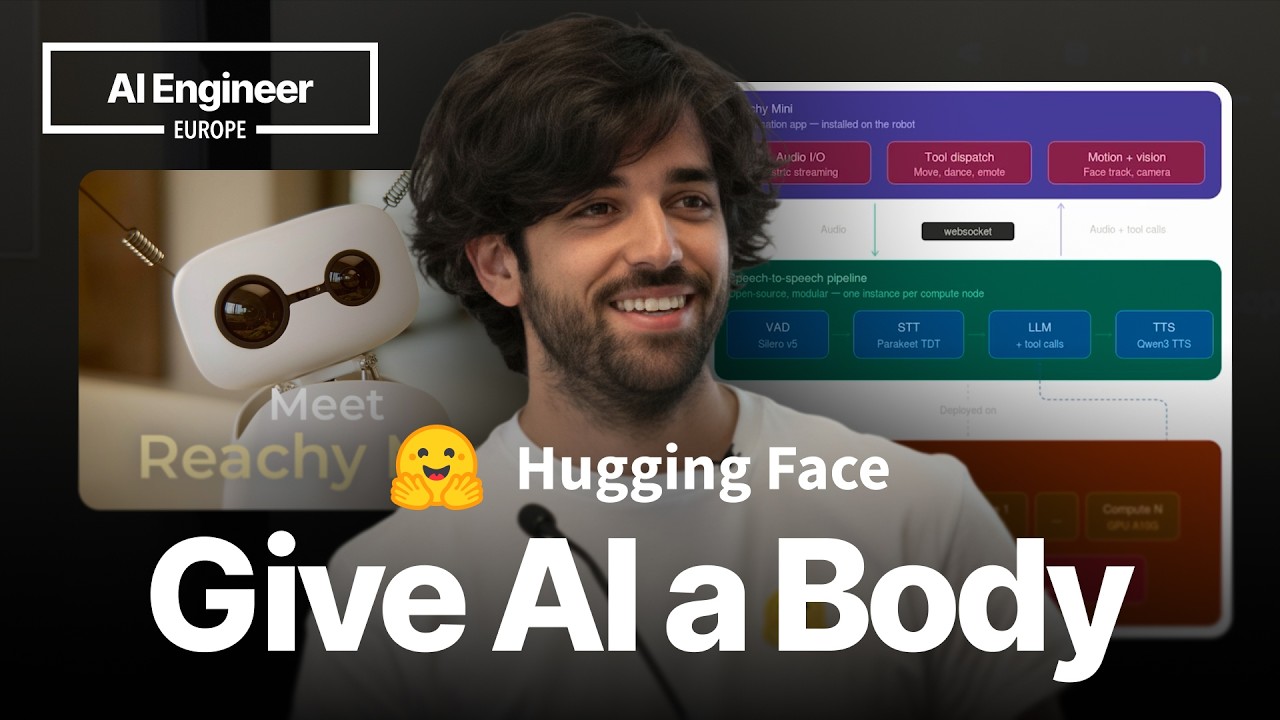
Reachy Mini is a small, affordable robot designed for hackers, researchers, students, and anyone who wants to build new interactions with robots.
2
The robot's voice agent transcribes speech every 150 milliseconds, sends partial results back while a person is speaking, and combines an LLM with movement and camera tools.
3
Andres Marafioti made Qwen3-TTS stream audio, avoid repeated CPU-GPU transfers, and use static KV caches and CUDA graphs, raising generation speed from 0.8x to 5.8x real time.
Summary
Andres Marafioti presents Reachy Mini as an affordable, expressive alternative to expensive humanoid robots. Hugging Face ships it unassembled so owners learn how it works and can repair or modify it. The robot supports open-source software, voice interaction, camera use, movement, face tracking, and custom hardware parts. Marafioti describes the voice stack behind the company's fleet of 7,500 robots. Parakeet transcribes speech every 150 milliseconds, partial transcriptions let the robot react before a sentence ends, and an LLM handles responses and tool calls. He also explains how he optimized Qwen3-TTS after finding that the original system did not stream, made 500 autoregressive steps per audio packet, and repeatedly moved data between the CPU and GPU. Static KV caching and CUDA graph captures improved speed from below real time to 5.8x real time, with first audio under 200 milliseconds. The talk argues for giving people practical hardware and software tools before robots become restricted to expensive corporate systems.
Expensive humanoid robots leave little room for experimentation
Marafioti says robotics is advancing quickly, but the most visible systems are still too expensive for ordinary experimentation. Humanoid robots cost at least in the mid-five-figure range, while Waymo vehicles are more expensive still. Their complexity also makes them hard to adapt. He does not think schools will order ten $50,000 robots for students to play with. He also questions the decision to make robots imitate human bodies. A spider-like robot could move faster, remain more stable, and be more agile, but humanoid form makes people assume they already understand what the machine can do.
Reachy Mini is designed as a repairable platform for hackers
Reachy Mini targets hackers, researchers, students, and people who want to explore new forms of interaction. Marafioti says its expressive design deliberately avoids looking human, so users do not treat it as a human replacement by default. The robot ships unassembled, which gives owners a first look at its construction. They receive the knowledge and tools needed to replace parts later. Hugging Face sells a $300 version and a $450 version with a Raspberry Pi and battery. Schools and universities can buy the cheaper model in bulk. Owners have already printed new parts, added lights, replaced antennas, and made a robot that reacts when petted.
Marafioti expects people to talk to robots rather than pull out a keyboard and type. Reachy Mini therefore includes software for building voice experiences. In the demonstration, the robot answers questions, takes a photo, describes a person in front of its camera, and displays an emotion through movement. The interaction combines speech with the robot's physical abilities. Its software can dispatch tools for movement, emotions, camera use, and face tracking. Hugging Face makes the models and agents open source, while also providing hosted options for users who do not have enough GPU capacity to run everything locally.
Partial speech recognition lets the robot react before a sentence ends
The speech-to-speech system uses voice activity detection to determine when someone is talking, then sends audio to Parakeet for transcription. The system transcribes every 150 milliseconds and sends partial transcriptions back to the robot. This allows it to react when it hears something interesting instead of waiting for a complete utterance. Once the transcription is complete, it goes to an LLM, which can answer, call tools for movement, or use the camera. The response then goes through Qwen3-TTS. The robot application also handles microphone input, speaker output, echo cancellation, tool dispatch, camera use, and face tracking.
Separate scaling for conversation nodes and LLM endpoints saves resources
Hugging Face hosts the speech pipeline on inference endpoints. A load balancer changes the number of compute nodes as the number of connected robots changes. Marafioti says the LLM endpoints need different scaling from the conversation nodes because users do not all talk the same amount. One node might have eight users who speak often and make heavy LLM demands, while another has eight users who barely talk. Separating the LLM service lets the system allocate resources according to actual model use rather than treating every connected robot as an equal workload.
Qwen3-TTS was too slow for a voice agent until its generation path changed
Marafioti spent about two weeks optimizing Qwen3-TTS for Reachy Mini. The released model generated the entire output before returning audio, so ten seconds of speech required generating ten seconds before playback could start. He added streaming. The autoregressive model also took 500 steps for each audio packet, with CPU-GPU coordination on every step. Compilation could move those interactions onto the GPU, but the dynamic KV cache prevented it. Replacing it with a static KV cache used more RAM from the start, then CUDA graph captures accelerated the complete generation process.
The optimization improved both throughput and first-audio latency
The original system ran below real time at a real-time factor of 0.8, meaning one second of audio took 1.2 seconds to generate. After the changes, it reached 5.8x real time, or about 200 milliseconds for one second of audio. Marafioti also reduced time to first audio from several seconds to under 200 milliseconds in the recorded demonstration. He released the faster implementation as an open-source Hugging Face Space and made it available for use with the Reachy Mini voice agent. He warns that model latency is only part of the experience, since network and other infrastructure delays can take a similar amount of time.
Reachy Mini apps can run locally and be written in several languages
In the question period, Marafioti says apps that do not need a GPU can run directly on the Raspberry Pi inside the robot. Developers can also use their own laptop as the hardware. The platform is not limited to one programming language. He mentions Java, Python, and HTML as possible choices. Plugin-style support for adding hardware is less formal. Developers may need to hack around the existing system, although Hugging Face designs its open-source robots to fit together. The SO100 and SO101 arms can connect, and the Kiwi three-wheel base is designed to accept Reachy Mini.