Real-time AI applications need models, an orchestration layer, and a deployment system.
2
Pipecat moves audio and video through asynchronous pipelines built from frames and processors, while exposing the behavior of a bot for debugging and production monitoring.
3
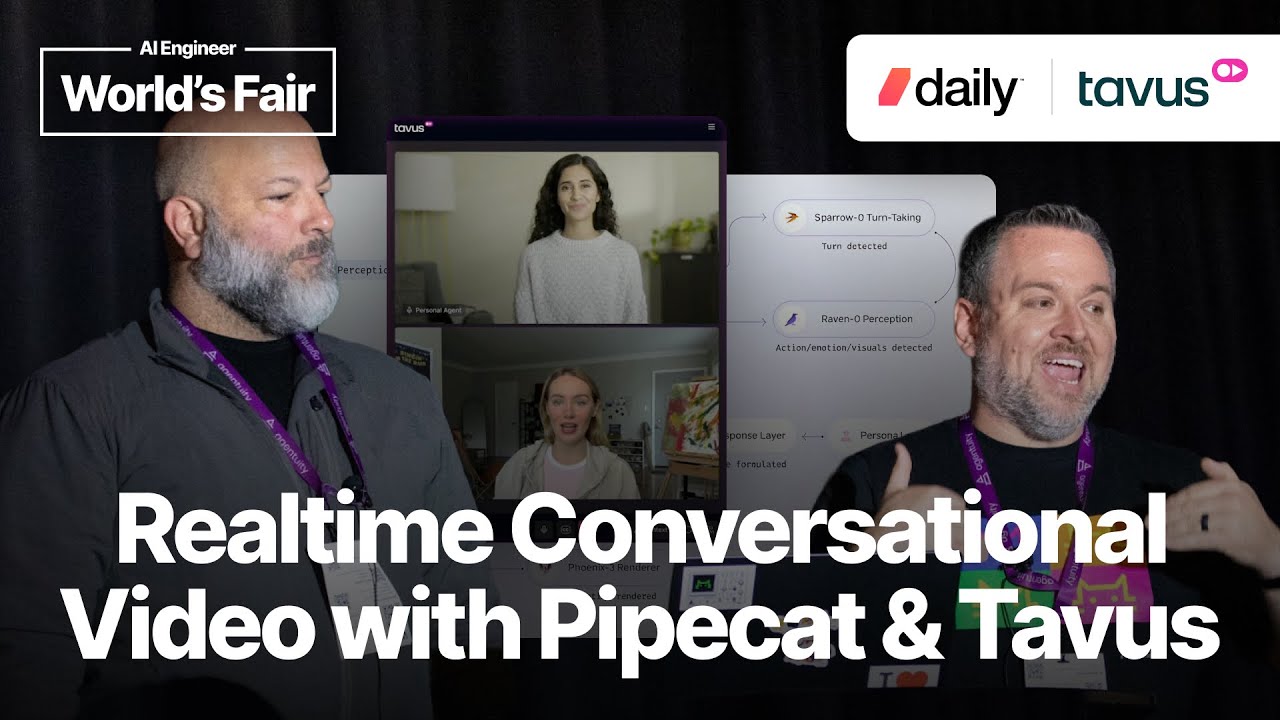
Tavus is integrating its rendering, turn detection, response timing, and perception models with Pipecat so developers can build more natural conversational video systems.
Summary
Chad Bailey and Brian Johnson explain how conversational video systems are assembled and deployed. Bailey separates the problem into models, orchestration, and deployment. Johnson describes how Tavus moved from a rendering model to a real-time conversational video platform, then found that turn detection, response timing, perception, and other coordination work were necessary. Bailey presents Pipecat as the open source, vendor-neutral orchestration layer. Its pipelines pass small audio and video frames through processors for transcription, context aggregation, language models, text to speech, and Tavus video generation. The same structure can run parallel models for tasks such as sentiment analysis or voicemail detection. Johnson says Tavus customers already use Pipecat and that Tavus is moving more of its models into the framework. The final section covers deployment: an API must start a bot instance and connect it to a user through a transport layer, usually WebRTC. Pipecat Cloud is offered for teams that do not want to manage Kubernetes themselves.
Bailey frames a real-time AI application around three parts: models, an orchestration layer, and deployment. A familiar voice pipeline uses speech to text, an LLM, and text to speech, although voice-to-voice models are also possible. Video adds more moving parts because generated video must stay synchronized with audio and respond quickly. Johnson says Tavus began with a rendering model, then had to add turn detection, response timing, signal handling, and orchestration before the system became useful in a real-time setting.
Pipecat gives production bots observability and control
Bailey describes Pipecat as an open source, vendor-neutral framework for orchestrating low-latency audio and video applications. A demo can hide the difficult infrastructure work, but production requires developers to understand why a bot behaves a certain way and why a response is slow. Pipecat provides a place to inspect the flow and capture metrics. Bailey says even Google's Gemini Multimodal Live documentation points developers toward additional orchestration when moving from a browser experiment to a production application.
Pipelines pass frames through processors asynchronously
Pipecat is built around frames, processors, and pipelines. Frames hold pieces of data such as 10 or 20 milliseconds of audio, video from a camera, or an event saying that a user started speaking. Processors consume frames and emit new ones. An LLM processor can receive completed context turns and emit streaming text frames. The pipeline describes the bot's behavior, while asynchronous execution aims to reduce the latency as each piece of information moves through the system.
Context aggregation decides when the language model should run
In the example pipeline, transport input receives media from WebRTC, WebSockets, Twilio WebSockets, or another transport. Speech-to-text collects audio frames and emits transcription. A context aggregator uses events such as the user's microphone level dropping to infer that the user has finished speaking, then groups recent transcription into a context frame. That frame triggers the LLM. Its streamed text goes to text to speech, and the resulting audio can be sent to Tavus to produce synchronized video.
Parallel pipelines let one conversation support several decisions
Pipecat can run additional processing at the same time as the main conversational flow. Bailey gives examples of a second LLM performing sentiment analysis and of Gemini Live Multimodal deciding whether a phone response is from a person or a voicemail greeting. The parallel pipeline sends a signal back to choose the human or voicemail branch. This lets a developer add behavior around a Tavus model even when Tavus handles most of the direct interaction.
Tavus is adding timing and perception models to the stack
Johnson says Tavus is moving more of its models into Pipecat, including Phoenix, its rendering model, and planned integrations for turn taking, response timing, and perception. The multilingual turn detection model decides when a person has finished speaking. Response timing decides how quickly the system should answer after that point. Johnson contrasts a serious conversation about a relative entering care with casual chitchat. Perception can use emotions, surroundings, and clothing to inform turn taking and response timing.
Deployment requires an API, a bot instance, and a media transport
Bailey says shipping a bot requires an API that tells the client a user wants to talk, then starts a new bot instance and connects it to that user. A transport layer moves the media, ideally through WebRTC. Developers can manage this infrastructure themselves, or use Pipecat Cloud if they do not want to operate Kubernetes and the rest of the deployment system. The architecture leaves those deployment choices open rather than imposing one hosting approach.
"There are three things you need to think about when you want to build real-time AI. The first is your models. The thing that you don't necessarily know you need to think about is your orchestration layer. And then of course you need to deploy these bots somewhere."00:28
Who should watch
You are building a voice or video agent and need an architecture that can move from a model demo to a production application.
Your application needs to combine transcription, LLMs, speech, video, and side tasks such as sentiment analysis or call routing.
You want to deploy real-time bots without deciding whether to operate the bot infrastructure yourself or use Pipecat Cloud.