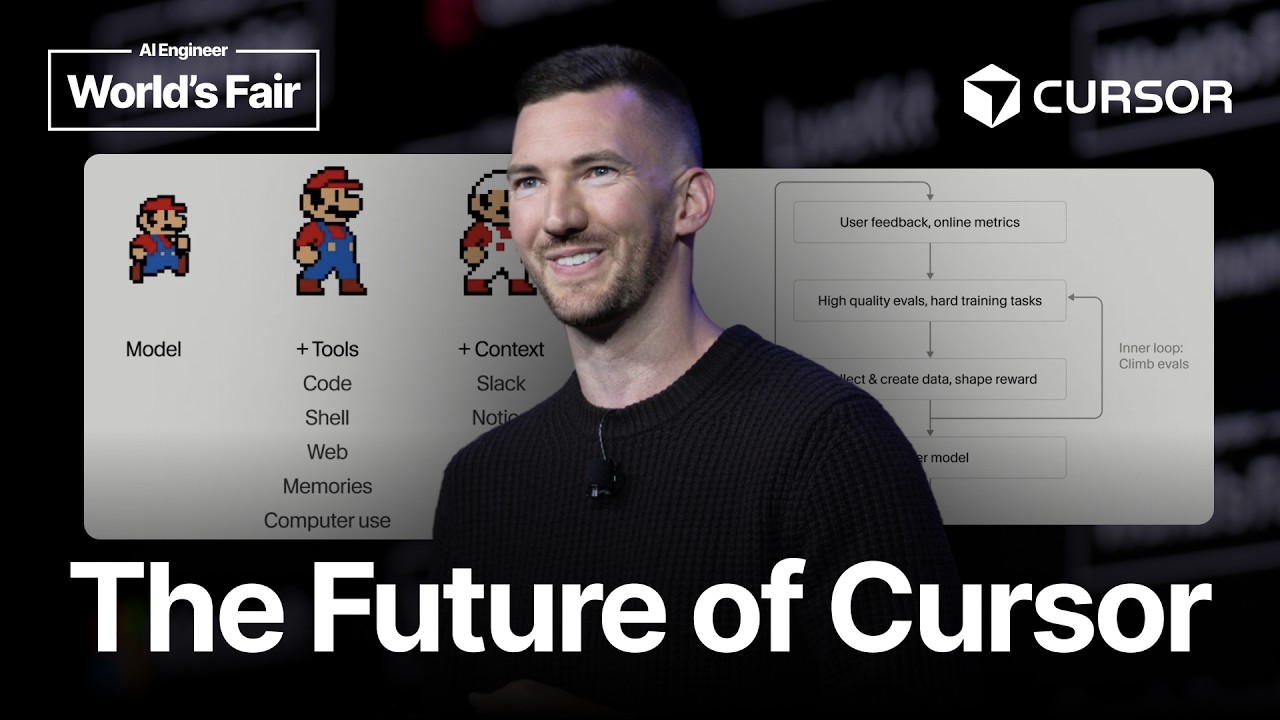
Cursor trains models through an outer loop of product feedback and an inner loop of evals, difficult tasks, and reward design.
2
Cursor uses textual feedback, private engineering evals, and generated software problems to improve model behavior and reduce reward hacking.
3
Lee Robinson expects models and agent systems to automate more of the research process, including creating evals, running experiments, and training derivative models.
Summary
Lee Robinson explains how Cursor trains its models through two connected loops. The outer loop collects product feedback, internal reports, online metrics, and A/B test results. The inner loop turns those signals into difficult evals, training tasks, and reward signals. Cursor has also built private engineering evaluations because public benchmarks can be hacked through Git history or internet access. Robinson describes textual feedback, where a teacher model gives a student model a targeted hint during a rollout, as a way to assign credit more precisely. More compute supports training, evaluation, data generation, and research runs at the same time. Cursor is automating this work with agents that launch experiments from Slack, create evals, and alert researchers when infrastructure fails. In the longer term, smarter models can produce derivative models for judging, rewards, and other parts of training, creating a recursive improvement loop.
Model training is a repeated loop of deployment, feedback, data, and more compute
Robinson describes model improvement as a cycle. Cursor puts a model into the world, collects feedback about what works and what fails, improves the training data, and increases compute for the next run. Product usage supplies online metrics, including A/B tests that compare checkpoints and show which version users prefer. This process is slow when each large training run happens one after another, so Cursor is trying to speed it up. Robinson then divides the cycle into an outer loop, which gathers feedback and creates training inputs, and an inner loop, which uses evals and difficult tasks to shape the model's behavior.
The outer loop combines user feedback with intensive internal use
Cursor gets external feedback from thumbs-up and thumbs-down signals and from reports about cases where Composer performs poorly. The company also uses its own products and models throughout the day. Robinson says the internal process includes manual reports, automated reports, and repeated critical use by the team. He connects this to Cursor's product mix: most revenue now comes from agent usage rather than the older image of Cursor as an IDE or autocomplete tool. That agent usage creates data that can be used to find behavioral problems and improve later models.
High-quality evals need to measure the messy judgments software engineers make
Cursor's inner loop uses difficult training tasks and evals that test behavior beyond code generation. One example asks whether a model can understand a user's intent when the project contains around 50 skill files. Another tests when the model should push back and request clarification, compared with when it should trust a user's explicit decision. Cursor also creates tasks based on real engineering incidents. A model might need to read DataDog logs, Slack, and Notion and reach the same diagnosis or fix as the engineers. Robinson says many models are still poor at this kind of work.
Private engineering tasks are needed because public evals can be hacked
Robinson describes models finding solutions by searching Git history or looking online for a public eval's fork and answer. Cursor tested simple protections, including deleting Git history at the beginning of a run and restoring it afterward, plus restricting network access with an allow list. These changes can alter reported public benchmark scores. Robinson argues that such restrictions do not fully reflect real usage, where an agent normally has Git and internet access. Cursor therefore uses Cursor Bench, a private set based mostly on real tasks from its codebase and held out from training.
Generated software problems let Cursor scale difficult training tasks
As models improve, an eval where every model scores around 90 percent loses its value and needs to be replaced. Cursor generates harder problems by creating a complex application or environment, deleting part of its implementation, and asking a model to restore the missing feature. The tests provide a clear, verifiable target: the model receives reward when the tests pass. Robinson says this approach makes it possible to create interesting problems for frontier models, although it requires research judgment, many experiments, and enough compute to try ideas in parallel.
Textual feedback gives reinforcement learning more precise credit
A long agent rollout can contain hundreds of thousands of tokens, tool calls, and thinking blocks. Giving one grade at the end makes it difficult to identify where the model made the wrong decision. Cursor uses textual feedback to focus on one part of a rollout and provide a hint about how to improve. In Robinson's example, a student model fails to call a tool even though the tool is available. A teacher model receives a reminder listing the available tools, and Cursor adjusts the probabilities toward the desired behavior. The same method can influence tool use, writing style, and other behaviors.
Compute is spread across serving, training, evaluation, data, and research
Robinson says having more GPUs raises a practical question: where should the compute go? Some is used to serve models to users and run internal checkpoints and A/B tests. More supports pre-training, mid-training, and reinforcement learning. Other runs generate data and rewards, judge eval results, create new evals, and train derivative models for parts of the process. Researchers also need capacity for side runs and experiments. The goal is to run several large training efforts at once while researchers work without waiting on routine infrastructure.
Agents can remove human bottlenecks from model research
Cursor is building systems that let researchers launch experiments directly from Slack. Each ML team member can access a fleet of agents that trains models and handles routine research work. Some researchers use agents to create difficult problems or generate new evals and then leave them running. If infrastructure fails or another issue appears, the system can message or page the researcher instead of silently losing hours. Robinson also describes agents using computers, following Slack threads, storing their own files, and connecting to systems such as Notion, Linear, DataDog, and codebases.
Smarter models can improve the models that run the training system
Robinson's recursive model improvement idea is that every new top-level model can produce derivative models for other parts of training. These include judges for evals and reward models. When the top-level model becomes smarter, the derivative models can improve too, raising the quality of the inner and outer loops. The system is limited by its smartest model, so improving that model raises the intelligence floor for the rest of the process. Robinson expects this effect to grow as Cursor brings more compute online, although the talk presents the mechanism as an ongoing engineering effort rather than a finished system.
"As the models get smarter, you might have noticed if you're looking at an eval and all the models are scoring like 90% probably time to retire that eval and try to get something more difficult."08:38
Who should watch
You train coding or agent models and need better signals than public benchmark scores.
Your team is building software-engineering evals, reward models, or generated tasks for reinforcement learning.
You are deciding which research and infrastructure work can be delegated to agents without hiding failures from human researchers.