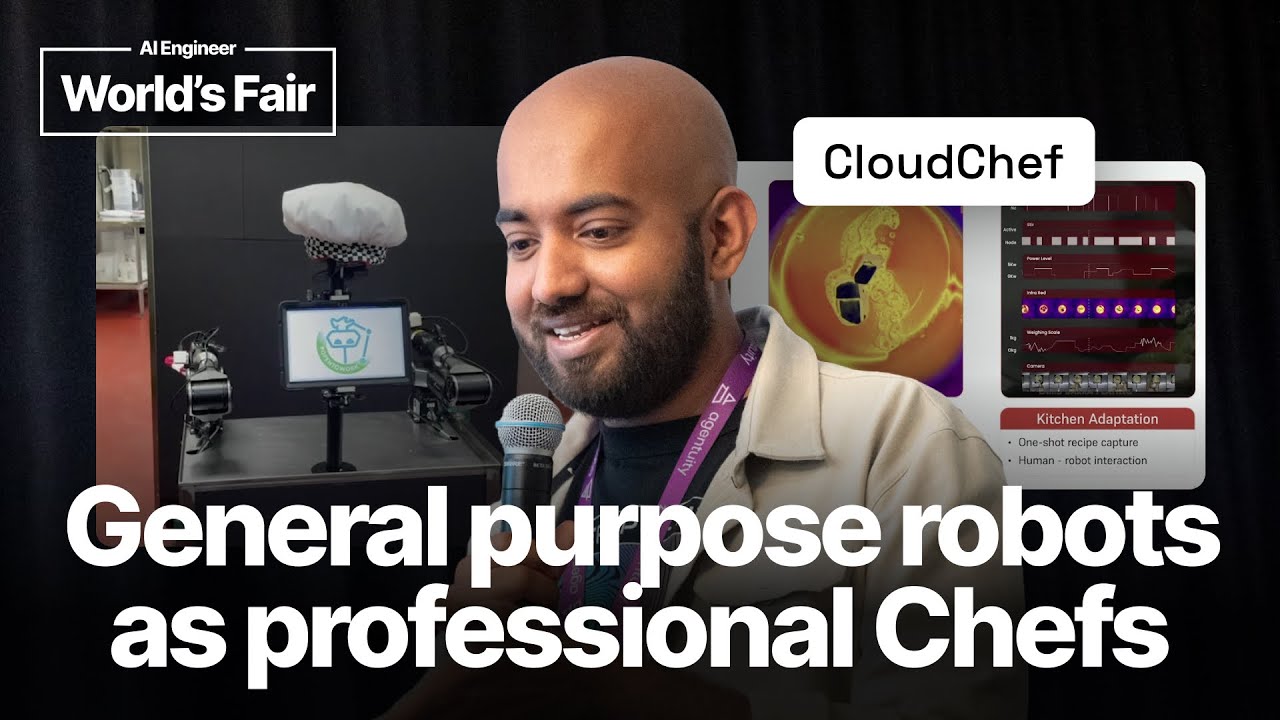
CloudChef turned a general-purpose wheeled robot with two arms into a kitchen worker that can learn recipes from one chef demonstration.
2
The robot combines robot foundation models, teleoperation, thermal sensing, visual sensing, and recipe state machines to decide what is happening during cooking.
3
CloudChef says its robots are about 95% autonomous, work in commercial kitchens, and currently focus on line cooking rather than preparation or dishwashing.
Summary
Nikhil Abraham describes how CloudChef adapted a general-purpose bimanual robot for commercial cooking. The robot uses motion primitives for tasks such as stirring, picking, pouring, and turning knobs, while thermal and visual models judge cooking states such as onion browning or shrimp doneness. Recipes are represented as state machines, and the system learns a new recipe from one expert demonstration rather than relying on fixed ingredient locations or appliances. CloudChef collected data from active kitchens, including thermal and RGB footage from hundreds of thousands of cooked meals, because thermal data is not available at internet scale. Abraham says the system is about 95% autonomous, with teleoperation for edge cases. Its motor skills remain slower than a person in some tasks, but its cooking-state perception performs well in the company's evaluations. The robots currently do line cooking at customer facilities, with humans handling some ingredient replenishment and daily cleaning tasks.
CloudChef chose a wheeled two-arm robot instead of a humanoid
Abraham starts with the hardware choice. CloudChef took a general-purpose robot with two hands and a mobile base, rather than building a humanoid. He says humanoids are currently too expensive, unreliable, and maintenance-heavy for this use. The wheeled form factor can move around a kitchen and perform the work a chef needs. CloudChef's goal is to make commercial kitchen labor affordable, with the robot priced in his example at $12 per hour. It can work without overtime, sick days, or staff turnover, and can plug into kitchens it has not seen before.
A robot needs culinary perception as well as physical skills
Putting a robot through culinary school means teaching both movement and judgment. CloudChef fine-tunes robot foundation models on motion primitives such as picking something up and stirring a pot. Teleoperation handles edge cases, but movement alone is insufficient. The robot must judge whether onions are brown enough, whether a steak is shrinking properly, or whether shrimp is done. Those conditions change with ingredients and seasons. An onion may need seven minutes to saute one day and nine minutes the next, so the robot needs cooking-specific sensing rather than a fixed timer.
Thermal and visual embeddings let recipes track cooking state
CloudChef uses thermal and visual embeddings to reason about cooking in unfamiliar settings. Abraham says the company models recipes as state machines built on top of these embeddings. The system estimates where a recipe is in its process from live cooking data, an expert demonstration, and a text recipe. Thermal sensing matters because temperature provides information that ordinary visual models cannot. CloudChef installed sensors in active commercial kitchens and collected data from hundreds of thousands of cooked meals across recipes, cuisines, seasons, and kitchen environments. It also combined this private data with public data and self-supervised models.
The system learns a new recipe and kitchen from one demonstration
Once the robot understands cooking states, it must adapt to a kitchen it has never seen. Abraham says the robot watches one chef prepare a recipe, then works out where ingredients are kept and how the available equipment is arranged. In a chicken example, it compares onion browning against the chef's demonstration and stops at the right level. It is not pre-programmed with the ingredient locations or the exact variation it will encounter. The same approach is meant to handle different appliances, portions, and ingredients rather than one fixed kitchen setup.
Cooking-state perception is ahead of the robot's motor speed
Abraham separates the system's perception from its physical execution. In the company's evaluations, its small perception model estimated cooking progress better than expert chefs who earn more than $150,000 a year. He also says Gemini 2.5 and o3 performed worse in these tests, partly because they lack a thermal modality. The robot's motor skills are less advanced. It is nearly as fast as a human at sauteing and somewhat slower at picking, pouring, grilling, and stirring. Overall, CloudChef reports a system that is about 95% autonomous and 5% teleoperated.
The demonstrations show robots cooking food that is served to real customers. One customer deployment has a robot fetch chicken wings, wait for them to cook, collect them, add sauce, and mix them. Joint torque data lets the robot estimate how much an ingredient weighs, so the robot can function as its own weighing scale. CloudChef says its robots work at facilities including Wingstop, India's Top 20 in Palo Alto, and the restaurant Alan in Menlo Park. The company is initially targeting line cooking, which Abraham estimates accounts for about half of the labor cost in a kitchen.
CloudChef can speed up some recipes through process analysis
The robot does not need to match a chef's exact pace if the recipe itself can be shortened. Abraham describes cases where observing a chef showed that a process taking 20 minutes could be completed in 14 minutes. That can offset a robot moving 10 percent more slowly than a human. Recipe modification remains experimental across cuisines. It works more easily where the thermodynamic behavior of the cooking process is straightforward, while other cuisines still require more work. The practical work schedule is also different from a person's. A robot can operate up to 168 hours per week, although it usually follows the facility's opening hours.
The current system leaves replenishment and cleaning to people
CloudChef has not tried to automate every kitchen task. Dishwashing is outside its short-term plans, and the company is concentrating on work that directly affects food quality. For cross-contamination, customers replace washable silicone pads on the robot each day. In the current version, a facility worker is alerted when the robot needs ingredients and supplies them. Abraham says future robots might communicate with one another when enough robots share a facility. Overnight work such as cutting and chopping is part of the longer-term direction, rather than the main current deployment.