Local AI became more practical because model quality and the software around models improved at the same time.
2
Organizations can control cost and sensitive data by combining frontier models for planning with smaller local models for execution.
3
The remaining barrier is ease of use, since local AI still requires too much knowledge about hardware, quantization, model selection, and deployment.
Summary
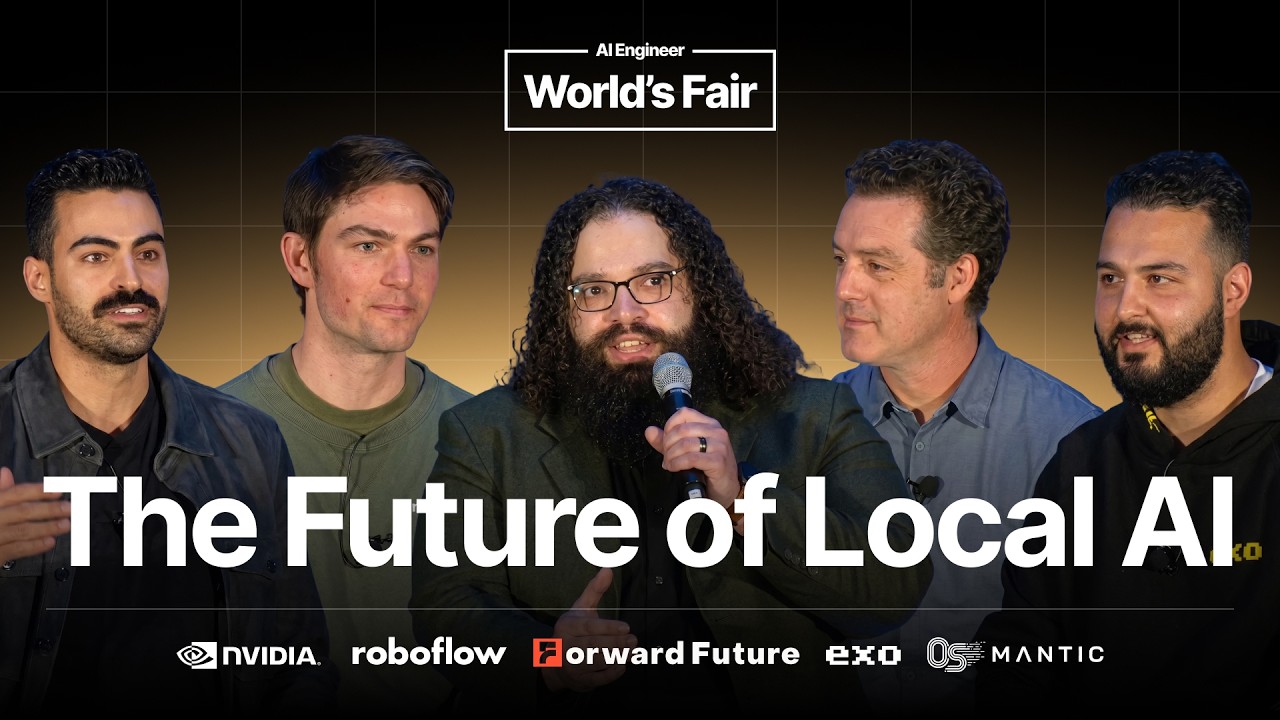
The panel argues that local AI reached an inflection point because capable models now fit on phones, desktops, and small clusters, while harnesses give them access to files, cameras, command lines, and business systems. Local execution matters when agents run continuously, handle private data, or generate enough tokens for cloud costs to become unpredictable. The panel expects a multimodel setup in which a frontier model plans and smaller specialized models execute tasks. That approach also gives organizations more control over model versions, weights, hardware, and data. Alex Cheema describes a three-week collaboration inside NVIDIA that produced a 10x inference improvement on the DGX Spark by combining existing optimizations. The speakers are candid that local AI is still difficult to install and configure. They compare the ecosystem to Linux in the 1990s and argue that point-and-click onboarding, better routing, inference optimization, and continued advocacy for open models are still needed.
Local AI became useful when models and harnesses improved together
The moderator says local AI reached an inflection point because models became much better while the software around them also improved. He recalls Andre Karpathy first warning that coding agents needed close monitoring, then saying three months later that he was struggling to keep up with their capabilities. Reasoning models changed the interaction pattern by spending tokens before producing an answer. Agents then made it possible to keep work running continuously. That creates pressure to keep private information inside the organization and to control the cost of continuously generated tokens. Local systems address both concerns by keeping data on the device and making token costs more predictable.
A phone can now run intelligence that once needed a data center
The panel describes how quickly local hardware has caught up. Alex Cheema recalls moving from running Llama across two MacBooks to demonstrating Nemotron 3 Ultra on four DGX Sparks. Matthew Berman points to several milestones: Llama 405B showed that open models could narrow the gap with frontier systems, DeepSeek demonstrated better performance on available hardware, and GLM 5.2 brought another jump in capability on a desk-sized device. The panel also says a four-billion-parameter Qwen 3.5 model can reach roughly GPT-4o-level quality on an iPhone. These examples support their view that better compression and smaller devices will keep moving capable models closer to users.
Local models can beat large companies in a concrete accessibility task
Joseph Nelson tells a story from a flight with a passenger who was using phone accessibility features to understand the seat around them. The phone described the seat back as a printer. Joseph photographed the same tray and ran the image through LLaVA, which correctly identified it as an airplane seat tray. He took this as evidence that a broadly available local model could outperform the latest vision intelligence shipped by a company with a trillion-dollar-plus market value. For him, the important point was access. A model became useful when it could use a camera and understand the surrounding context, rather than answering an isolated text prompt.
Harnesses give models access to the world where work happens
The panel says models become more useful when a harness connects them to real inputs and tools. Vision systems often run beside cameras, robots, or devices with limited connectivity, so they have long had to work within fixed compute limits. Joseph says this encouraged specialized models that run quickly in a narrow domain. Language systems are moving toward a similar pattern through coding agents, command-line tools, file-system access, and task-specific workflows. Cursor changed his coding process by letting an agent inspect the whole file system and decide which files it needed. The panel expects language applications to use more specialized models and harnesses instead of relying on one general model for every task.
Routing models can raise token use without raising costs at the same rate
Matthew Berman cites Coinbase CEO Brian Armstrong's report that the company's token consumption was exploding while costs stayed flat. The panel attributes this to using different models for different jobs. A frontier model can create the high-level plan, while smaller models handle execution and subtasks. This division avoids paying for the largest model when a smaller one is sufficient. It also fits local deployment, where a capable device can run a workhorse model while a cloud frontier model handles difficult planning. The speakers say enterprises want control over which model and version handles each workload, rather than being locked into one provider's model and pricing.
Small specialized models need data from real workflows
Ahmad Osman argues that specialization has to be decided per use case, business, and workflow. Organizations should collect traces from employees and agents, examine which tasks go to which models, and gather feedback on the results. That data can support routing and eventually smaller models tuned to the organization's needs. He describes this as part of recursive self-improvement, where systems can update their behavior through continued training. The panel connects local execution to this idea because private, ongoing updates are easier when the organization controls the hardware, weights, and endpoints. Ahmad also warns that current agents often store information in Markdown files, which can become inefficient as context grows.
NVIDIA collaboration improved DGX Spark inference by assembling existing work
Alex Cheema describes spending about three weeks in a conference room at NVIDIA headquarters with people pulled in from different teams. The group worked on the DGX Spark by combining optimizations that NVIDIA experts had already developed, rather than inventing new computer science. They tuned models for local use, including quantization and inference configuration, and reported a 10x performance improvement over NVIDIA's existing Spark playbook. Cheema says the Spark and data-center systems share the Grace Blackwell architecture, so kernels and other work can carry over. The remaining effort is adapting data-center-focused settings to the smaller device. He gives the example of Nemotron 3 Ultra running at 30 tokens per second across four Sparks.
Matthew Berman sets a simple adoption test: local AI should be no harder than opening Cursor, or perhaps installing codecs and opening an application. He says current systems are still too sophisticated for most people and businesses. Users need help choosing the right model, harness, and hardware for a particular task, and that information cannot live only in documentation. Ahmad describes ODS as an open-source deployment system that configures tools, agents, and models for a given device. The desired experience automatically downloads a small model first, starts working, and then adds another model suited to the hardware. The user should not need to understand quantization, extensions, or deployment details.
When asked about open problems, the panel returns to inference optimization, hardware constraints, and easier setup. Ahmad says the same older GPUs can now run much larger and more capable models, but extracting that performance still takes work. Matthew adds a second concern: the importance of open models is increasingly being questioned. He argues that local AI depends on the ability to use, change, adapt, and experiment with models. The closing discussion supports advocacy alongside engineering. The panel points to a tension between commercial products and freely shared software, while arguing that both can coexist. It also mentions Right to Intelligence as a way for nontechnical people to support open-source AI.