An agent earns trust by proving business value against a pre-deployment baseline, not by matching analysts during a pilot.
2
Leaders must assign ownership, define where human judgment remains necessary, and record the evidence behind each decision.
3
Autonomy should advance through shadow operation, reviewed drafts, sampled exception handling, and independent checks for missed issues.
Summary
Michele Grant frames agent adoption as an operating decision rather than a software launch. In her acquisition integration example, an agent produces reports that match analysts' work, but that only proves the technology functions. Leaders also need a value case based on reporting cycle time, analyst capacity, operating cost, and the time needed to detect material problems. They need named owners across management, risk and compliance, and internal audit. Grant's Human Works Standard records each decision, its authorized human role, required evidence, and escalation path. She also recommends an auditable decision log, an agent inventory, and an autonomy scorecard. Financial calculations should run in deterministic, approved code, while the model provides narrative and interpretation. Authority increases in stages, with independent sampling at the highest stage because missed issues may remain invisible when people review only exceptions.
Grant says a four-week pilot can show that an agent's drafts match analyst reports line for line, but that only establishes that the technology works. Once the agent enters a core workflow, the test becomes whether it creates value inside the controls set by leadership. She asks leaders to agree on the value case before production data is used. In the acquisition example, the measures include report cycle time, analyst capacity, net operating cost, and detection time. A faster report matters only if the steering committee sees a problem sooner or the organization assigns released analyst time to work that needs attention.
Every value claim needs a baseline before deployment
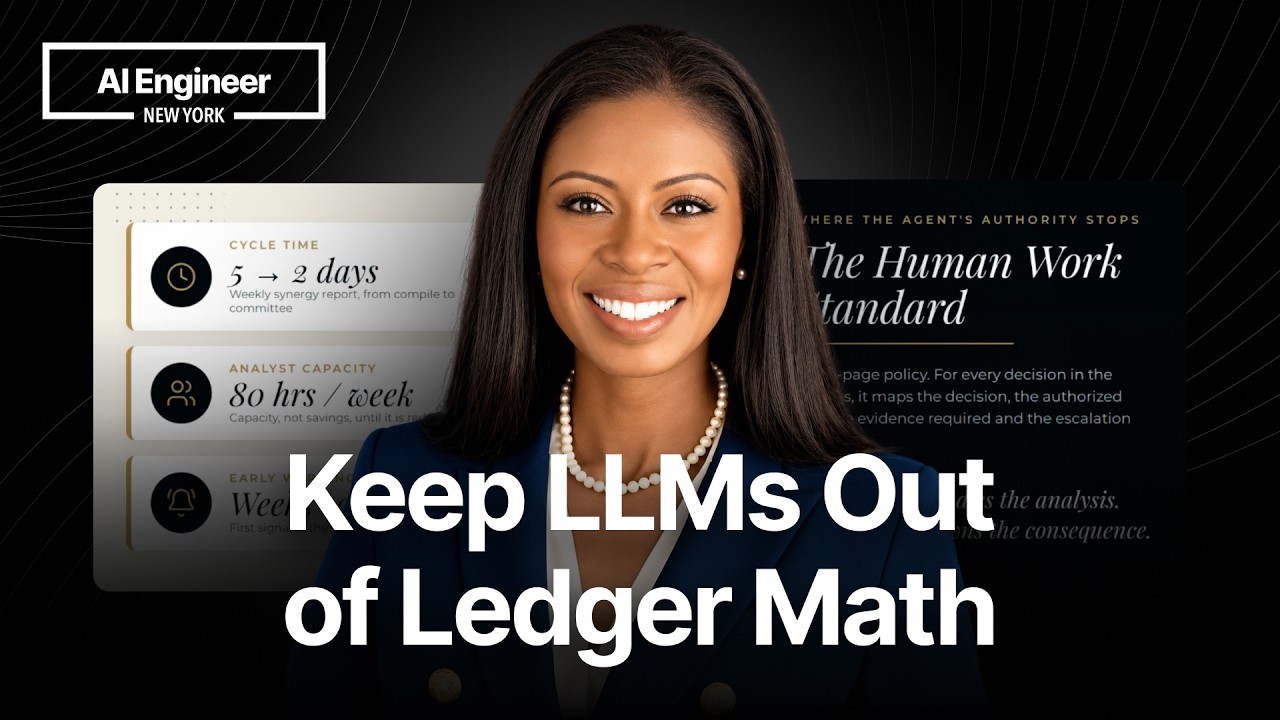
The baseline covers how long the report takes, how much analyst time it consumes, the cost of compute, licensing, and human review, and how quickly the organization detects a slip. Grant gives an illustrative example in which reporting falls from five business days to two and four analysts spend half their week building the deck. The recovered capacity counts only when the integration lead assigns it to workstreams that are behind. A shorter report also does not automatically mean earlier detection. Grant's rule is direct: if the integration management office cannot state its starting point, it should not deploy.
Management owns the controls and the accountable executive owns the agent's output in the same way they owned the manual process. Risk and compliance oversee the agent and challenge how it runs, with review depth based on exposure. Internal audit provides assurance and decides when the agent enters the audit plan based on material risk. Grant also assigns one employee to oversee the agent each day. That person must understand the operating boundaries, interpret outputs in context, have authority to override or reverse the result, and have a clear kill switch. An unassigned decision owner is the one reason she gives for delaying deployment.
The Human Works Standard keeps decisions with named people
Grant documents authority in a one-page Human Works Standard. For each fork in the process, it records the decision, the human role authorized to make it, the required evidence, and the escalation path. In the acquisition example, the senior analyst decides whether a variance reflects accounting timing or a real cash shortfall. The workstream lead decides how to address the shortfall. The integration lead decides whether to flag the initiative as at risk to the steering committee. The agent prepares the analysis behind each decision and stops there. The person making the decision owns the consequence.
Audit evidence belongs in telemetry and deterministic code
Grant asks for an auditable decision log that records the raw data, tool calls, prompt, model versions, generated output, and human sign-off for each workstream. Reconciliation and core financial calculations should run in deterministic, finance-approved code rather than conversational prose from an LLM. The model's written summary is an explanation, not proof. The proof is in the records pulled, the tools that ran, and the person who signed the review. If reported savings do not match the general ledger, the agent should flag the discrepancy rather than alter the number. An inventory should also record ownership, data lineage, dependencies, validation results, escalation, the kill-switch runbook, and triggers for full revalidation.
Autonomy should increase through four review stages
The autonomy scorecard moves through four stages. In shadow mode, the analyst works as usual while the agent runs alongside the process for comparison. In supervised draft mode, the agent creates the first draft and the senior analyst reviews every line. In exception handling with sampling, the analyst reviews lagging initiatives and a random sample of claims. At the final stage, the analyst reviews high-risk anomalies while periodic independent sampling checks the rest. Grant warns that this last stage creates a blind spot because the agent may fail to flag an issue at all. A falling override rate can mean weaker review rather than better performance.
Leaders can promote, hold, or reduce authority from one scorecard
The scorecard places control measures beside value measures such as cycle time, analyst hours deployed, and detection time. Independent sampling tracks missed material issues and error severity while the organization watches the override rate. This gives the steering committee evidence to promote the agent, keep it at its current stage, step it back, or return it to supervised review. Grant closes by separating the agent's contribution from the acquisition's projected synergies. Procurement, supply chain, and operating leaders capture those synergies through integration work. The agent's contribution is earlier verified evidence that gives leaders more time to act.
"An agent earns trust when it delivers the value the business budgeted for while staying strictly within the company's approved risk appetite, policies, and regulatory guardrails."00:55
Who should watch
You are moving an agent from a pilot into a core workflow and need a value case that goes beyond matching human output.
Your team needs to assign decision rights, escalation paths, and daily oversight before increasing an agent's authority.
You are designing review controls for exception-based operation and need to test for issues the agent failed to flag.