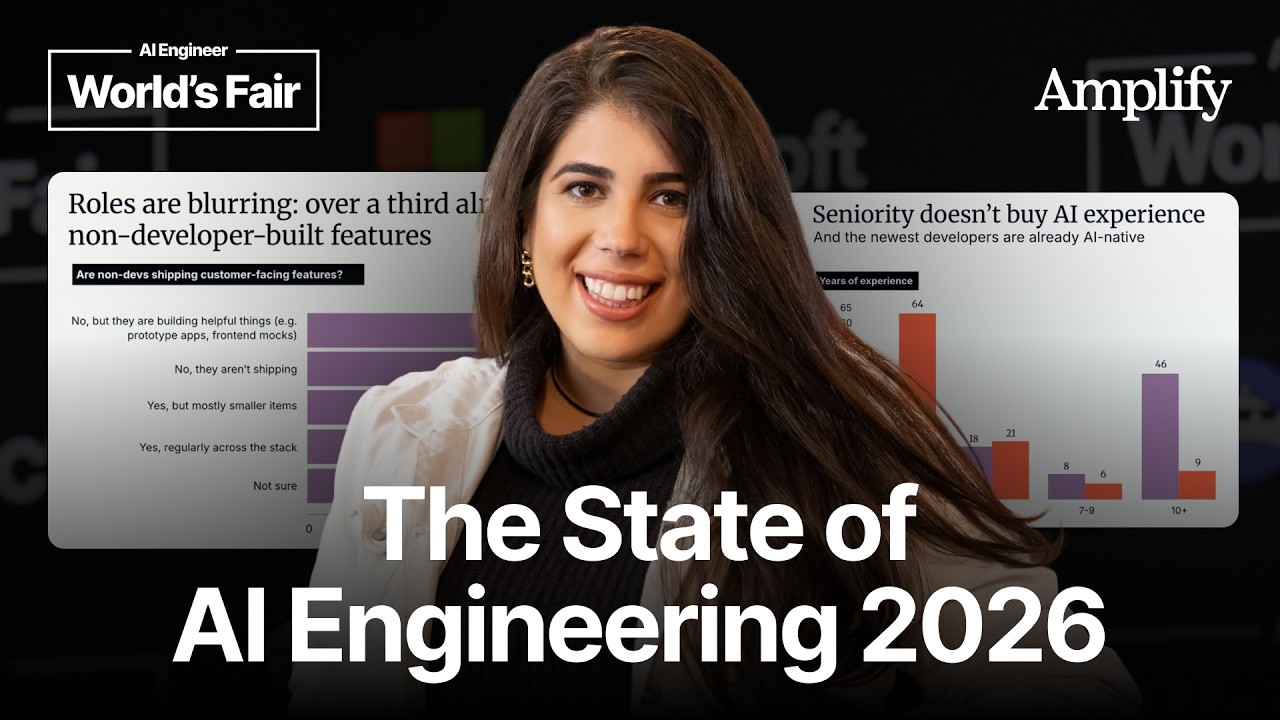
AI engineering is a discipline spread across founders, technical leaders, engineers, and product staff, with experienced software engineers learning AI while newer engineers have grown up with it.
2
Teams are using multiple models, adjusting their AI use based on cost, and increasingly giving agents permission to write data inside their systems.
3
Evals remain the leading stack problem, while teams buy infrastructure such as inference and keep product logic such as prompts, RAG, and evals closer to home.
Summary
Barr Yaron presents results from a survey of 1,048 people involved in AI engineering. She describes a field that crosses job titles and company sizes, with senior software engineers often new to AI and newer engineers entering with substantial AI experience. Text still dominates current work, while audio has the strongest intent to adopt and image generation has grown sharply. Most teams use closed models, but open-weight models usually augment them. Teams increasingly route between models and treat cost as an engineering constraint. Agents have moved from drafting and summarizing to taking actions, with write access becoming much more common. That shift has exposed weaknesses in control systems and evaluation. Evals remain the most common stack challenge, with human review still the leading approach. Yaron also describes cheaper experimentation, heavier review demands, blurred roles, and non-developers shipping software. The survey points to optimism alongside concern about maintenance and long-term code liabilities.
AI engineering cuts across roles, while experience is unevenly distributed
The survey had 1,048 respondents, and Barr Yaron treats AI engineering as a discipline rather than a job title. The group includes founders, CTOs, engineers, product staff, and people from different company sizes. More than half of respondents with over 10 years of software experience have three years or less of AI experience. At the same time, the median new engineer has nearly as much AI experience as the median 10-year software veteran. New engineers have never known software without AI, while experienced engineers are learning a new technical approach during their careers.
Audio has the strongest future interest, while image generation has moved into ordinary work
Text remains the dominant modality in current AI work. Among people who are not using a modality, audio has the strongest intent to adopt: 56% say they plan to use it, up from 37% last year. Image generation shows a different pattern. The share of respondents using generative AI for images and feeling good about it doubled from 18% to 36%. Barr connects that change to better products, including Nano Banana, Nano Banana 2, and ChatGPT Images 2.0. Image generation is increasingly part of real work rather than an easy way to produce poor-looking hands.
Model choice is driven by quality, capability, and cost rather than the open-versus-closed debate
Closed models are used by 94% of respondents, while 45% use open-weight models. Open-weight models usually add to closed models rather than replace them, since over 90% of open-weight users also use closed models. When teams choose a model, quality leads the list, followed by agentic capabilities such as tool calling and cost. Only 5% name open versus closed as a top-three consideration. Barr says 87% of teams use more than one model, routing by task, comparing outputs, or routing based on cost. Teams are standardizing tools and platform layers while staying flexible about models.
AI cost has become part of the product and infrastructure decision
Forty percent of respondents say cost regularly shapes how ambitiously they use AI, and another 36% say it sometimes does. Barr summarizes this as roughly three out of four people adjusting AI use because of cost. Cost and token usage are also the second most monitored production signals, just below quality. The result is a change in product decisions. Teams cannot treat model usage as an unlimited resource when they are managing several models and workflows. Cost affects which use cases get built and how much ambition teams can afford.
Agents are taking actions, but their control systems remain basic
Ninety-five percent of respondents say they use agents, roughly double last year's figure. Among teams using agents, the share whose agents can write data rose from 52% to 89%. The share of all respondents using write-enabled agents therefore grew more than three times relative to last year. Agents now operate inside systems instead of only reading, summarizing, or drafting. Teams mainly control them with human approvals and permission gates. They also use task decomposition, retrieval, memory, and sandboxing, but no control layer has become standard. About two-thirds say hallucination or losing context mid-task frustrates them most.
Evals remain the leading stack problem, with human review still common
When respondents are asked about the biggest challenge in their stack, evals come first every year. Barr says the lead is narrow, so the survey shows a broad set of unresolved problems rather than one dominant answer. She estimates that 96% of people in the room have a stack problem but disagree about which problem to solve. Evaluating AI outputs requires several methods, and vibe review remains the most common approach. The persistence of evals at the top of the survey gives infrastructure builders a view of where teams still need help.
Teams buy inference and keep much of the product logic in-house
Across eight stack layers, inference and model serving are the layers teams buy most often. Prompt management has the opposite pattern, with 61% building it themselves. Product logic around prompts, RAG, and evals also tends to remain in-house. Fine-tuning is different because most respondents do not use it at all. Barr observes that teams that bought a layer are not usually looking to build it, while teams that built a layer are not usually looking to buy it. This creates a mixed stack with a clearer split between infrastructure and application logic.
Cheap experimentation has expanded participation in shipping software
Among this builder-heavy sample, 97% report a net positive effect on their organization. The main benefit is not only speed. Teams can fail more cheaply, run more experiments, build more prototypes, and place more bets. The same tools increase review burden, and more than nine in ten respondents report some negative downstream effect, especially erosion of technical skills and understanding of the codebase. AI is also blurring engineering, product, design, and marketing roles. More than a third of teams have non-developers shipping features, and 17% say non-developers regularly ship customer-facing features across the stack.